Dual Cooling Water Cooling Vests for Outdoor Shifts
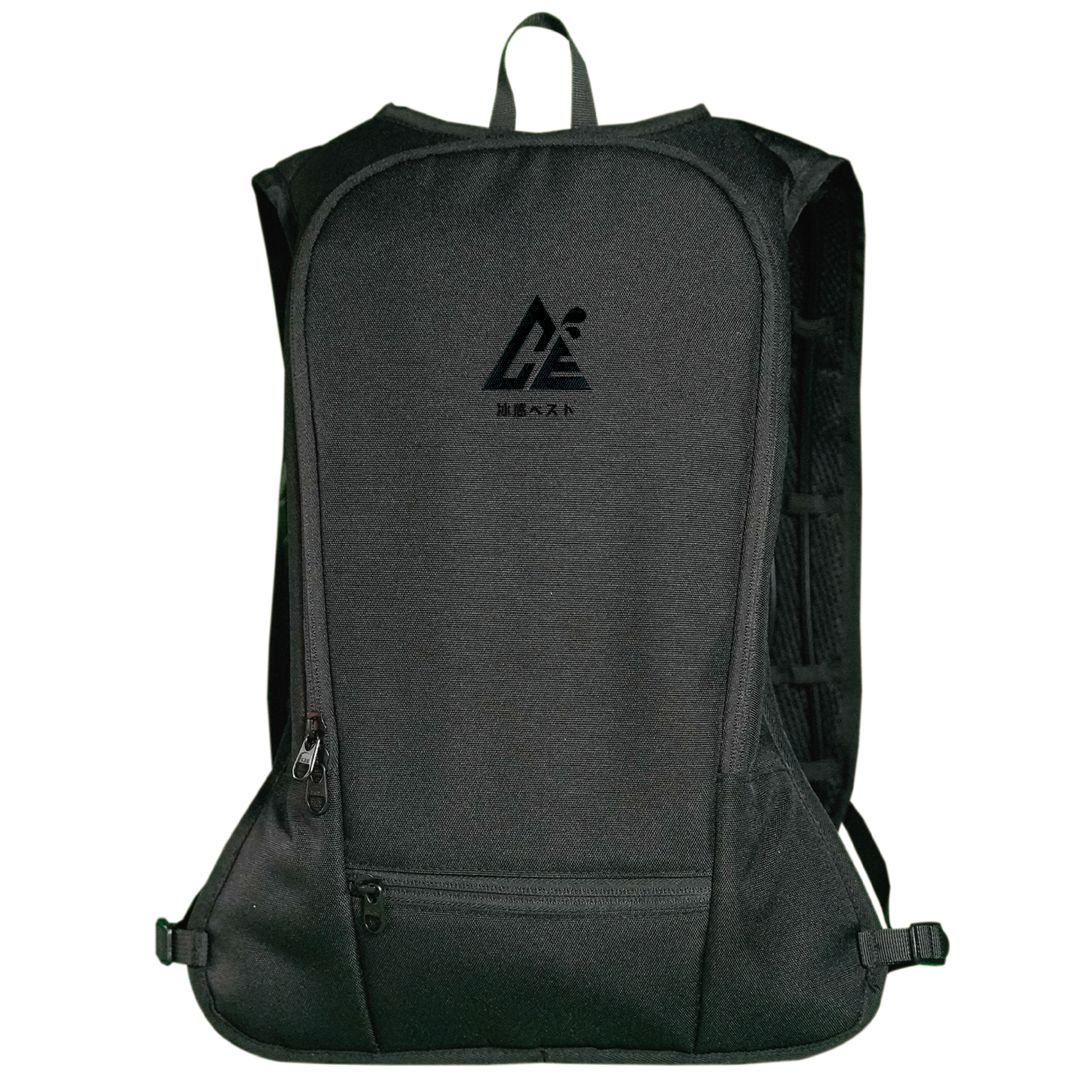
COOLWAVE Professional Model in black. Image: Shokunin product record.
Deploying dual cooling water vests across shift-based outdoor teams works best when the vest is matched to the work block, not just to the job title. The COOLWAVE Water-Circulation Cooling Vest is listed with a 3–4 hour cooling duration per charge/ice-pack cycle, a weight within 2 kg, and a pump flow rate of max 320–370 ml/min. Those figures support a simple deployment rule: plan one cooling block around the listed runtime, rotate ice packs at the block boundary, and check pump power before the shift starts.
Why shift-based outdoor teams need a scenario match
Outdoor heat exposure is not a single condition. A construction crew may start in cooler morning air and face radiant heat by midday. Traffic controllers may stand in direct sun through several relief cycles. Street vendors may carry heat load through setup, peak selling and evening cleanup. A single vest policy often fails because it ignores these differences in shift length, clothing layers, break access and ice-pack handling.
The deployment problem is therefore not simply whether to buy a cooling vest. It is how to schedule limited cooling capacity across a mixed workforce. The COOLWAVE Water-Circulation Cooling Vest is one product family, but the decision changes when the same vest is used by a worker who is climbing scaffolding, a controller standing at an intersection, and a vendor working a night-market stall.
A useful scenario guide separates three questions: how long one cooling block lasts, who can reach a spare ice pack during the shift, and what power source the pump needs. The answers determine vest count, ice-pack rotation, training and the size of the first order.
Industry background: personal cooling as heat-stress equipment
Heat exposure at work is a recognized occupational-safety issue. NIOSH identifies water-cooled garments, air-cooled garments, cooling vests and wetted overgarments as examples of auxiliary or personal cooling systems. That classification supports the use of a wearable cooling product as part of a heat-management program, but it does not certify a particular vest or guarantee a specific cooling result.
The commercial category is also substantial. Dataintelo's 2026 cooling-vest market report estimated the global market at USD 342 million in 2025, with industrial applications accounting for 34.5% of revenue share. These figures frame the category and show why industrial buyers compare cooling duration, weight, power and service support. They do not validate any single product's runtime or heat-removal performance.
The supplied verified data also distinguishes water-circulation cooling from phase-change material and evaporative approaches. This article stays with the COOLWAVE water-circulation product because the assigned deployment question is about a specific vest family across shift-based outdoor work, not a ranking of cooling technologies.
The COOLWAVE solution: what the verified product record supports
Shokunin is the professional e-commerce brand launched by Feng Shang Precision Co., Ltd., a Taiwan-based manufacturer founded in 2009. The COOLWAVE Water-Circulation Cooling Vest is listed as industrial cooling apparel and personal protective equipment in the product record. The supplied technical description combines reusable ice packs with pump-driven water circulation through a TPU water bag and a sand-rubber cooling tube.
The product record lists a pump output of 5V 150mA maximum and a maximum flow rate of 320–370 ml/min. The cooling duration is listed as 3–4 hours per charge/ice-pack cycle, and the vest weight is within 2 kg. The contents include one water-cooled vest backpack and two ice packs. Shoulder straps are specified as 600D polyester, the main material as PEVA, the water bag as TPU, the water bag cap as polypropylene, and the cooling tube as black sand rubber.
| Listed specification | Product record | Deployment meaning |
|---|---|---|
| Cooling duration | 3–4 hours per charge/ice-pack cycle | Plan one cooling block around the listed duration; rotate ice packs at mid-shift for longer shifts. |
| Weight | Within 2 kg | Supports wear during standing or moving outdoor work; fit still needs a trial with required clothing. |
| Pump output | 5V 150mA (max) | Confirm a compatible power source, connector and power-bank plan before deployment. |
| Flow rate | Max 320–370 ml/min | Use as a pump specification for sample comparison; it is not a heat-stress performance rating. |
| Materials | 600D polyester shoulder strap; PEVA; TPU water bag; polypropylene cap; sand-rubber cooling tube | Check cleaning, wear, tube routing and replacement-part availability during the pilot. |
| Contents | Water-cooled vest backpack ×1; ice packs ×2 | Plan a spare ice-pack rotation pool for teams working beyond the listed duration. |
Step-by-step deployment across a mixed outdoor workforce
Step 1: Map the shift into cooling blocks
List each crew's start and end times, break schedule, clothing layers and access to shade or cool water. A normal eight-hour shift will usually contain at least two cooling blocks when the listed duration is 3–4 hours. The objective is to place an ice-pack change at a natural break rather than asking a worker to manage a swap during a high-risk task.
For construction, the morning block may run from site start to lunch. For traffic control, the natural block may end at a relief rotation. For street vendors, the block may split setup from peak selling. These boundaries matter more than a job title because they determine who can reach a spare ice pack and when.
Step 2: Assign the model and check fit with required clothing
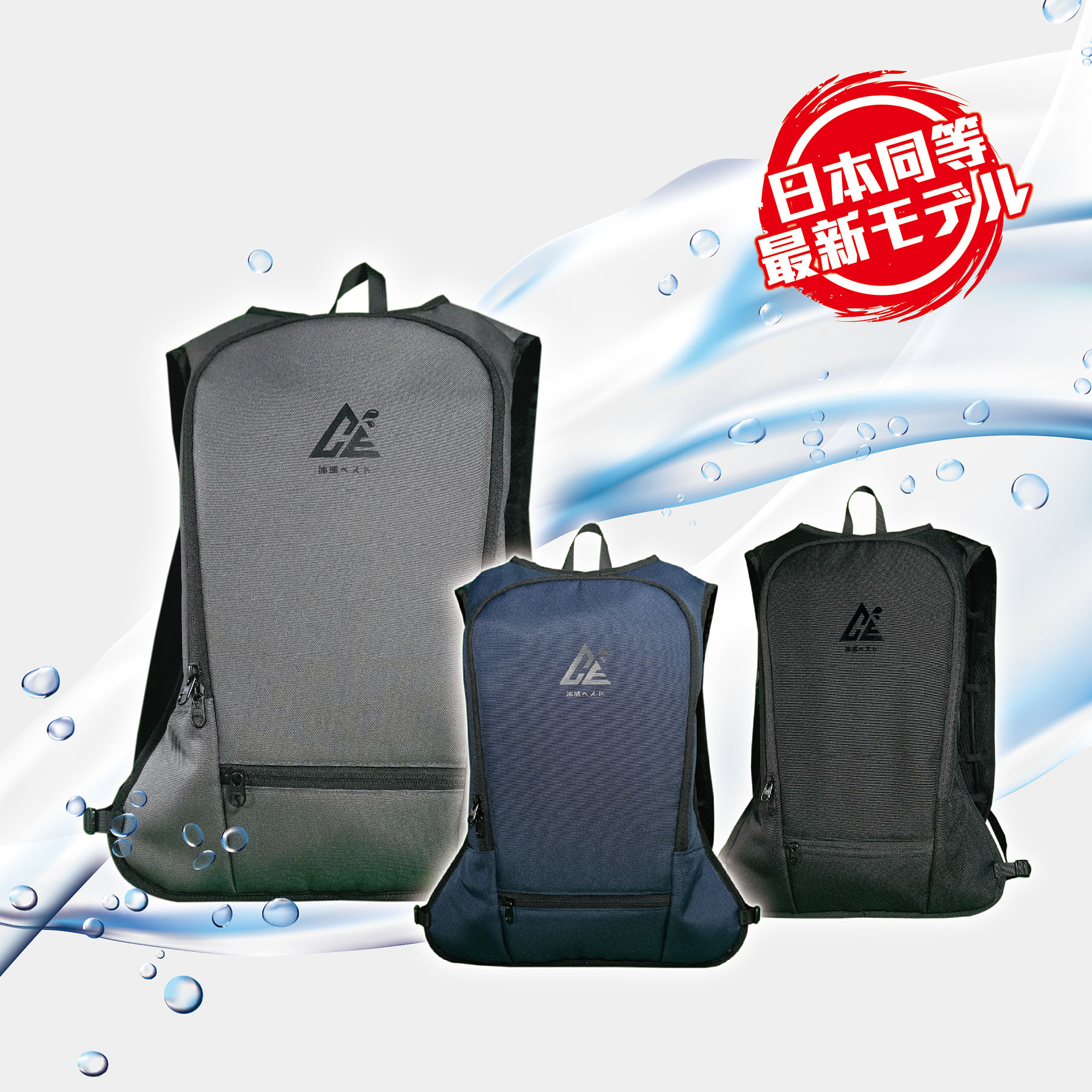
The supplied product units include a COOLWAVE Basic Model and Professional Models in blue, gray and black. Model names should be checked against the quotation before ordering. The deployment question is not which color looks right on site; it is whether the vest can be worn with the required uniform, tool belt, harness or high-visibility garment.
The case record highlights an adjustable one-size-fits-all design. That is a useful starting point for mixed crews, but it does not replace a fitting check. Workers should test shoulder-strap adjustment, water-bag position, tube routing and access to the pump while wearing their normal work clothing.
Step 3: Build an ice-pack rotation plan
Two ice packs are included with the vest. For a shift longer than the listed 3–4 hour cooling duration, the team needs a rotation plan: one set in use, one set chilled and ready, and a labeled process for returning used packs to the cooler. The plan should identify who checks the cooler, when packs are exchanged, and how a worker reports that cooling has faded.
Do not treat the ice pack as a decorative accessory. The cold source is part of the cooling system. If packs are left in a hot vehicle or mixed between crews without a check, the vest may be worn without useful cooling. Use insulated storage, label packs by crew, and confirm cleaning and refill instructions with the supplier during sampling.
Step 4: Verify pump power and flow before the shift
The pump is rated 5V 150mA maximum with a maximum flow of 320–370 ml/min. Those figures make the power source a deployment item, not an afterthought. If a power bank is used, confirm that it is compatible with the pump connector and that the team has a charged spare. The supplied contents list the vest backpack and two ice packs; they do not establish that a power bank is included.
Flow rate should be checked during the sample review. Ask the supplier for the conditions behind the max 320–370 ml/min figure, including tubing length, reservoir level and pump settings. A flow number without test conditions is a specification, not proof of cooling performance in every worksite.
Step 5: Train fit, hygiene and daily checks
A short training session should cover the water bag, cap, cooling tube, shoulder straps and pump. Workers need to know how to check for leaks, how to route the tube without sharp bends, and how to report a damaged component. The supplied materials list is specific enough to support a component check: TPU water bag, polypropylene cap, sand-rubber tube and 600D polyester shoulder strap.
The training should also set the boundary between cooling and heat-stress controls. A cooling vest supports worker comfort, but it does not replace water, shade, work-rest cycles, acclimatization or emergency planning. Supervisors should treat the vest as one control in a broader heat-management program.
Step 6: Pilot with a mixed crew, then scale
The capability record lists a minimum order quantity of 10 units, a lead time of 7–14 days and a 6-month warranty for the water-cooled vest. A 10-unit pilot can test fit, ice-pack rotation, pump power and supervisor workload across a mixed crew. Record swap times, wear complaints, damaged parts and whether workers actually used the vest through the full shift.
Scale only after the pilot shows a workable rotation. A 100-unit deployment has different logistics from a 10-unit trial: more ice packs, more power sources, more fitting time and a clear process for replacing failed components. The Taiwan case record provides a field-use pattern, but your own pilot data should determine the final vest count and spare-pack ratio.
Use cases: construction, traffic control and street vending
Construction site teams
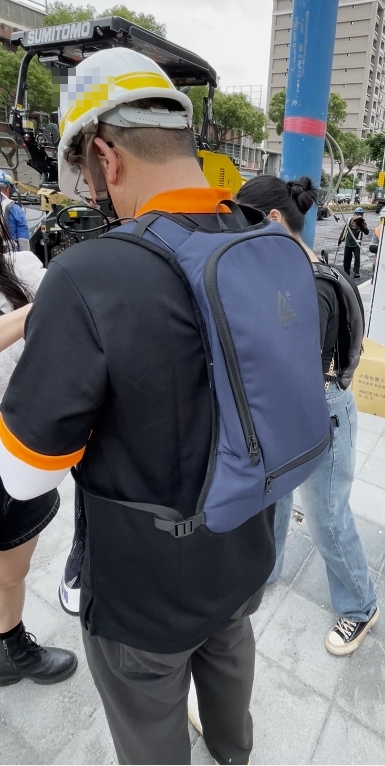
Construction site use case. Image: Shokunin application record.
Construction work combines high exertion, radiant heat, dust and required PPE. The listed 3–4 hour cooling duration maps to a morning or afternoon block, while the under-2 kg weight matters when a worker is also carrying tools or wearing a harness. The Taiwan case record includes construction sites among its client types.
A practical construction deployment uses lunch as the main ice-pack rotation point. The supervisor should check that the vest does not interfere with the harness or task, and that the water tube is routed away from cutting, welding or snag hazards. The vest should be introduced alongside hydration and work-rest controls, not as a substitute for them.
Traffic control teams
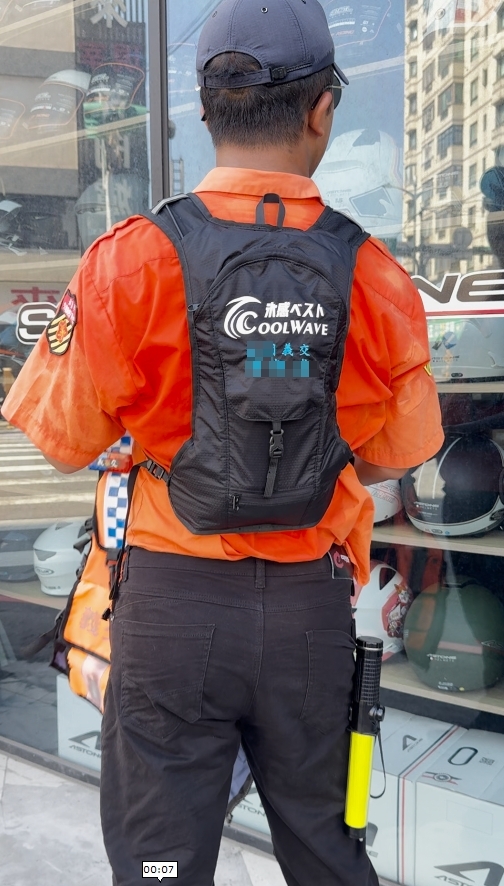
Traffic control use case. Image: Shokunin application record.
Traffic controllers often face long stationary exposure with limited shade. The same 3–4 hour listed duration can be aligned with relief rotations, so the ice-pack change happens when the controller steps away from the post rather than during active traffic management. The lightweight specification supports standing work, but the vest must fit under or over the required uniform without blocking movement or visibility.
The supplied product record does not list a high-visibility rating for the vest. Buyers should confirm layering rules with the site or traffic authority and check whether the vest can be worn with the required high-visibility garment. If the vest cannot be worn in the required position, traffic control may need a different deployment window, such as rest-area cooling rather than on-post wear.
Street vendors and market crews
Street vendor use case. Image: Shokunin case record.
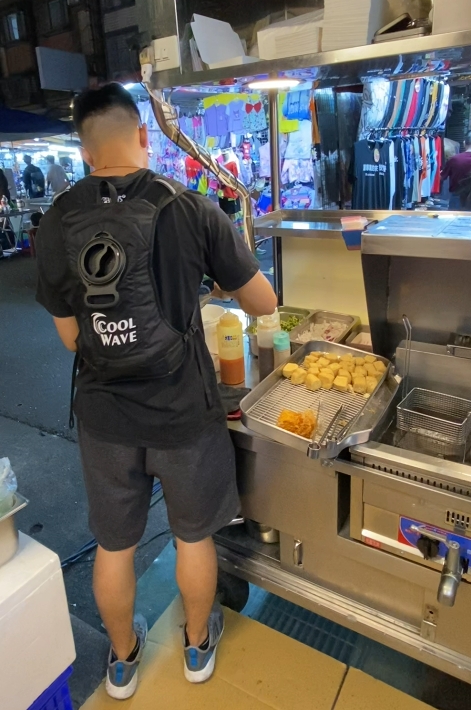
Street vendors and food-stall operators often work long standing shifts with heat from cooking equipment, pavement and evening crowds. The 3–4 hour cooling duration fits a selling block, and the under-2 kg weight reduces the burden of wearing a cooling system while moving between storage, stall and customer areas. The case record includes street vendors and a night-market vendor image.
Vendors need a simple rotation: one set in use, one set chilled in a cooler, and a safe place for the pump and water bag away from cooking heat and spills. The 5V 150mA pump requires a power source; confirm power-bank compatibility and keep the connector dry. A vendor working a long evening may need a spare ice-pack set even if the first block feels comfortable.
Scenario matrix for mixed outdoor workforces
The matrix below turns the listed specifications into deployment decisions. It is not a ranking of workers or a claim that one scenario is more important than another. It is a planning table for supervisors who must assign a limited number of vests and ice packs across different shift patterns.
| Scenario | Shift pattern to plan for | Why the COOLWAVE specification fits | Ice-pack rotation point | Deployment check |
|---|---|---|---|---|
| Construction site | Eight-hour site shift with morning and afternoon blocks | 3–4 hour listed duration covers one block; under-2 kg weight supports wear with tools and PPE | Mid-shift and lunch; keep spare packs in an insulated cooler | Check harness and clothing compatibility; pair with shade and water breaks |
| Traffic control | Long stationary exposure with relief rotations | Same 3–4 hour block; light weight suits standing posts | At each relief; label packs by controller or crew | Confirm uniform rules; supplied record does not list a high-visibility rating |
| Street vending | Three-to-four-hour selling blocks, often in evening heat | Listed duration aligns to one selling block; under-2 kg supports standing and moving | Between setup and peak; keep spare pack chilled | Confirm 5V power source; protect water bag and tube from cooking heat and spills |
| Mixed crew | Staggered starts, breaks and relief times | One vest family with Basic and Professional models | Use a check-out board by shift block | Pilot 10 units before a larger order; record swap compliance |
Taiwan 100-unit deployment: what the case record shows
The supplied case record documents a 100-unit deployment in Taiwan. Its client types include construction sites, outdoor work, metal sheet factories and street vendors. The application is cooling use in a high-temperature environment. The result field reports effective body cooling, heatstroke prevention, improved work efficiency and worker comfort.
The same case record highlights ice-pack cooling, a portable design, an adjustable one-size-fits-all fit and a disaster-prevention product certification. The company profile states that the COOLING water-cooled vest received the Disaster Prevention Product and Service Certification Award issued by the Taiwan Disaster Prevention Industry Association. These are company case-record statements and should be read as field-use evidence, not as a controlled thermal trial.
For a mixed outdoor workforce, the Taiwan case is useful because it shows a deployment pattern rather than a single-user purchase. It indicates that a 100-unit order can be distributed across different outdoor and high-heat client types. It does not establish the ideal vest count, ice-pack ratio or cooling duration for every site. Those decisions still depend on shift length, access to a freezer, clothing layers and supervisor capacity.
The case record also includes construction sites, metal sheet factories and street vendors in the same deployment context. That is relevant for buyers who manage mixed teams because it supports a common product family across different outdoor tasks. It does not prove that every worker will experience the same comfort result. The buyer should measure swap compliance, wear time and worker feedback during the pilot.
What to verify before scaling
The first verification is cooling duration under your conditions. The listed 3–4 hours is a useful planning figure, but the supplied data does not define ambient temperature, humidity, workload, clothing or measurement method. Run a pilot in the actual season and shift pattern. If workers report that cooling fades earlier, shorten the rotation interval rather than assuming the listed duration applies unchanged.
The second verification is pump power and flow. The pump is rated 5V 150mA maximum, and the flow is listed as max 320–370 ml/min. Confirm the power source, connector type, spare power capacity and replacement-pump availability. Flow rate is not a heat-stress score. It describes the pump's listed maximum water movement, not the vest's cooling effect on a worker.
The third verification is compliance and documentation. The product record lists a disaster-prevention award and industrial cooling apparel/PPE classification, but that does not establish compliance with every market's PPE rules. Check the required standard, marking, instructions and documentation for the jurisdiction where the vest will be used. If the vest is intended as PPE, confirm the applicable requirements before purchase.
The fourth verification is commercial. The supplied data does not include prices. The capability record lists a MOQ of 10 units, a 7–14 day lead time and a 6-month warranty for the water-cooled vest. Request a quotation for the exact model, color, spare ice packs, power source and replacement parts. Do not infer price from the specification table.
Frequently asked questions
Is the COOLWAVE water-circulation vest certified for heat-stress PPE?
The supplied company profile states that the COOLING water-cooled vest received the Disaster Prevention Product and Service Certification Award from the Taiwan Disaster Prevention Industry Association. The product record does not establish a general PPE certification or compliance with every market's heat-stress PPE rules. Buyers should confirm the applicable standard, required marking and documentation for their jurisdiction before treating the vest as PPE.
How should a crew plan vests, ice packs and pump power for an eight-hour shift?
Start with one vest per worker. The listed cooling duration is 3–4 hours per charge/ice-pack cycle, and the product contents include two ice packs. For an eight-hour shift, plan at least one mid-shift ice-pack rotation; crews working beyond the listed duration need a spare-pack rotation pool. The vest weighs within 2 kg, and the pump is rated 5V 150mA maximum with max 320–370 ml/min flow. Confirm the compatible power source before the shift, because the supplied contents do not establish that a power bank is included.
What should a pilot budget include?
The supplied data does not include prices. A pilot budget should include the vest and backpack, the two included ice packs, spare ice packs for rotation, a compatible 5V power source if required, cleaning and replacement allowance, and supervisor time for fitting and feedback. Request a quotation for the exact configuration; do not infer price from the specification.
Can we sample 10 units before a larger order?
The capability record lists a MOQ of 10 units, a lead time of 7–14 days and a 6-month warranty for the water-cooled vest. A 10-unit sample can test fit, ice-pack rotation and pump power across a mixed crew. Confirm current lead time, warranty terms and spare-pack supply in the quotation.
What lead time should we plan for a 100-unit deployment?
The supplied capability record lists 7–14 days lead time, but a 100-unit deployment also needs sample approval, power-source checks, fitting and training. Build those steps into the schedule and confirm the current lead time with the supplier. To review sample configuration and current lead time, contact Shokunin through the official site.
Conclusion
Deploying dual cooling water vests across shift-based outdoor teams is a scheduling problem as much as a product choice. Match the listed 3–4 hour cooling duration to the work block, use the under-2 kg weight to support wear during standing or moving work, and check the 5V 150mA pump and max 320–370 ml/min flow before the shift starts. Construction, traffic-control and street-vending teams can share one product family, but they need different ice-pack rotation points and different fit checks.
The Taiwan 100-unit case record provides field-use evidence for heatstroke prevention, worker comfort and a mixed high-temperature deployment. It should guide the pilot, not replace it. Start with a 10-unit sample, measure swap compliance and worker feedback, then scale with a documented ice-pack, power and replacement plan.
COOLWAVE Water-Circulation Cooling Vest, Basic Model. Image: Shokunin product record.
For specifications and model details, download the Shokunin product brochure (PDF). For company information, visit Shokunin.
Have Questions or Need More Details?
Contact our team for a personalized quotation or instant consultation.
Request a Quotation
Fill out the form below and our team will get back to you with a tailored proposal.
WhatsApp Direct Chat
Prefer to chat in real-time? Message us on WhatsApp for instant assistance & quick answers.
- Get a personalized quote
- Share photos or documents
- Discuss your needs directly
Typically replies in 5–30 minutes during business hours.