
Street Vendor Heat Relief: Dual Cooling Water Cooling Vest
An application guide for food stall operators and street vendors: how the COOLWAVE water-circulation cooling vest is worn, rotated, and ordered across a working market day.
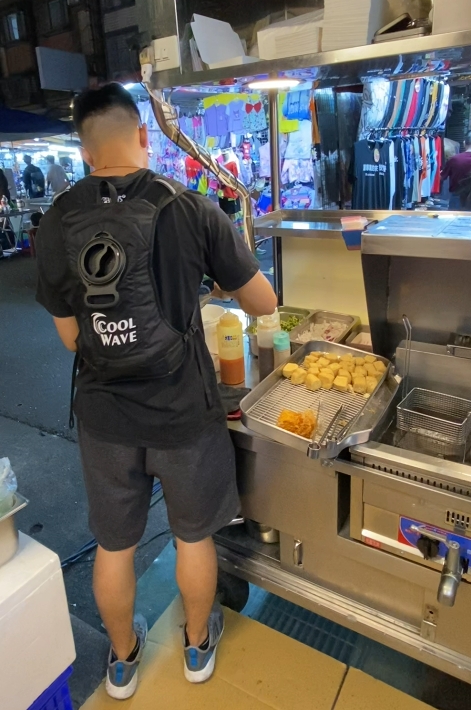
A street food stall concentrates heat in a way that an open workshop does not. The operator stands in roughly one square metre for hours, under a canopy that traps cooking heat, with the sun on one side of the stall and no cooled rest area to step into. The COOLWAVE Dual Cooling Water Cooling Vest, made by Shokunin, the professional tool brand of Feng Shang Precision Co., Ltd., is designed around that pattern: two ice packs chill water held in a TPU bag, and a 5V pump circulates that chilled water through tubing in the vest. The manufacturer states a cooling duration of 3–4 hours per ice-pack and charge cycle, a net weight within 2 kg, and a water flow rate of 320–370 ml/min.
This guide covers the parts a vendor actually has to decide: how to wear and rotate the system at a stall, how a 3–4 hour cycle maps onto real market sessions, which catalog variant and color to prefer for different pitches, where the published specification stops short, and how a single operator or a group of ten stallholders orders through the ODM channel.
Why a food stall is a harder heat problem than it looks
Street vendors are a small part of the global cooling-vest market: Dataintelo's 2026 cooling-vest market report put global revenue at USD 342 million in 2025, with industrial applications accounting for 34.5% of it. That means vendor-grade hardware is usually drawn from designs built for industrial heat exposure — which is useful, provided the vendor checks the specifications against their own working pattern rather than buying on the category name.
Four conditions separate a stall from a factory floor.
- The operator cannot leave the position. During service the vendor is tied to the stall — the queue, the cash box, the griddle. Fans, misting lines and shaded rest areas help only where the layout allows them. Wearable cooling moves with the operator instead of depending on the site.
- The canopy traps heat rather than removing it. A market awning blocks direct sun but also blocks airflow, and it holds the heat rising from grills, fryers, steamers and hot oil. The result is a position that is shaded and still hot.
- Sessions are long and repetitive. A morning or evening market session is often four hours; a full day at one pitch can run eight to ten. Runtime and the logistics of swapping a cold source matter more than a short burst of intense cooling.
- Standing still reduces natural cooling. Air movement across the skin is low when a person stands at a counter, so evaporative heat loss is limited even in warm air. A circulating-water loop works by moving chilled water against the torso rather than relying on evaporation.
That last distinction is recognised in occupational-safety guidance. The U.S. National Institute for Occupational Safety and Health (NIOSH) groups water-cooled garments, air-cooled garments, cooling vests and wetted overgarments under the heading of personal cooling systems for heat-exposed work — a list that treats water-cooled and evaporation-dependent designs as separate examples within the same category. For a stall operator, the practical consequence is simple: an evaporative accessory depends on airflow and dry air that a canopy pitch may not provide, while a water-circulation vest depends on ice packs, water and a power source that the vendor controls.
How the dual cooling system works
The product name describes two stages working together: a cold source, and a loop that carries that cold around the torso.
- Cold source — two ice packs. Both packs are frozen before a session and carried in the water-cooled vest backpack, where they chill the water in the reservoir.
- Reservoir — TPU water bag. A flexible TPU bag holds the water that the ice packs cool, and is closed with a polypropylene cap.
- Pump — 5V, 150 mA (max). The pump draws chilled water from the bag and pushes it into the loop at a rated 320–370 ml/min.
- Loop — sand rubber cooling tube. The tube carries chilled water across the torso and returns it to the bag, so the same water is re-chilled and re-circulated rather than replaced.
- Carry system — 600D polyester shoulder strap. The backpack format distributes the load, and the stated net weight of the complete vest stays within 2 kg.
Two consequences follow from those numbers. First, 5V at 150 mA is a low-power draw, which is why the pump is specified to run from a 5V USB power bank rather than a dedicated battery pack. Second, the flow figure describes a defined volume of water per minute, but the published specification does not state the head pressure or tube length used in the measurement, so 320–370 ml/min should be read as a rated range rather than a guaranteed in-field value.
According to the specification used for this guide, the pack contains the vest, the water-cooled vest backpack and two ice packs. A power bank is not listed among those items, so confirm the power-supply arrangement with the supplier before a shift is planned around it.
Specification summary
| Item | Stated specification |
|---|---|
| Cooling method | Ice packs as the cold source plus pump-driven water circulation |
| Stated cooling duration | 3–4 hours per ice-pack and charge cycle |
| Pump | 5V, 150 mA (max) |
| Water flow rate | 320–370 ml/min |
| Net weight | Within 2 kg |
| Water reservoir | TPU water bag |
| Cap | Polypropylene |
| Cooling tube | Sand rubber |
| Shoulder strap | 600D polyester |
| Models listed | Basic (CW-01) and Professional (CW-PRO) |
| Colors | Black, Blue, Gray |
| Included items | Vest, water-cooled vest backpack, two ice packs |
| Production mode | ODM |
| Minimum order | 10 units |
| Lead time | 7–14 days |
| Stated monthly capacity | 3,000 units |
| Warranty | 6 months for the water-cooled vest |
| Patent | I886033 (ROC), issued 1 June 2025, valid to 27 August 2044 |
What 3–4 hours means across a selling day
The stated cooling duration is 3–4 hours per ice-pack and charge cycle. It is a manufacturer figure, and the conditions behind it — ambient temperature, humidity, workload, clothing layers and the starting temperature of the ice packs — are not published alongside it. For a vendor, that makes it a planning baseline rather than a promise: build the day around one cycle per four-hour block, then confirm the real runtime with a sample under your own canopy.
Two ice packs are included, which is the minimum for rotation: one pack works in the backpack while the second refreezes. For vendors without freezer access at the pitch, the refreeze step is the part of the routine that needs the most planning, and it is the first thing to test.
| Selling pattern | Cooling cycles | Ice packs in rotation | What it means at the stall |
|---|---|---|---|
| Single four-hour market session | 1 | 2 (one worn, one ready) | The vest goes on before the queue forms; a single cycle fits the stated range |
| Full day at one pitch, eight to ten hours | 2–3 | 2 plus an insulated box | Swap at mid-session and keep the spare pack away from cooking heat |
| Two operators sharing one pitch | 2 concurrent | 4 | One vest per operator avoids a hand-off during service; a MOQ of 10 covers a small group |
| Mobile cart moving between pitches | 1–2 | 2 plus an insulated box | Backpack format and under-2 kg weight make repeated donning practical |
This table is a planning aid derived from the stated 3–4 hour duration and the two included ice packs. It is not a tested schedule, and actual runtime depends on conditions at your pitch.
Step by step: fitting the vest to a stall routine
- Freeze both ice packs overnight. Transport them in an insulated box. A pack that has already softened before the session shortens the usable part of the cycle.
- Fill the TPU water bag and close the polypropylene cap firmly. Fill before leaving for the pitch, not during service, when both hands and the counter are occupied.
- Run the pump for a minute before trade starts. Confirm water is moving through the loop and that the sand rubber cooling tube is not kinked or folded.
- Put the vest on first, then the backpack. Adjust the vest against the torso, then set the water-cooled vest backpack and the 600D polyester shoulder straps so the load sits high and does not pull on the neck.
- Route the tube clear of the apron line. Keep the cooling tube flat against the torso and away from knives, ladles, tongs and open flame.
- Secure the power bank and cable. Mount the 5V power bank in the backpack, keep the connector dry, and keep the cable out of steam, wash water and hot oil splash.
- Check the tube run whenever you change position. Bending at a griddle or reaching into a display case is the most common way to pinch a water line during service.
- Rotate at the three-to-four-hour mark. Swap the ice packs, refill or top up the water, dry the skin under the vest, and re-don in the same order as the first fitting.
- Close down properly. Empty the bag, drain the tube run, dry the components, recharge the power bank and refreeze both packs for the next session.
The sequence above is a working routine for stall use. Where the supplier's care instructions differ, follow the supplier's instructions.
Choosing a variant and a color for your pitch
The catalog lists two model families — Basic (CW-01) and Professional (CW-PRO) — with Black, Blue and Gray among the colors listed for the models. The supplier listing applies the same stated 3–4 hour cooling duration and the same net weight within 2 kg to both CW-PRO and CW-01, so the published numbers do not separate them. That makes variant selection a question of setting and stocking, not of stated performance, and it makes the supplier's current specification sheet the document to request before a group order.
| Stall setting | Preferred configuration | Basis for the preference |
|---|---|---|
| Open-air pitch with sun on the stall through the afternoon | Professional, Blue or Gray | A lighter outer layer absorbs less solar radiation than black when the vest is exposed to direct sun rather than shade |
| Covered night-market pitch, evening trade | Basic, Black or Gray | Shade removes the direct-sun factor, and one four-hour session fits a single cycle |
| Mobile cart working several pitches a day | Basic, any color, plus an insulated box | Under-2 kg weight and the backpack format support repeated donning and removal |
| Group order for a food street or market association | Decide from a trial, not from the variant name | Published duration and weight are the same across both variants, so the difference has to be documented before it can be chosen |
Where color is chosen for a reason other than heat, be explicit about it. Black shows less staining in a greasy cooking environment, and blue or gray are easier to pick out in a crowded market at night. Those are practical preferences, not published properties of the product, and they should not be used to justify a claim the specification does not make.
Operating limits the specification does not settle
- No published thermal test. The 3–4 hour figure is not accompanied by a stated ambient temperature, humidity level or workload, so it cannot be compared directly with other products or guaranteed across seasons.
- Ice-pack logistics are the real constraint. A vendor without freezer access needs a plan for refreezing overnight, usually an insulated box plus a shared freezer — which is one reason a group order is practical.
- A power bank is not listed in the pack. The 5V, 150 mA (max) rating tells you the pump's demand, not the runtime you will get from a particular bank; confirm both with the supplier.
- The bag is a reservoir, not a chiller. Chilling is done by the ice packs, so cycle length depends on pack condition rather than on refilling warm water.
- Weight adds up. The stated net weight stays within 2 kg, but a filled bag and a power bank add to what the operator carries; confirm how the figure was measured.
- It is a personal cooling device, not a heat-illness control. A vest does not replace hydration, scheduled breaks, shade, workload management or medical advice.
Where the configuration fits
Within the limits above, the format suits positions defined by a fixed spot, a canopy and a session of three hours or more: night markets and food streets, morning wet markets and produce stalls, roadside fruit and drink stands, mobile carts and event concessions, and stallholders who run two pitches in one day.
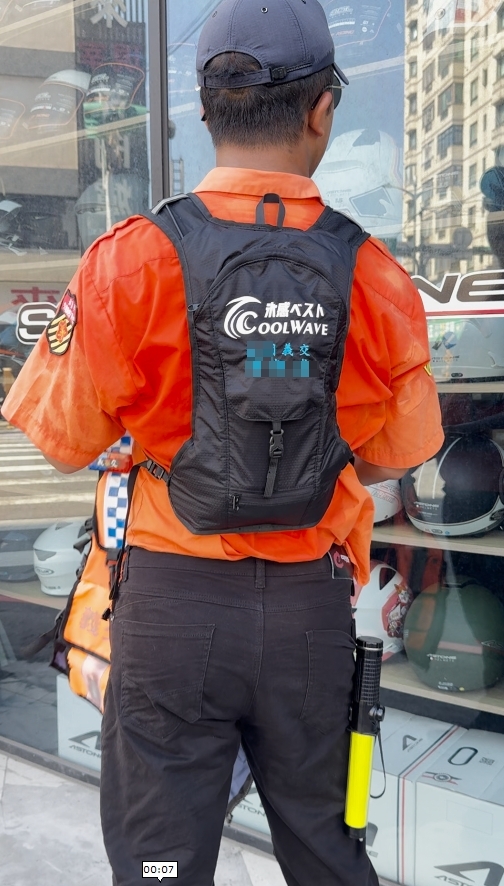
The only deployment documented in the material available for this guide is a Taiwan project that placed 100 units into high-temperature work, covering construction sites, outdoor workers, metal sheet factories and street vendors. The reported results were effective body cooling, heatstroke prevention, improved work efficiency and worker comfort. Those are the supplier's case descriptions rather than an independently audited study, so they are useful as category context and as a sign that street vending has been considered in the product's design, not as proof of performance in your particular stall.
Ordering for one stall or a market group
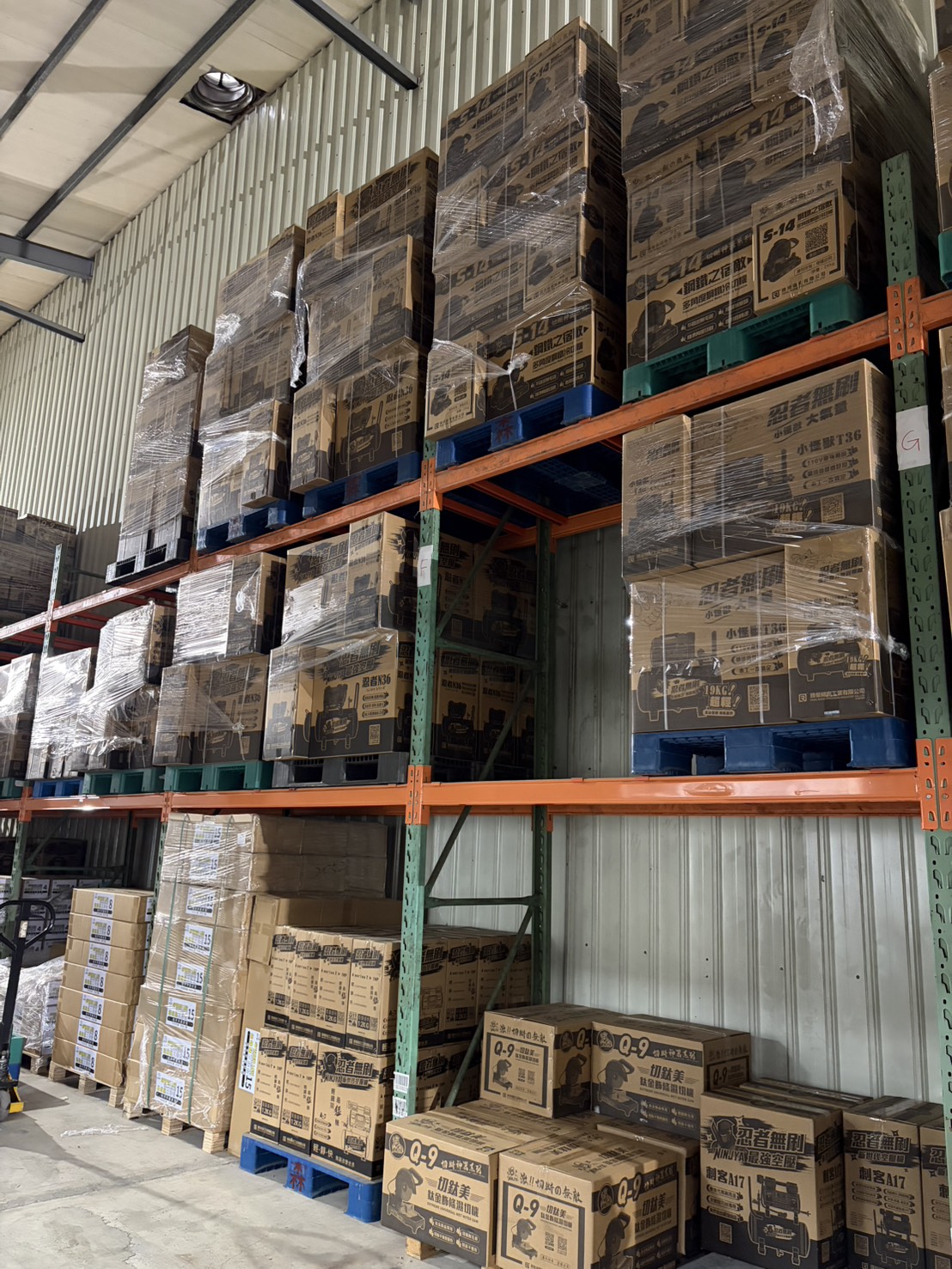
Shokunin is the professional tool brand of Feng Shang Precision Co., Ltd., a Taiwan-based company established in 2009 with a 1,000 m² facility, 30 employees and 5 R&D engineers, exporting about 50% of its output with the USA and Taiwan as its main markets. For a vendor buyer, the relevant commercial terms are unusually small-batch friendly: a minimum order of 10 units, a 7–14 day lead time, and a stated monthly capacity of 3,000 units for scaling a seasonal program.
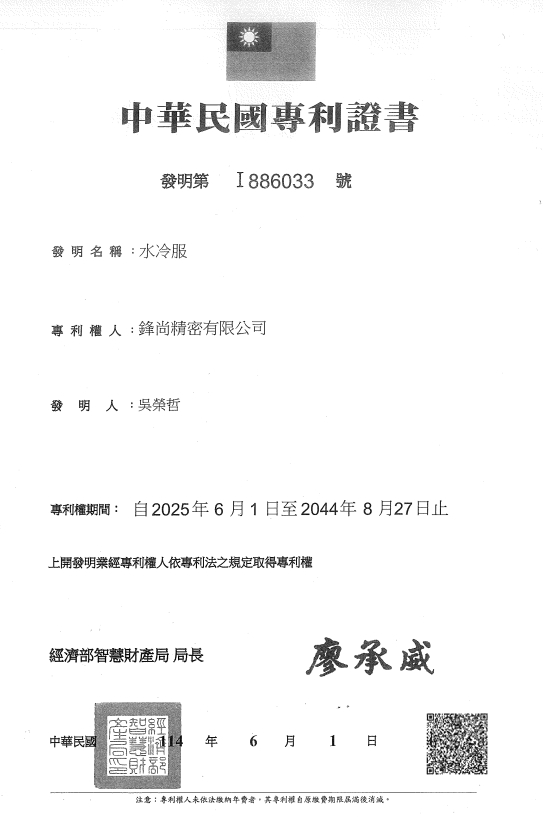
Production is listed as ODM, and open customization is not recorded as available on the current capability record — confirm that with the supplier before planning a private-label program around the product. A 6-month warranty applies to the water-cooled vest. The design is protected by patent I886033, issued by the Intellectual Property Office of Taiwan's Ministry of Economic Affairs for water-cooled vest structure and cooling system, and the vest has received a Disaster Prevention Product and Service Certification Award from the Taiwan Disaster Prevention Industry Association.
Before a group order, put these six questions to the supplier:
- What is the documented difference between the Basic (CW-01) and Professional (CW-PRO) variants?
- What head pressure and tube length were used to measure the 320–370 ml/min flow rate?
- What conditions sit behind the stated 3–4 hour cooling duration?
- What power-bank capacity is recommended for a full cycle, and is a bank supplied?
- What are the written warranty terms for the pump, TPU water bag, cap, tube and ice packs?
- Can a trial batch be supplied at the 10-unit minimum for testing under real stall conditions?
Frequently asked questions
Is the COOLWAVE Dual Cooling Water Cooling Vest patented or certified?
Two separate items are documented. Patent I886033, issued by the Intellectual Property Office of Taiwan's Ministry of Economic Affairs, covers water-cooled vest structure and cooling system; it was issued on 1 June 2025 and runs to 27 August 2044. Separately, Shokunin holds a Disaster Prevention Product and Service Certification Award from the Taiwan Disaster Prevention Industry Association. Neither is a thermal-performance certificate: they confirm the design's protected status and its recognition in Taiwan's disaster-prevention category, not a measured cooling result at your stall.
How long will the cooling last during a market session?
The manufacturer states 3–4 hours per ice-pack and charge cycle. Because the test conditions behind that figure are not published, plan one cycle per four-hour session, keep the second included ice pack in an insulated box, and confirm actual runtime with a sample under your own canopy before ordering for a group of stallholders.
What power source does the pump need, and is a power bank included?
The pump is rated at 5V and 150 mA (max) and moves water at a rated 320–370 ml/min. That rating suits a standard 5V USB power bank, but a power bank is not listed among the included items — the specified pack contents are the vest, the water-cooled vest backpack and two ice packs. Confirm the power-supply arrangement and expected runtime per bank with the supplier.
What is the minimum order quantity and lead time?
The minimum order is 10 units, the stated lead time is 7–14 days, and the stated monthly capacity for the line is 3,000 units. Ten units matches a group of stallholders on one food street ordering together, which also spreads the cost of a trial batch.
What does the 6-month warranty cover?
The company lists a 6-month warranty for the water-cooled vest. Ask for written terms that name the pump, the TPU water bag, the polypropylene cap, the sand rubber cooling tube and the ice packs, and that state what is excluded, before a group order is placed.
What should a trial order test before a full season?
Run at least one full session per operator and record five things: whether one cycle covers your longest session; how the weight feels after four hours with a filled bag and a power bank; how quickly the ice packs refreeze overnight; whether the tube run survives bending at the griddle; and how long end-of-day draining takes. Then compare the Basic and Professional variants on the same checklist. A trial of that size is what the 10-unit minimum is designed for, and the team can quote a trial batch and confirm current variant specifications from there.
Conclusion
Street vendor heat relief comes down to three published numbers and one routine: a stated 3–4 hours per ice-pack and charge cycle, a net weight within 2 kg, and a rated 320–370 ml/min through the loop, wrapped in a rotation routine built around the vendor's longest session. The specification is specific enough to plan with, provided the vendor treats the duration as a baseline to verify rather than a guarantee, and treats the refreeze step as the constraint that decides how many cycles a day is realistic.
For a single stall, the practical starting point is one vest plus a second ice-pack set kept in an insulated box, with the variant chosen from a trial rather than from the model name. For a food street or market association, a minimum order of 10 units and a 7–14 day lead time make a group trial achievable before the season starts.
Next step for stall operators and market groups
The full product brochure with specifications and model information is available to view and download: COOLWAVE cooling vest brochure (PDF).
Company details, current model information and contact options are published on the Shokunin / Feng Shang Precision website.
Have Questions or Need More Details?
Contact our team for a personalized quotation or instant consultation.
Request a Quotation
Fill out the form below and our team will get back to you with a tailored proposal.
WhatsApp Direct Chat
Prefer to chat in real-time? Message us on WhatsApp for instant assistance & quick answers.
- Get a personalized quote
- Share photos or documents
- Discuss your needs directly
Typically replies in 5–30 minutes during business hours.