
How Dual Cooling Water Cooling Vests Work: Pump, TPU Water Bag, and Ice Packs
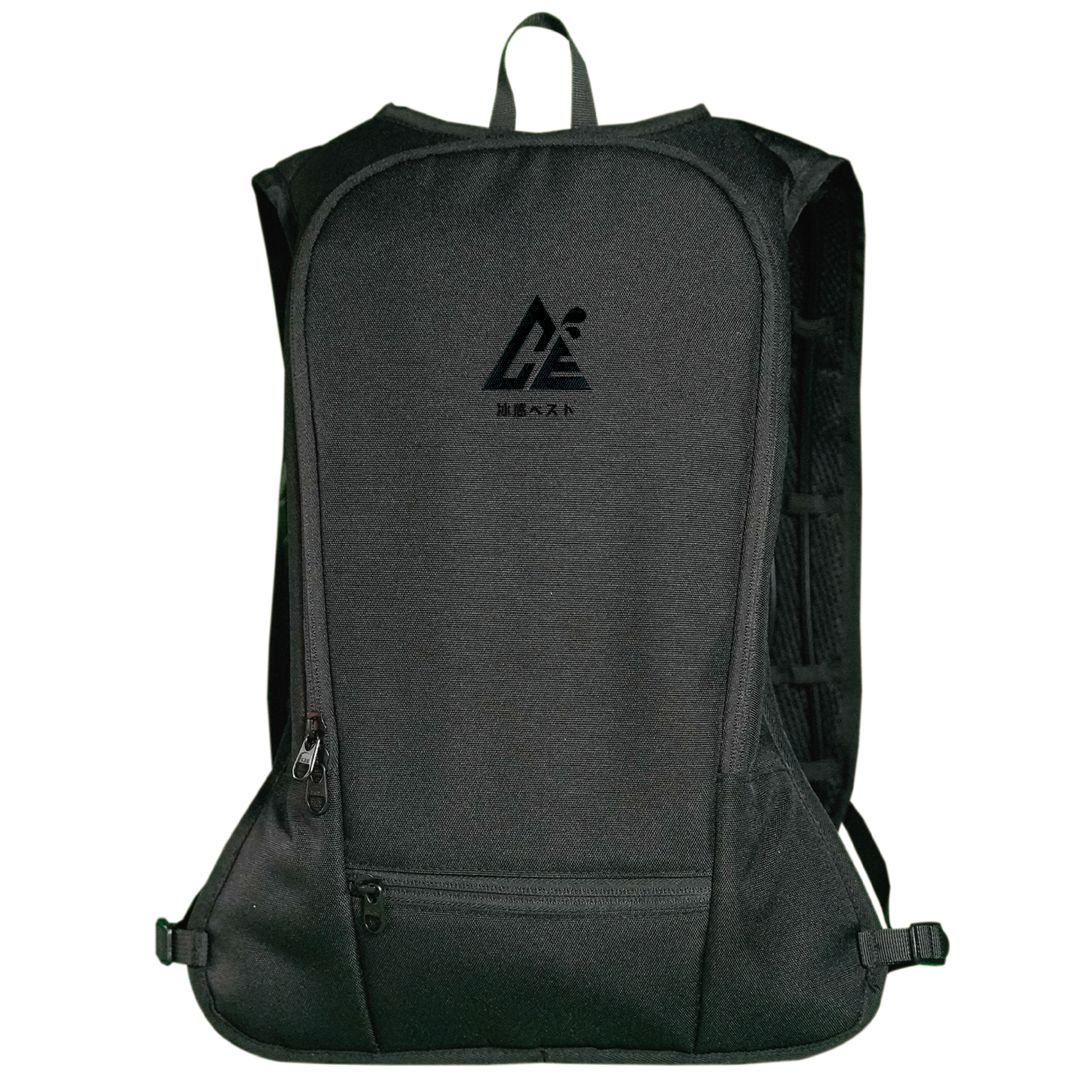
A dual cooling water cooling vest works by carrying cold from two frozen ice packs through an actively pumped water loop and into a body-contact vest worn against the torso. The "dual" in the name does not describe two circuits; it describes two roles working together — a passive cold source (the ice packs) and an active delivery mechanism (the 5V pump, TPU water bag, and sand rubber cooling tube). The reference product for this breakdown is the COOLWAVE Water-Circulation Cooling Vest from the Shokunin brand, which Feng Shang Precision Co., Ltd. manufactures in Taiwan. Its published specification set lists a water-cooled vest backpack ×1, ice packs ×2, a TPU water bag, a polypropylene water bag cap, a black sand rubber cooling tube, a 600D polyester shoulder strap, a 5V / 150mA (max) pump, a 320–370 ml/min flow rate, a 3–4 hour cooling duration, and a net weight within 2 kg.
Why Passive Cooling Alone Is Not Enough on Industrial Sites
Heat exposure on construction sites, in metal sheet factories, and at open-air work positions imposes a real physiological load on the wearer. NIOSH, the U.S. National Institute for Occupational Safety and Health, identifies water-cooled garments, air-cooled garments, cooling vests, and wetted overgarments as examples of personal cooling systems — that is, wearable gear that reduces heat burden on the body. Within that category, a cooling vest that only holds frozen inserts works on a static principle: the insert cools whatever it happens to touch, and as it melts, the cold delivery weakens.
An actively circulated design changes that. Instead of relying on contact with a fixed cold pack, cold water is pushed continuously from a chilled reservoir into a tube network against the wearer's torso. That is the design logic behind heatstroke prevention gear for extreme heat: the cooling surface is refreshed by flow, not by stillness. For construction crews and metal-roof factory workers who move, bend, and reach throughout a shift, a circulated loop keeps the cooling interface consistent while the ice packs supply the reserve that the loop draws from.
Understanding the component architecture matters at the procurement stage because each part has a defined role in whether the cooling cycle holds up over a work shift. A garment that satisfies the spec sheet but fails to circulate is a garment that only cools by contact. A vest that circulates but runs out of ice in an hour leaves the wearer without a cooling source. The dual cooling architecture is the way those two failure points are addressed in the COOLWAVE design.
Industry Context: Where This Category Sits
According to the Dataintelo cooling vests market report published in May 2026, the global cooling vests market reached US$342 million in 2025, and industrial applications accounted for 34.5% of revenue share that year. More than a third of category revenue therefore comes from buyers who select cooling garments as work equipment rather than as leisure accessories — a distinction that shapes how the product should be evaluated.
The same occupational-safety framework that classifies personal cooling systems also clarifies the buyer's responsibility. If water-cooled garments belong to a recognized category of personal cooling systems, then the practical questions become component reliability, flow consistency, and the recharge window. An effective industrial cooling vest is not defined by how cold it feels on the first minute of use; it is defined by whether it still delivers cold in hour three.
The dual cooling architecture also separates two concerns that otherwise get tangled together. Ice packs answer the question "where does the cold come from?" The pump, water bag, and tube answer "how is that cold moved?" When the two are designed as separate parts, each can be maintained, replaced, or re-frozen independently. That separation is what the rest of this breakdown explains component by component.
Component Breakdown: What Each Part Does in the Loop
Two Reusable Ice Packs — The Cold Source
The two ice packs in the COOLWAVE kit are the passive cold source. They are frozen before use and loaded into the water-cooled vest backpack, where they sit near the water reservoir. While ice remains inside them, the circuit has a cold reserve that the pump can draw from. The published contents list confirms ice packs ×2 per kit — a quantity that supports a rotating routine, where one pair is in service while the other is re-freezing.
The ice packs are not the wearable part. They stay inside the backpack; cold transfers from the packs to the water in the bag, and the pump moves that chilled water to the vest. This detail matters for buyers because the cold source is user-serviceable without touching the garment itself.
TPU Water Bag — The Carrier for Chilled Water
The water bag material is listed as TPU. TPU is a thermoplastic polyurethane — an elastomer widely used in flexible fluid-containment applications. In this vest, the TPU water bag is the reservoir from which the pump pulls chilled water, and to which the returning water travels. Because the bag sits inside the backpack alongside the ice packs, water held in it is chilled by proximity before the pump begins moving it through the loop.
Polypropylene Water Bag Cap — Seal and Fill Port
The water bag cap is specified as polypropylene. Polypropylene is a rigid thermoplastic used in sealing caps and closures. In the vest, the cap performs a functional role: it closes the TPU water bag, keeps the filled water contained, and provides the access point for refilling before each new cooling cycle. A well-sealed cap keeps the circuit intact for the full operating window.
The 5V / 150mA Pump — The Circulation Engine
The pump is what makes this design an active cooling system rather than a passive one. The listed pump output is 5V, 150mA (max), with a flow rate of 320–370 ml/min at maximum. Those three numbers describe three separate properties of the device, and buyers generally benefit from reading them as such.
- 5V is a direct-current voltage in the same range as standard USB power delivery. This is an electrical-classification fact, not a claim about any specific battery: the motor is designed to operate on a low-voltage DC supply.
- 150mA (max) is the maximum current draw. At that level, the motor belongs to a low-power class — the implication for the wearer is that a compact portable power source can operate the pump for the duration of the cooling cycle without drawing a heavy load.
- 320–370 ml/min is the maximum flow rate. It describes how much chilled water the pump can move past the cooling surfaces per minute. In practice, this figure determines how quickly water completes a full pass through the loop and returns for re-chilling.
Taken together, these specifications describe a pump designed for consistent circulation over the 3–4 hour operating window, rather than for short bursts of high-volume flow.
Sand Rubber Cooling Tube — The Delivery Path
The cooling tube is specified as black sand rubber. Rubber is chosen because the tube has to route along the body surface, and a flexible material can follow the torso contour without collapsing at a bend point. The sand texture adds surface grip — a practical detail for a tube worn under clothing that otherwise might slide out of position during movement.
In the loop, the tube is the transport link between the reservoir and the torso. Chilled water enters at one end, passes the contact area of the vest, and returns to the bag for re-chilling. During a working shift, this is the part of the system that keeps the cooling surface refreshed rather than letting contact-cooling fade as static inserts warm up.
PEVA Vest Body — The Body-Contact Cooling Layer
The vest body material is listed as PEVA. PEVA — polyethylene vinyl acetate — is a flexible polymer used in water-resistant, pliable applications where the material has to remain supple. In the vest, PEVA carries the cooled water against the wearer's torso while keeping the garment wearable and flexible. This is the layer that translates the liquid cooling loop into direct body contact.
600D Polyester Shoulder Strap — The Load-Bearing System
The shoulder strap is specified as 600D polyester. The 600D designation refers to yarn weight per unit length — a denier count typically associated with heavier, more durable webbing. In the vest architecture, the strap is not a comfort detail; it is the retention system that keeps the backpack loaded with ice packs, the TPU water bag, and the pump in a stable position while the wearer moves. If the pack shifts, the cooling contact area shifts with it.
Water-Cooled Vest Backpack — The Carry Enclosure
The contents list specifies a water-cooled vest backpack ×1. This is the enclosure that holds the ice packs, the water bag, and the pump, and it is carried on the back so that the cooling hardware sits behind the wearer rather than on the chest. That layout keeps the body-contact vest relatively slim while allowing the heavier components to sit on the back, where load distribution is more natural for walking and lifting work.
Step-by-Step: How a Full Cooling Cycle Runs
The operating sequence below follows the order of use. Each step corresponds to one component described above, so the logic of the assembly becomes visible as the cycle is followed from start to finish.
- Freeze the ice packs. Both reusable ice packs are placed in a freezer until solid. The ice packs are the only cold source in the circuit, so they must be fully frozen before a cycle can begin.
- Fill the TPU water bag. The polypropylene cap is opened, water is added to the TPU water bag, and the cap is sealed. This step establishes the circulating fluid inventory.
- Load the ice packs into the backpack. Both frozen ice packs are placed into the water-cooled vest backpack — adjacent to the water bag so cold transfer can begin before the pump starts.
- Don the vest and tighten the 600D straps. The vest is worn over the torso, with the backpack positioned on the back. The 600D polyester shoulder strap is adjusted until the pack sits stable against the body.
- Start the pump. The 5V / 150mA motor begins driving chilled water out of the TPU bag and into the sand rubber cooling tube at a maximum flow of 320–370 ml/min.
- Circulate throughout the cooling window. Chilled water moves from the bag → pump → cooling tube → PEVA vest body → and returns to the bag. Heat drawn from the wearer passes into the returning water, which is re-chilled as it sits near the ice packs.
- Recondition after 3–4 hours. The published cooling duration is 3–4 hours per cycle. After that window, the ice packs are returned to the freezer and the water bag is refilled for the next cycle.
The same components in the same order support the lightweight cooling vest target: net weight is stated within 2 kg, which reflects the sum of the vest body, backpack, two ice packs, water bag, pump, tube, and straps together.
Where the Design Fits: Use Cases and Work Scenarios
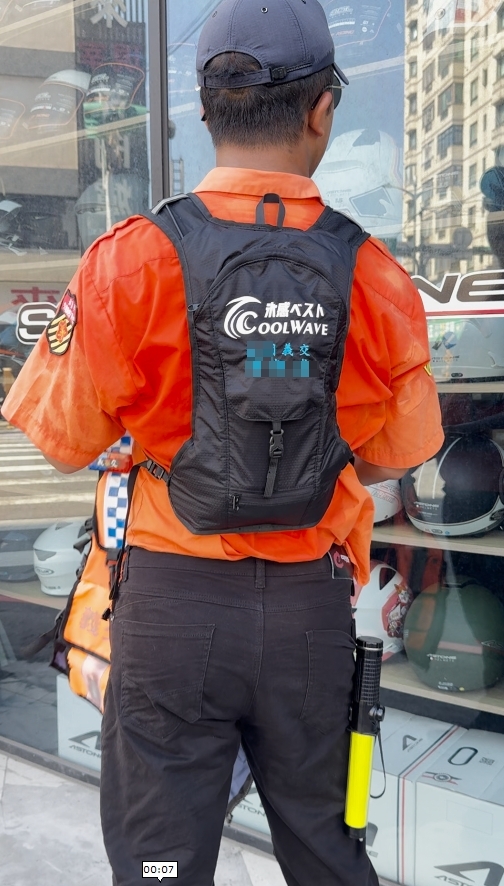
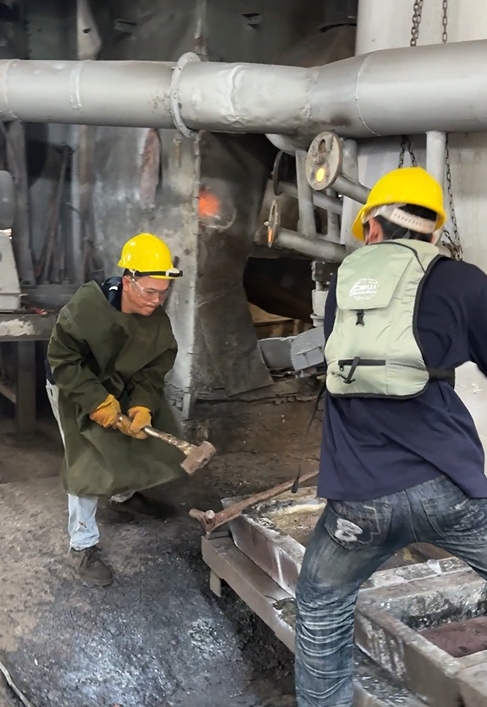
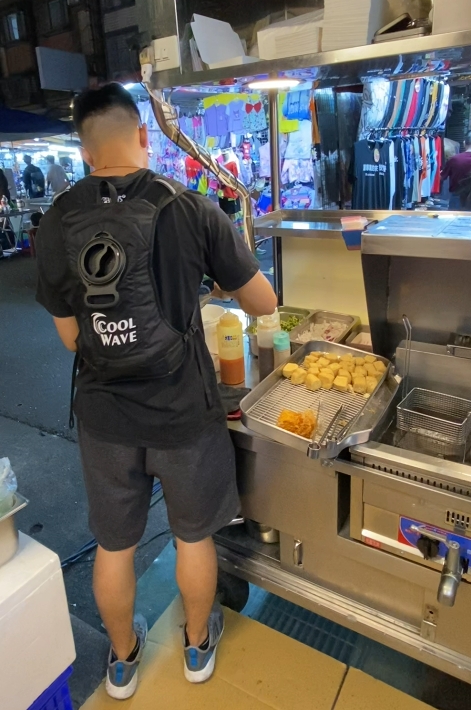
The listed applicable industries for the COOLWAVE Water-Circulation Cooling Vest are construction workers, outdoor workers, food stall operators, street vendors, traffic controllers, and metal sheet factories. These groups share a common profile: they work in high-temperature conditions for extended periods, without the option of returning to a cooled indoor area between tasks.
A construction site presents a combination of solar radiation, physical exertion, and variable workload. A case record for the cooling vest describes deployment at construction sites and outdoor work in Taiwan, where a 100-unit application was used for cooling in a high-temperature environment; the record cites effective body cooling, heatstroke prevention, and improved worker comfort and efficiency as outcomes. That record also identifies the COOLWAVE product as a certified disaster prevention product under the Taiwan Disaster Prevention Industry Association certification award held by Feng Shang Precision Co., Ltd.
For metal sheet factories, the heat load is driven by radiant heat from production equipment rather than by direct sun. The dual cooling architecture is useful in that setting because the ice packs supply cold independent of the surrounding air temperature — within the limits of the ice volume, the cooler the pack, the cooler the circulated water.
Traffic control and street vending both involve prolonged standing in exposed locations. Here the within-2 kg net weight is the relevant specification: a heavy cooling system becomes its own fatigue source over a long shift. Relative to that constraint, a long-lasting cooling vest with a full 3–4 hour cycle and a compact carry format is what the COOLWAVE configuration is built to deliver.

Scene-Fit Checklist: Matching the Vest to the Work Environment
Because dual cooling vests are selected for specific work environments, the most useful way to evaluate one is to compare its published operating parameters against the conditions of the site it will be used on. The table below maps the listed specifications to common industrial scenarios.
| Work scenario | Heat condition | How the 3–4 hour cycle fits | Architecture rationale |
|---|---|---|---|
| Construction site | Solar radiation plus physical exertion | Approximates one half-shift rotation | Circulation keeps the cooling interface active while the wearer moves |
| Metal sheet factory | Radiant heat from production equipment | Matches a production cycle block | Cold supply comes from ice packs, not from ambient air |
| Traffic control | Continuous direct sun while standing | Aligns with an on-post rotation | Net weight within 2 kg reduces long-standing fatigue load |
| Street vendor / food stall | Extended exposure over a sales window | Matches a peak trading block | Backpack format leaves both hands free for service work |
| General outdoor work | Variable ambient temperature | Cycles at 3–4 hour intervals | Ice packs are replaceable between cycles |
Component Reference Table
The table below summarises the published specification set of the COOLWAVE Water-Circulation Cooling Vest in a component-by-component format that maps to the explanation above.
| Component | Role in the loop | Listed material / value | What the buyer should note |
|---|---|---|---|
| Ice packs ×2 | Cold source | Two per kit (contents list) | Supports a re-freeze rotation between cycles |
| TPU water bag | Reservoir for chilled water | TPU | Sits adjacent to the ice packs inside the backpack |
| Polypropylene cap | Seal and fill port | Polypropylene | Provides the refill access point between cycles |
| Pump | Circulation engine | 5V, 150mA (max); 320–370 ml/min max flow | Low-voltage DC input; low-current draw |
| Cooling tube | Delivery path | Sand rubber (black) | Flexible routing with a textured grip surface |
| Vest body | Body-contact layer | PEVA | Wearable layer that carries the cooled water |
| Shoulder strap | Retention system | 600D polyester | Heavier webbing intended to hold the pack steady |
| Full kit | Wearable system | 3–4 hour cooling duration; net weight within 2 kg; suitable temperature below 10°C | Buyers should confirm the operating environment against the site conditions |
Frequently Asked Questions
1. Does a dual cooling water cooling vest fall under a recognised category of personal cooling equipment?
Yes. NIOSH identifies water-cooled garments, air-cooled garments, cooling vests, and wetted overgarments as examples of auxiliary or personal cooling systems used for heat exposure. That classification supports viewing a powered water-circulation vest as a form of wearable protective cooling gear rather than as ordinary apparel. Buyers evaluating heatstroke prevention gear for extreme heat can use that category placement as a starting reference point when reviewing a supplier's documentation.
2. What do the pump specifications — 5V, 150mA, and 320–370 ml/min — actually mean in practice?
The pump specification describes three things: the electrical input (5V DC and 150mA maximum), and the maximum flow rate the pump can deliver (320–370 ml/min). In practice, the flow rate determines how rapidly chilled water completes a full pass through the tube and returns for re-cooling. The 5V input is a low-voltage DC rating, which is compatible with standard USB-class portable power delivery, and the 150mA maximum current draw classifies the pump as a low-power device relative to the 3–4 hour operating window.
3. How does the 3–4 hour cooling duration map onto a typical work shift?
The listed cooling duration for the COOLWAVE Water-Circulation Cooling Vest is 3–4 hours per cycle. Rather than treating that figure as a full-shift guarantee, buyers typically use it to plan a rotation: a cooling interval of 3–4 hours corresponds to roughly one half-shift block, after which the ice packs are re-frozen and the water bag is refilled. Because two ice packs are supplied per kit, the rotation can continue across a multi-shift schedule without waiting for a single pair to re-freeze.
4. Can buyers test a unit before committing to larger orders?
Yes. The supplier's published commercial terms list an MOQ of 10 units, which is consistent with sample evaluation and pilot deployment ahead of a larger order. The product also carries a 6-month warranty for the water-cooled vest. Procurement teams assessing industrial cooling equipment can therefore obtain a working unit to confirm the pump behaviour, the fill-and-freeze routine, and the circulating experience under their own site conditions before scaling.
5. What is the reorder lead time for a bulk cooling vest programme?
The supplier has stated a monthly capacity of 3,000 units and a lead time of 7–14 days for its ODM model. Those figures describe the reorder window for programme restocking, not the delivery time for a single sample. Buyers planning a summer deployment should confirm both figures in writing against the current season's schedule before setting delivery dates. For a quotation, sample request, or a review of the product catalogue, buyers can contact Shokunin through the Feng Shang Precision Co., Ltd. website or request the current catalogue directly.
Conclusion
A dual cooling water cooling vest works because the components divide the job rather than duplicate it. Two reusable ice packs supply the cold; a TPU water bag holds the circulating fluid; a polypropylene cap seals it; a 5V / 150mA pump moves 320–370 ml/min through a sand rubber cooling tube; the PEVA vest body applies that cold to the torso; and a 600D polyester shoulder strap keeps the whole assembly in place. Together, those parts deliver a 3–4 hour cooling cycle at a net weight within 2 kg.
For buyers evaluating a professional cooling vest for construction, metal sheet factories, traffic control, or outdoor work, the component architecture is what to review against the work conditions. The pump, the reservoir, the tube, and the cold source each define a separate limit — and the value of the dual cooling design is that each of those limits can be checked, replaced, and planned for independently.
Planning a heat-relief programme?
Request a sample or quotation for the COOLWAVE Water-Circulation Cooling Vest, or review the full product range on the Shokunin website.
🌐 www.fstool.com.tw · 📘 Download the current product catalogue (PDF)
Shokunin is a professional e-commerce brand launched by Feng Shang Precision Co., Ltd. (Taiwan), which manufactures the COOLWAVE water-circulation cooling vest line. Product specifications referenced in this article are drawn from the manufacturer's published product documentation.
Have Questions or Need More Details?
Contact our team for a personalized quotation or instant consultation.
Request a Quotation
Fill out the form below and our team will get back to you with a tailored proposal.
WhatsApp Direct Chat
Prefer to chat in real-time? Message us on WhatsApp for instant assistance & quick answers.
- Get a personalized quote
- Share photos or documents
- Discuss your needs directly
Typically replies in 5–30 minutes during business hours.