
Dual Cooling Water Cooling Vest: Solving Sustained Heat Exposure
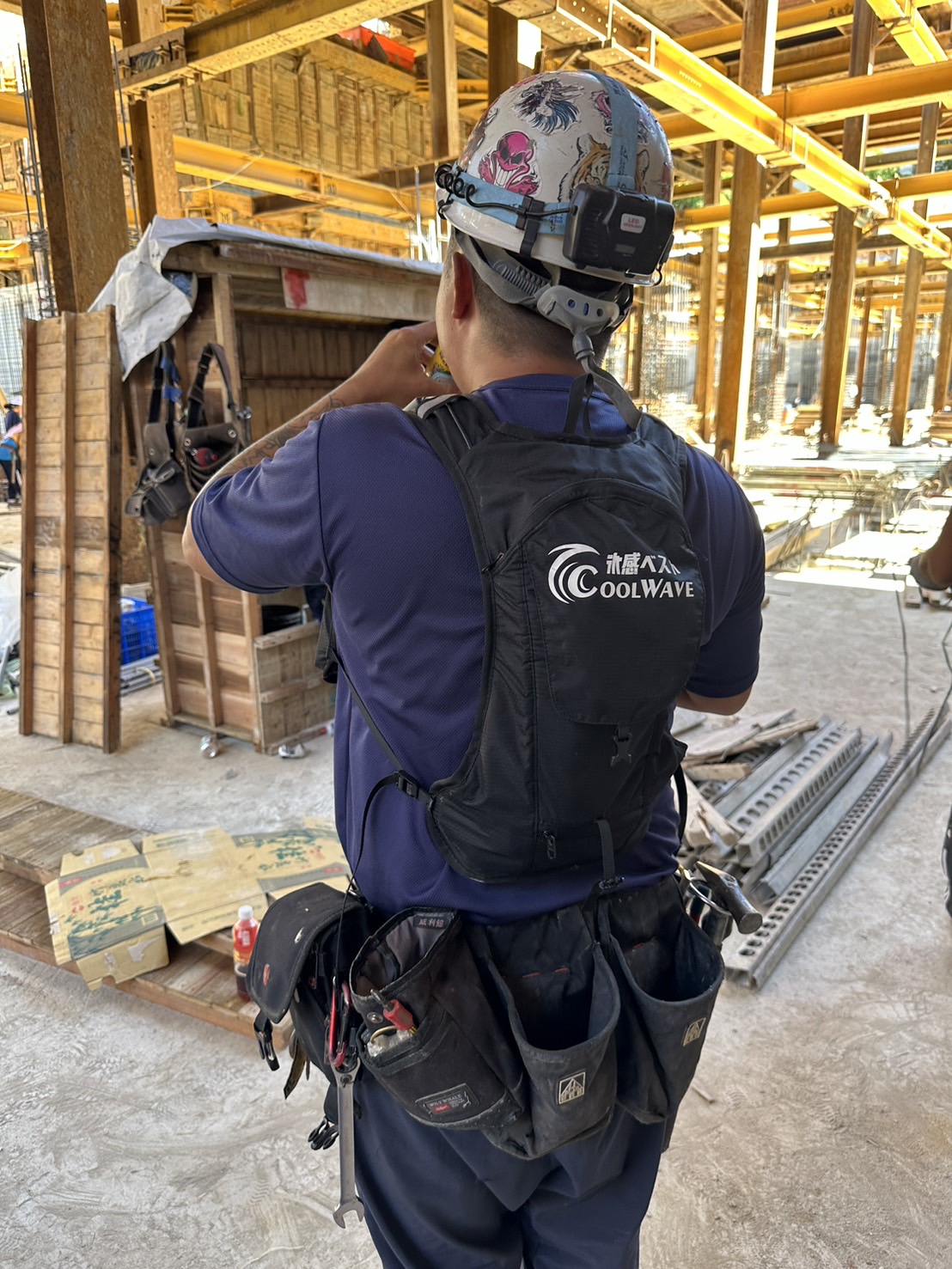
Sustained heat exposure: the working condition that a dual cooling water cooling vest is built to address.
Problem Definition: Why Ordinary Cooling Methods Fail in Sustained Heat
The cooling vest category looks simple from the outside: put something cold on the body and let conduction do the work. In practice, that model breaks down quickly once the workday extends beyond a short task. Once a crew is in the heat for a full shift, the cooling system has to keep producing cold, not just start cold.
Three failure modes show up repeatedly in hot-weather work environments:
- Thermal decay. A single passive ice-pack vest cools well for the first short period, then warms up. Without a way to keep drawing heat out of the body, the wearer is left in a warm vest that adds weight without adding cooling.
- No circulation. Passive cold stays where the pack touches. Body areas away from the pack — back, shoulders, torso margins — stay hot, and the perceived cooling is uneven.
- Workflow mismatch. Many work environments do not allow the wearer to leave the hot zone to re-cool. Construction sites, metal-roof factories, direct-traffic control and street vending all keep workers in place for long stretches. Cooling must work in place.
A solution for these environments therefore has to combine an ongoing cold source with active distribution of that cold across the body. That is the design problem a water-circulation cooling vest is built to solve, and it is the reason a “dual cooling” architecture appears in this category.
Industry Background: Personal Cooling as a Recognized Heat-Stress Category
Personal cooling is not a marketing category invented by suppliers. Occupational-safety guidance treats wearable cooling systems as a recognized way to reduce heat burden. The U.S. Centers for Disease Control and Prevention / National Institute for Occupational Safety and Health (CDC/NIOSH) identifies water-cooled garments, air-cooled garments, cooling vests and wetted overgarments as examples of auxiliary or personal cooling systems for heat exposures.
That classification matters for buyers because it places cooling vests within the broader PPE discussion rather than in leisure accessories. Industrial applications are also commercially significant: market research cited in verified third-party data reports industrial applications at 34.5% revenue share of the global cooling vest market in 2025, within a market sized at approximately USD 342 million in 2025.
Within that context, Shokunin — the professional e-commerce brand of FENG SHANG PRECISION CO., LTD., a Taiwan-based manufacturer founded in 2009 and based in Luzhu District, Taoyuan City — positions the COOLWAVE Water-Circulation Cooling Vest as an industrial cooling apparel product for construction workers, outdoor workers, food-stall operators, street vendors, traffic controllers and metal-sheet factory workers.
Detailed Solution: The Dual Cooling Water Cooling Vest
The COOLWAVE Water-Circulation Cooling Vest is an industrial cooling apparel product classified as Personal Protective Equipment (PPE). Its “dual cooling” identity comes from combining two mechanisms in one wearable system: reusable ice packs as the cold source, and a pump-driven water-circulation loop that carries chilled water through a cooling tube routed across the body.
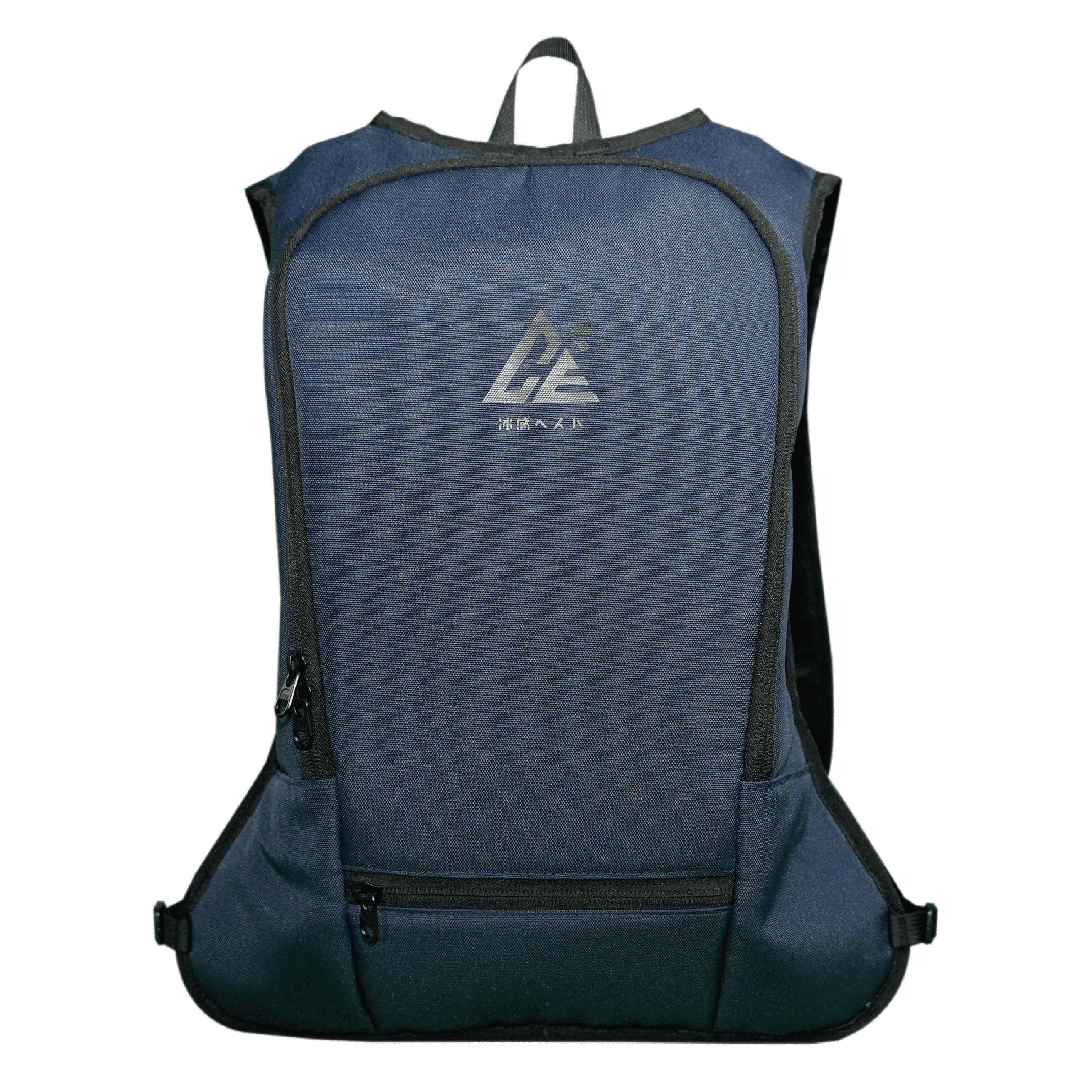
COOLWAVE Water-Circulation Cooling Vest (Professional Model, Blue) — backpack format with pump-driven water circulation and two reusable ice packs.
Verified product specifications
The following specifications are taken directly from the COOLWAVE product specification sheet (Basic and Professional models share the same published specifications):
- Cooling duration: 3–4 hours
- Weight: Within 2 kg
- Pump output: 5V 150mA (max)
- Flow rate: Max 320–370 ml/min
- Shoulder strap material: 600D polyester
- Main material: PEVA
- Water bag material: TPU
- Water bag cap: Polypropylene
- Cooling tube: Sand rubber (black)
- Contents: Water-cooled vest backpack ×1, ice packs ×2
- Stated temperature condition: Below 10°C
The published cooling duration of 3–4 hours per charge/ice-pack cycle is the figure most relevant to scheduling. It reflects a supplier-published specification, and it does not specify ambient temperature, humidity, workload or clothing layer — so buyers should treat it as a planning figure to be validated with a site sample rather than as a laboratory-verified thermal-performance number.
How the dual cooling mechanism actually works
In use, the two ice packs provide the cold source. The pump draws chilled water from the TPU water bag and pushes it through the sand-rubber cooling tube at a flow rate of up to 320–370 ml/min. The circulated water carries cold along the tube's route, so cooling is distributed rather than concentrated at a single contact patch. The pump is rated at 5V, 150mA (max), which is within the output range of common portable power banks.
The architecture, therefore, is not “active cooling instead of ice.” It is a combination: ice provides the thermal reservoir, circulation distributes the cold, and the pump's low-voltage draw keeps the system compatible with portable power. This is what distinguishes a dual cooling water cooling vest from a purely passive ice-pack vest.
Documented product and compliance facts
Two documentation points distinguish this product line in a procurement review:
Patent protection. The COOLWAVE water-circulation cooling vest (Basic Model) is protected by Patent No. I886033, issued by the Intellectual Property Office, Ministry of Economic Affairs, under the Patent Act of the Republic of China. The patent covers the water-cooled vest structure and cooling system, applies to the ROC market, was issued on 2025-06-01, and remains in force through 2044-08-27.
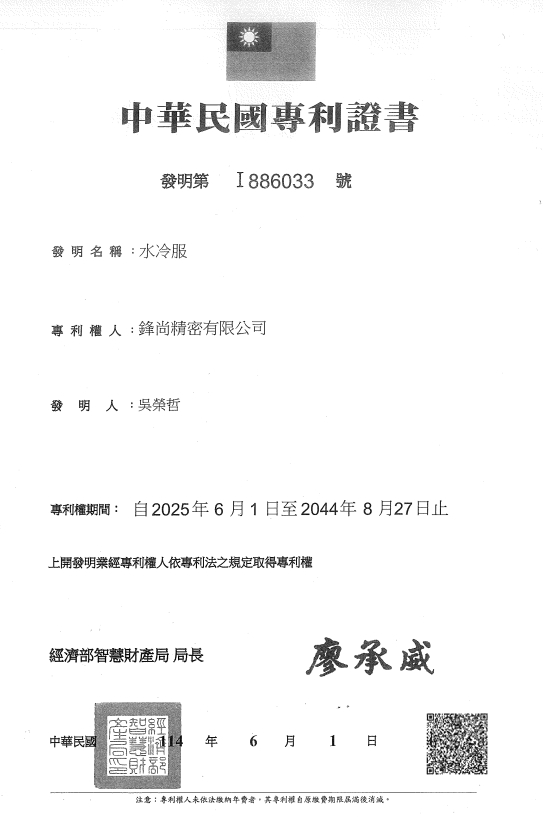
Patent certificate for the water-cooled vest structure and cooling system — Patent No. I886033, ROC market.
Disaster-prevention recognition. The COOLING water-cooled vest received the Disaster Prevention Product and Service Certification Award from the Taiwan Disaster Prevention Industry Association (Taiwan market). This is the specific certification claim documented for this product line; buyers evaluating other markets should confirm the applicable compliance pathway directly rather than assuming cross-market equivalence.
Step-by-Step Breakdown: Matching the Solution to a Sustained-Heat Scenario
Buyers rarely fail at the product-selection step itself. They fail at the step before it, when they try to match a cooling vest to a scenario without first defining what the scenario actually requires. The following sequence is a practical way to work from the problem rather than from the catalog.
Step 1 — Define the exposure window
Start with how long a worker remains in the heat between breaks. The COOLWAVE vest's published 3–4 hour cooling duration is the relevant planning figure here. If the exposure window is within that range, a single cycle can cover it. If the shift extends beyond it, the buyer needs to plan ice-pack rotation and refill logistics — not assume unlimited runtime.
Step 2 — Define the ambient conditions
Heat type changes the cooling requirement. Metal-sheet factories present radiant and ambient heat; construction sites present solar load plus physical workload; traffic-control posts combine standing exposure with limited shade; street-vending environments combine humidity, crowd heat and long standing time. The product's stated temperature condition is below 10°C; the crew's actual ambient conditions should be recorded on site so the sample test reflects reality.
Step 3 — Confirm power availability for the pump
The pump draws 5V, 150mA (max). That rating sits inside the range of common portable power banks, so the practical question is not whether the vest can run on a power bank, but how many power banks a crew needs, how each is charged between shifts, and who on site is responsible for that routine. A pump that depends on a power bank is only as reliable as the power-bank schedule behind it.
Step 4 — Plan the cold-source cycle
Two ice packs are included with each vest. For a longer program — particularly a 24-hour operation or a multi-shift site — the buyer should size the number of ice packs and freezers around the shift pattern, not around the number of vests. The ice packs and the water bag represent the maintenance cycle that procurement should plan for, including replacement availability across seasons.
Step 5 — Validate with a sample before scaling
A sample run is the correct way to verify that the published specifications hold in the buyer's actual environment. That test should measure the same things that matter in deployment: how long the vest stays cool under the crew's workload, how much weight the wearer tolerates over a full shift, and how the pump performs over repeated use.
Use Cases: Where the Dual Cooling Water Cooling Vest Fits
The documented application scope of the COOLWAVE vest is construction sites, outdoor work, metal-sheet factories, food-stall operation and street vending, plus direct-traffic control. These are not abstract examples — they are the working conditions the product is specified for, and the product has been deployed in Taiwan against them.
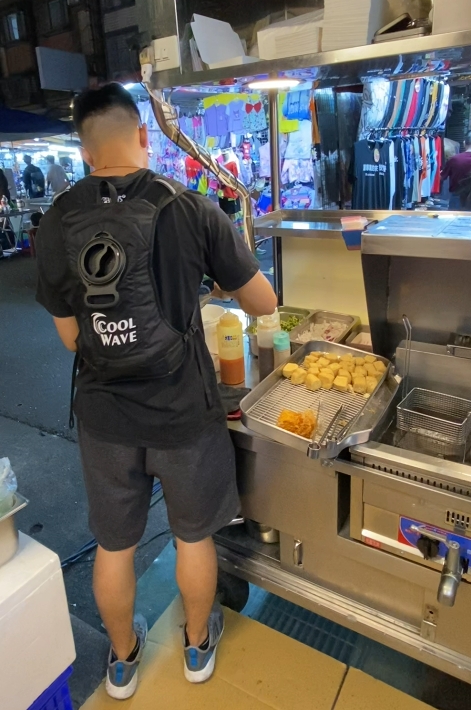
Street vending and night-market operation — a documented application scenario for the COOLWAVE water-circulation cooling vest.
Metal-sheet factories
Metal-sheet factories present sustained radiant heat in a fixed location where the worker cannot simply walk away. A pump-driven vest with a 3–4 hour cooling window can cover an extended production segment without requiring the wearer to leave the line.
Construction sites
Construction work combines solar load, physical exertion and inconsistent shade. Circulation helps here because cooling continues along the tube route while the worker is moving, rather than depending on the wearer being stationary against a cold source.
Direct-traffic control
Traffic-control posts are fixed, exposed and often without nearby shade or rest facilities. The backpack format and 2 kg weight are the relevant planning facts for posts where the wearer stands for extended stretches.
Street vending and food-stall operation
Street vendors and food-stall operators work in crowd heat, ambient heat and long standing windows. The documented application scope for the COOLWAVE vest explicitly includes food-stall operators and street vendors, which matches the fixed-position, long-duration character of that work.
Outdoor leisure with the same heat profile
The same underlying heat exposure also appears in outdoor leisure — the product's documented application scenarios include fishing. The relevant criterion is the heat profile and duration, not the industry label.
Comparison Table: Cooling Architectures for Sustained Heat
The table below compares the three cooling architectures most often considered for hot-weather work. It is limited to verifiable category-level differences and the documented COOLWAVE specifications; it does not rank one product above another.
| Consideration | Dual Cooling Water-Circulation Vest (COOLWAVE) | Passive Ice-Pack Vest | Evaporative Cooling Vest |
|---|---|---|---|
| Cooling mechanism | Ice packs + pump-driven water circulation (documented architecture) | Ice packs only, cold held at contact points | Evaporation of moisture from an outer layer |
| Published cooling window | 3–4 hours per charge/ice-pack cycle (supplier-published) | Depends on pack count and insulation; typically shorter without active distribution | Depends on ambient humidity and airflow |
| Distribution of cold | Circulated along the sand-rubber cooling tube | Localized at pack contact areas | Depends on evaporation from fabric surface |
| Power requirement | 5V 150mA (max) pump; portable power bank compatible | None | None |
| Stated temperature condition | Below 10°C | Not standardized | Not standardized |
| Product weight | Within 2 kg | Varies | Varies |
| Verified compliance / documentation | Patent No. I886033 (ROC); Taiwan Disaster Prevention Product and Service Certification Award | Case-by-case | Case-by-case |
| Maintenance cycle | Ice packs, water bag refill, pump power-bank rotation | Ice packs only | Re-wetting required during use |
| Best-fit scenario | Sustained exposure in fixed or semi-fixed hot environments | Short tasks or intermittent cooling | Hot, dry, low-humidity environments with airflow |
Two limits deserve attention. First, the cooling duration is a supplier-published specification without a stated test protocol — the buyer should validate it on site. Second, evaporative cooling depends on dry air; the comparison above should not be read as an unconditional performance claim.
Manufacturing, ODM Support and Scale
FENG SHANG PRECISION CO., LTD. was founded in 2009, operates a 1,000 m² facility with 30 employees, and maintains a 5-engineer R&D team. The company reports a 10,000-unit annual output company-wide and a 50% export ratio, with main markets in the USA and ROC. For cooling-vest programs specifically, documented commercial terms are a 3,000-unit monthly capacity, 7–14 day lead time, MOQ of 10 units, an ODM production model, and a 6-month warranty for the water-cooled vest.
The documented case record describes a Taiwan deployment of 100 units over a 10-year duration, with reported outcomes of effective body cooling, heatstroke prevention, and improved work efficiency and worker comfort. Buyers considering a comparable program should treat that record as a reference case rather than as a performance guarantee, and should confirm capacity and lead time directly through RFQ for their own volume and season.
FAQ
Does the COOLWAVE vest hold a recognized certification?
The COOLING water-cooled vest received the Disaster Prevention Product and Service Certification Award from the Taiwan Disaster Prevention Industry Association. The product line is also protected by Patent No. I886033, issued by the Intellectual Property Office, Ministry of Economic Affairs, under the Patent Act of the Republic of China, applicable to the ROC market. Buyers evaluating other markets should confirm the applicable compliance pathway for their jurisdiction directly.
How long does the cooling last, and what does the pump require?
The published cooling duration is 3–4 hours per charge/ice-pack cycle. The pump is rated at 5V, 150mA (max), with a flow rate of up to 320–370 ml/min, and it is compatible with common portable power banks. Both figures are supplier-published specifications; buyers should confirm them against their own ambient and workload conditions with a sample.
What is the minimum order and lead time for an ODM program?
Documented commercial terms are a MOQ of 10 units, 7–14 day lead time, and 3,000-unit monthly capacity, with a 6-month warranty for the water-cooled vest. A small pilot order is the correct way to validate fit, cooling performance and packaging before scaling.
Can I test the vest before committing to a full order?
Yes. A sample is the recommended first step for any buyer entering sustained-heat deployment. Use the sample run to confirm cooling duration under the crew's actual workload, weight tolerance over a full shift, and pump behavior over repeated use. You can request a sample or quotation directly through the Shokunin channel before finalizing an order.
Conclusion: Matching the Solution to the Exposure, Not the Catalog
A dual cooling water cooling vest solves a specific problem: keeping cold in circulation during sustained heat exposure, in places where the worker cannot leave the hot zone. The COOLWAVE Water-Circulation Cooling Vest addresses that problem with a documented combination of ice-pack cold source, pump-driven water circulation at 5V/150mA (max), and a published 3–4 hour cooling window in a sub-2 kg package. Its documentation — Patent No. I886033 and the Taiwan Disaster Prevention Product and Service Certification Award — gives procurement a verifiable starting point rather than a marketing claim.
The correct way to evaluate it is to start from the exposure window, the ambient conditions, the power-bank routine and the cold-source cycle, then validate with a sample before committing to scale. That is also the difference between buying a cooling product and deploying a cooling solution.
Plan a Sustained-Heat Deployment
Review the full COOLWAVE product line, specifications and commercial terms in the Shokunin catalog. Sample and quotation requests are handled directly by FENG SHANG PRECISION CO., LTD.
Phone: +886 3-312-6606 | Email: fsmarketing@fstool.com.tw | WhatsApp: +86 18858260055
Address: No. 155-17, Sec. 2, Nanzhu Rd., Luzhu Dist., Taoyuan City 338454, Taiwan
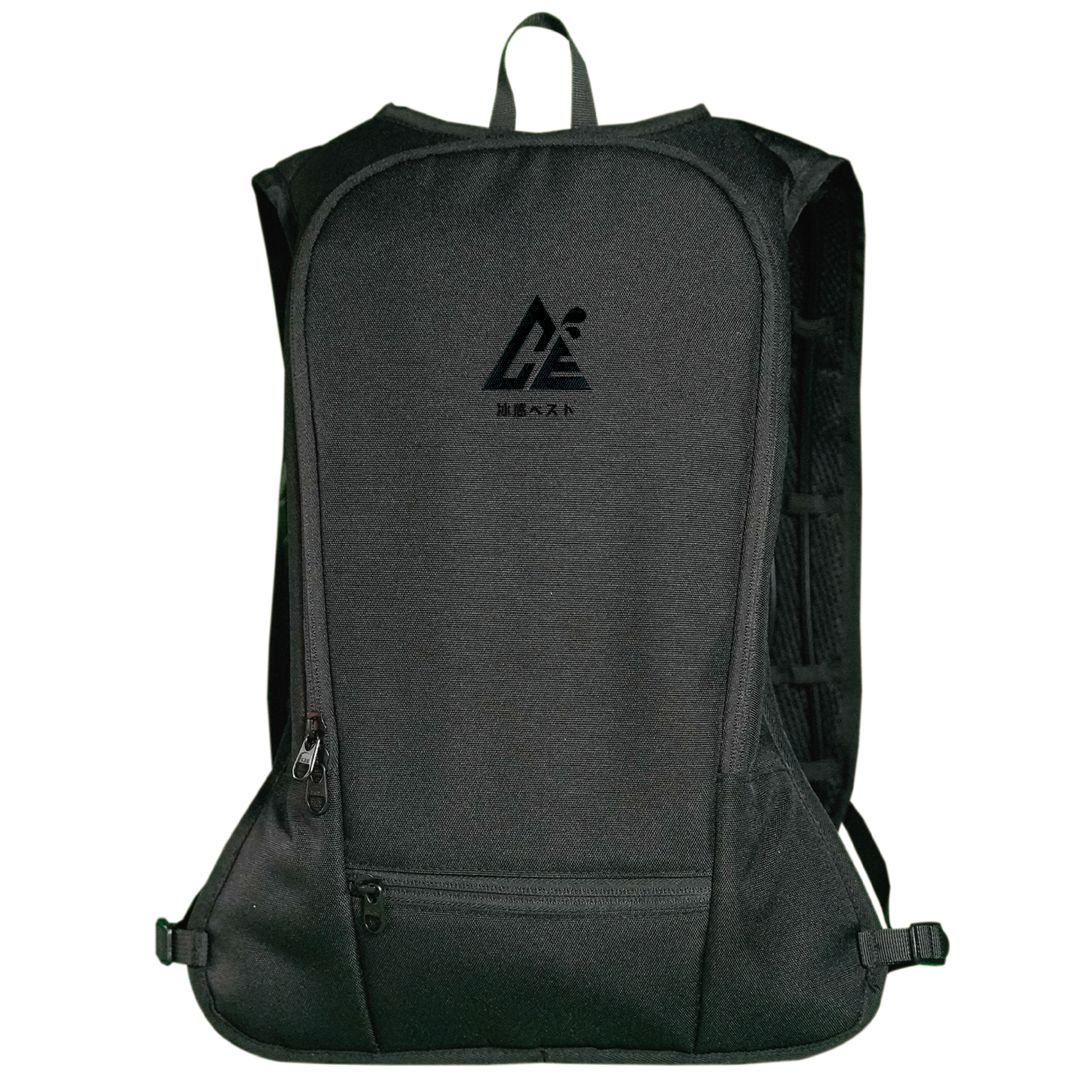
COOLWAVE Water-Circulation Cooling Vest (Professional Model, Black) — one of the documented professional colorways alongside Gray and Blue, plus the Basic Model.
Have Questions or Need More Details?
Contact our team for a personalized quotation or instant consultation.
Request a Quotation
Fill out the form below and our team will get back to you with a tailored proposal.
WhatsApp Direct Chat
Prefer to chat in real-time? Message us on WhatsApp for instant assistance & quick answers.
- Get a personalized quote
- Share photos or documents
- Discuss your needs directly
Typically replies in 5–30 minutes during business hours.