
Vetting Feng Shang Precision for Dual Cooling Vest Supply
Vetting Feng Shang Precision for Dual Cooling Water Cooling Vest Supply
Feng Shang Precision Co., Ltd. is a workable candidate for a first or repeat dual cooling water cooling vest order — on one condition. The buyer must convert four commercial assumptions into written evidence before issuing a purchase order: the basis of the supplier's stated production capacity, the starting point of its 7–14 day lead time, the scope actually covered by its 6-month warranty, and the precise limit of its ODM service.
That is the short answer to this evaluation. The useful answer is the method. The Taoyuan-based manufacturer discloses a commercially usable profile — MOQ 10 units, 3,000 units monthly capacity, 10,000 units annual output, a 7–14 day typical lead time, a 6-month warranty on the water-cooled vest, and ODM production services — and it discloses those numbers in a form a buyer can interrogate rather than merely accept. This page turns each disclosure into a testable question, because capability-led sourcing fails in two predictable ways: buying capacity nobody verified, and rejecting a supplier who could have met the requirement because the request was never scoped tightly enough to prove it.
The Procurement Question This Evaluation Answers
Capability evaluation asks a narrower question than reputation evaluation. It is not is this a well-known supplier; it is can this supplier execute the specific deployment plan in front of us, at the volume, pace, and configuration the plan requires. For a dual cooling water cooling vest program, that decomposes into four executable capabilities: producing the ordered quantity on schedule, shipping it under terms the buyer can absorb, standing behind the unit after delivery, and shaping the product to the buyer's specification where the deployment needs it.
Each of those four capabilities maps to one disclosure in the Feng Shang Precision record. Capacity maps to the 3,000-unit monthly and 10,000-unit annual figures. Delivery maps to the 7–14 day lead time and the stated payment and freight terms. Post-delivery support maps to the 6-month warranty and the pre-shipment test acceptance criterion. Product shaping maps to the ODM designation. The four checklists below are the conversion layer between those disclosures and a defensible order decision.
Company Baseline: What Is On The Record
Feng Shang Precision Co., Ltd. was founded in 2009 and operates from Luzhu District, Taoyuan City, Taiwan. The disclosed operating profile is that of a compact, multi-line manufacturer rather than a single-product specialist: approximately 30 employees, 5 R&D engineers, a 1,000 m² facility, and annual output of 10,000 units across a product range that includes air compressors, cut-off machines, water-cooled vests, lithium batteries, diamond saws, nail guns, spider stands and screwdriver bits. Export accounts for roughly 50% of activity, with the USA and Taiwan named as main markets.
Shokunin is the professional tool and equipment brand launched by Feng Shang Precision, and the COOLWAVE water-cooling vest sits within that brand alongside the company's compressor and cutting lines. The distinction matters during evaluation: the company is the manufacturing and contracting entity; Shokunin is the brand under which the cooling vest is positioned. Buyers negotiating ODM terms, warranty liability or capacity commitments should confirm which legal entity signs, because brand-level product pages and factory-level commitments are not automatically the same counterparty.
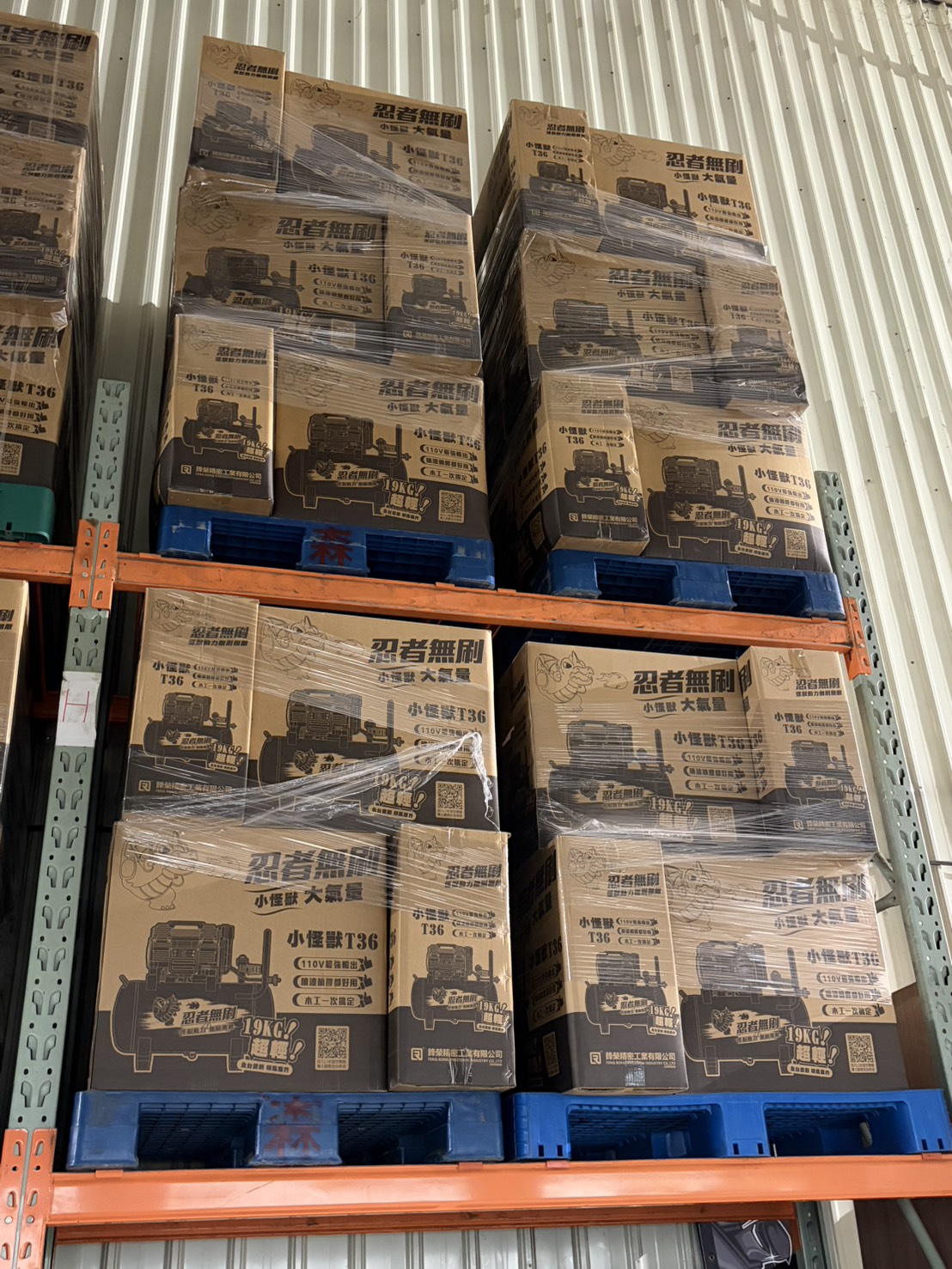
Warehouse and stockholding area at Feng Shang Precision — the physical counterpart to the disclosed 3,000-unit monthly and 10,000-unit annual capacity figures.
What You Are Actually Buying: The Dual Cooling Architecture
A dual cooling water cooling vest combines a passive cold source with an active circulation loop, and both halves carry procurement consequences. The cold source is a reusable ice pack. The manufacturer's product record describes this passive element as requiring no power, which is why the vest remains wearable when a battery is depleted or unavailable. Circulation is handled by a pump rated at 5V and 150 mA (max), with supplier-listed flow of 320–370 ml/min, drawing from a power bank. The loop moves chilled water across the torso; the ice pack supplies the thermal reservoir the loop draws from.
Supplier-listed performance for the COOLWAVE line states a cooling duration of 3–4 hours per charge or ice-pack cycle and a unit weight within 2 kg. The listing also references suitability for environments below 10°C. Read those numbers as supplier-listed, not as independently measured results: the public record does not state the ambient temperature, humidity, workload, clothing layer or measurement protocol behind the 3–4 hour figure, and flow rate is meaningless for comparison unless head pressure, tubing length and reservoir level are fixed. That gap is not a defect in the product — it is an incomplete specification, and it is exactly what a pre-order RFQ is for.
Two further attributes belong in the evaluation rather than the marketing column. The vest features an adjustable one-size-fits-all design and is lightweight and portable, which simplifies sizing and reduces the number of SKUs a site has to hold. And the product carries a Taiwan disaster prevention product certification from the Taiwan Disaster Prevention Industry Association, plus a Taiwan patent (I886033) issued 1 June 2025 by the Intellectual Property Office of the Ministry of Economic Affairs, covering water-cooled vest structure and cooling system, with an expiry date of 27 August 2044.
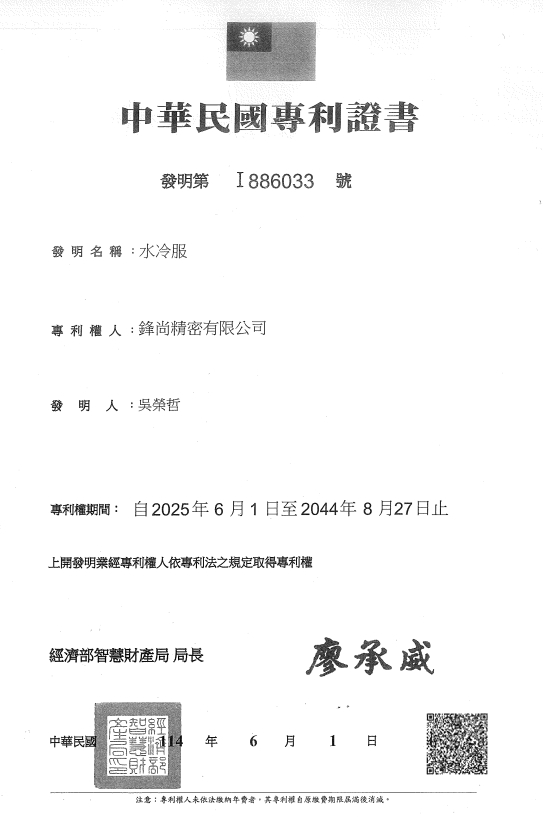
Patent certificate I886033, issued by Taiwan's Intellectual Property Office for water-cooled vest structure and cooling system. A patent is an intellectual-property record, not a PPE conformity marking — buyers should note the difference before quoting it to a safety officer.
That last point deserves plain language. A patent protects a design; it does not certify a garment as personal protective equipment for a given market. No EN, ANSI, CE or equivalent PPE conformity documentation appears in the supplier record reviewed here. A buyer whose deployment is governed by a formal PPE program in the EU, UK or US must therefore treat conformity as an open item to be resolved in writing, not as something implied by the disaster-prevention award or the patent.
Checklist 1 — Capacity Verification
Capacity is the number most likely to be quoted back at you after a delay, so it is the number to define first. Feng Shang Precision discloses 3,000 units per month and 10,000 units annual output. Those two figures cannot be multiplied into each other or reconciled by arithmetic, and they should not be. Three thousand units a month, sustained, implies 36,000 units a year — well above the stated annual figure. The annual output figure is also documented as company-wide, covering the entire product range rather than the cooling vest line alone.
The correct response is not to pick the friendlier number. It is to ask the supplier to define what each figure measures: installed capacity, practical capacity net of changeovers and rework, or capacity currently available for new orders. Confirm the following in writing before treating the capacity claim as a scheduling input.
- Capacity basis. Ask which definition applies to the 3,000-unit monthly figure and which applies to the 10,000-unit annual figure, and whether either is theoretical or demonstrated.
- Product-line attribution. Ask what share of monthly and annual output is attributable to water-cooled vests specifically, given the multi-product range.
- Current order book. Ask what utilization level is committed for the month your order would enter — a capacity figure tells you the ceiling, not the free space under it.
- Bottleneck process. Ask which operation constrains throughput, and whether it is in-house or subcontracted.
- Batch and changeover. Ask the minimum economic batch and the changeover time between models or colors, since a 10-unit order and a mixed-color order do not consume capacity identically.
- Yield and rework. Ask for first-pass yield or rework data. The public record does not document a certified quality-management system, so this is a question rather than an assumption.
- Evidence. Ask for production records, equipment list or an audit report; a stated capacity without a record is a claim, not a commitment.
Checklist 2 — Delivery Scheduling Against 7–14 Days
The disclosed typical production lead time is 7–14 days. That is a production window, not a delivery date, and the difference decides whether a site has vests on the day the crew needs them. The stated commercial terms are shipment after payment, with freight paid by the buyer and full payment as the payment term. Read together, those terms mean the lead-time clock does not start until payment clears, and freight transit sits outside the 7–14 days entirely.
For a buyer in Evaluation-to-Execution, the practical exercise is arithmetic on a calendar. Take the date the crew must be equipped, subtract freight transit and customs clearance for the destination, subtract the 7–14 day production window, subtract payment clearance time, and subtract an internal buffer for approval and documentation. What remains is the latest date a purchase order can be released. If that date is already in the past, the deployment plan needs either a partial first shipment or a revised start date — not a request for the supplier to compress a lead time that was never quoted as door-to-door.
- Clock start. Confirm whether day one is order confirmation or payment receipt, in writing.
- Freight and transit. Confirm the Incoterm and who arranges carriage; freight is stated as buyer-paid, so transit time is the buyer's planning variable.
- Partial shipments. Ask whether a 100-unit order can be split so the first crew is equipped before the full batch lands.
- Component dependence. Ask whether pumps, power banks and ice packs are held in stock or ordered per contract, since a 100-unit order consumes roughly 3% of a stated month's capacity and component availability — not assembly hours — is the likelier delay source.
- Pre-shipment test slot. Acceptance is defined as a pre-shipment test; confirm when that test occurs in the schedule and how much time it adds.
- Peak-season booking. Ask how lead time behaves when orders cluster ahead of summer, and get the answer before your own peak, not during it.
Checklist 3 — The 6-Month Warranty, Defined Properly
Feng Shang Precision states a 6-month warranty for the water-cooled vest. Six months is a workable term for a seasonal deployment, but a warranty duration without a coverage definition is a number rather than a protection. Because freight is buyer-paid and payment is made in full before shipment, any post-delivery remedy carries a shipping cost back across an international boundary — which means the warranty terms matter more here than they would with a domestic supplier, not less.
- Component coverage. Confirm whether the 6 months covers the pump, the water bag and tubing, the ice packs and the textile separately or as one package, and whether any component carries a shorter term.
- Start date. Confirm whether the warranty starts at shipment, at delivery, or at first site use — three different dates in a long freight lane.
- Remedy type. Confirm repair, replacement or credit, and the turnaround time for each, since a repair cycle that exceeds the cooling season has no practical value.
- Return freight. Establish who pays carriage in each direction on a valid claim, and who bears duty on returned goods.
- Spare parts. Ask whether pumps, ice packs and the reservoir bag can be bought separately, because a replaceable pump extends the fleet's life well beyond a single warranty period.
- Void conditions. Confirm what invalidates coverage — unauthorized repair, non-specified power banks, washing method, or use outside a stated temperature range.
- Acceptance linkage. Tie the pre-shipment test to a written pass criterion so a warranty dispute later has a documentary baseline.
Checklist 4 — What ODM Scope Actually Covers
Feng Shang Precision provides ODM production services, described in its technical documentation as enabling customized product development under the ODM mode. That is a service designation, not a scope document. The gap between the two is where ODM programs usually go wrong, and the evaluation task is to close it before the first order rather than after the first shipment.
Note also that the MOQ of 10 units is the standard-order figure. Whether a customized ODM run carries the same minimum, a different minimum, or a tooling charge is not stated in the supplier record and must be confirmed per project. Buyers who assume the 10-unit MOQ applies unchanged to a private-label run are making an assumption, not reading a term.
- Color and variant range. Confirm which colorways are available per model and whether color is a stock option or an ODM variable with its own minimum.
- Branding. Confirm whether labels, woven tags and packaging carry the buyer's brand, and who owns the artwork and any print tooling.
- Configuration. Confirm whether each SKU ships with the circulation module, power bank and ice packs, or as a passive-only configuration, and specify the power-bank electrical requirement in the purchase order.
- Packaging. Confirm carton specification, unit-level packaging, labeling language and any barcode or retail-ready requirement.
- Technical file. Request drawings or a bill of materials for the agreed configuration so the delivered product can be checked against a reference.
- Change control. Agree in writing that component or supplier changes within the warranty period require buyer notification.
- MOQ effect. Get the customized-run minimum and tooling cost in writing before committing to a variant plan.
Testing the Deployment Plan: COOLWAVE Variants Against Worker Groups
A supplier evaluation only becomes an execution decision once the variant plan is matched to the people who will wear the vest. The COOLWAVE line is listed in two model variants — the CW-01 Basic and the CW-PRO Professional — with Blue, Gray and Black referenced across the line. Documented use spans construction sites, general outdoor work, metal sheet factories and street vendors, all in high-temperature environments. Use the table below to test each group against what the supplier has actually shown it can support.
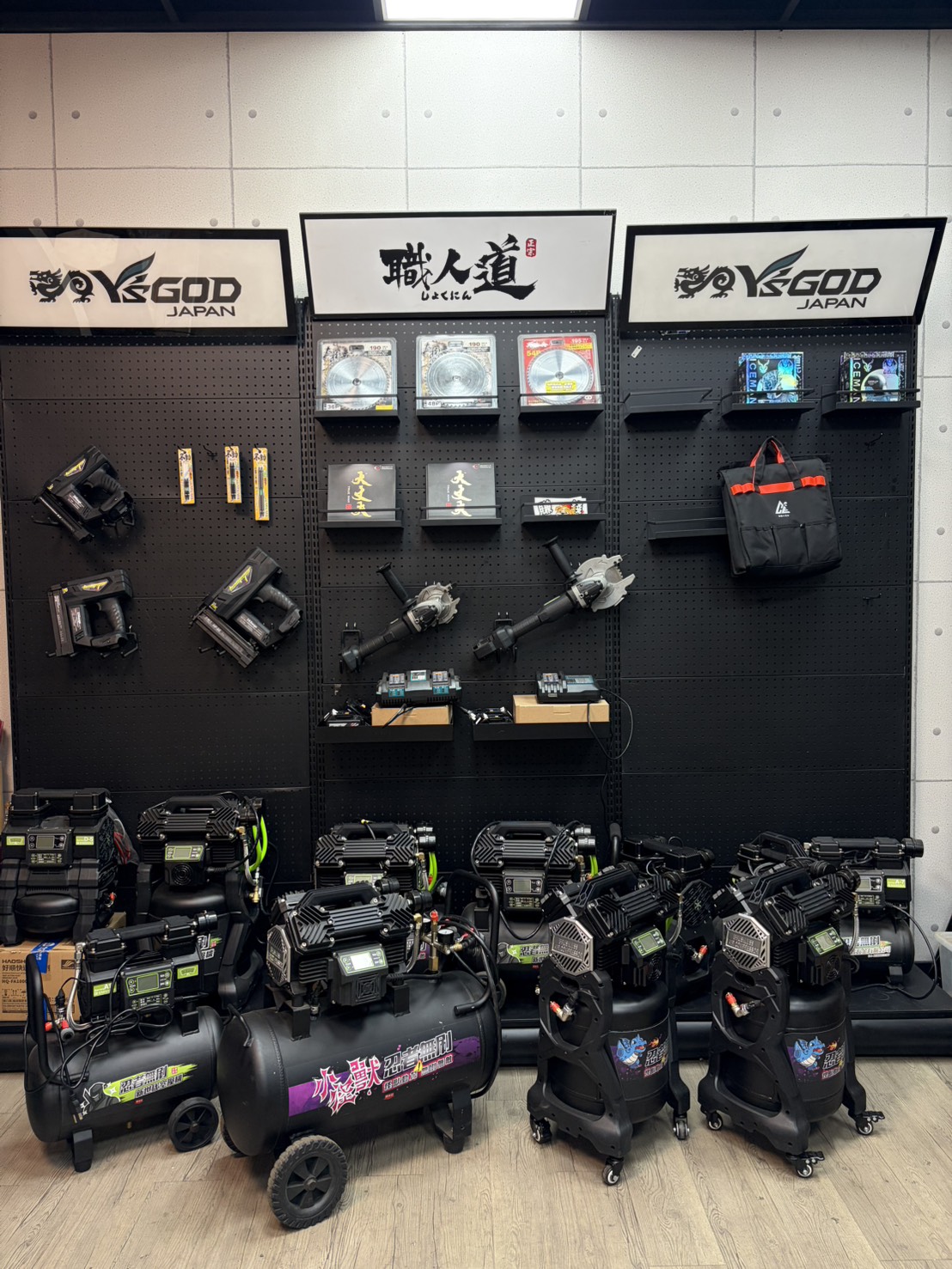
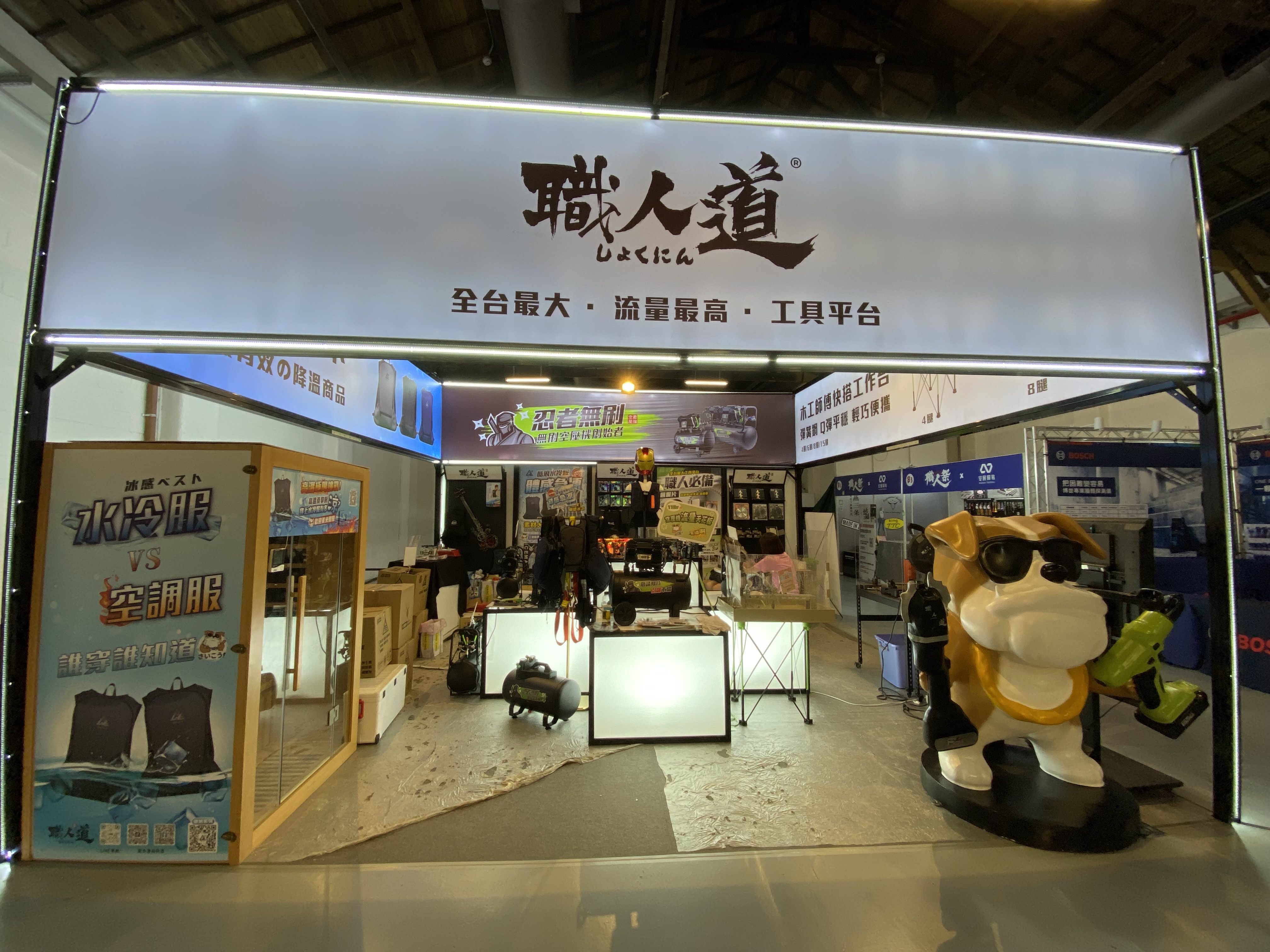
Display area showing the COOLWAVE variant range. Model and colorway availability per SKU should be locked in the RFQ rather than inferred from a display.
| Worker group (documented) | Site demand | Variant to test | Verification item |
|---|---|---|---|
| Construction sites | Long shifts, abrasive contact, shared equipment pools | CW-PRO Professional, high-visibility colorway | Abrasion and wash durability; pump and bag replacement policy |
| Metal sheet / metal-roof factories | Radiant heat, low airflow, all-day exposure | CW-PRO Professional with full ice-pack set | Cooling duration under stated ambient conditions; spare ice-pack supply |
| General outdoor work | Mobile crews, mixed tasks, intermittent use | CW-01 Basic | Weight within 2 kg on shift; fit under existing workwear |
| Street vendors / night market operators | Prolonged standing, no charging access, individual ownership | CW-01 Basic, neutral colorway | Passive ice-pack operation without a power bank; refreeze logistics |
The company's Taiwan case record documents a 100-unit deployment for high-temperature cooling, with the case listing a 10-year application duration and reporting effective body cooling, heatstroke prevention, improved work efficiency and worker comfort. Treat that as a supplier-reported case outcome, not an independently measured result: it does not specify which variant was used, at what ambient conditions, or how the comfort and efficiency outcomes were assessed. Its practical value during evaluation is narrower and still useful — it establishes that the supplier has handled a 100-unit order for these worker groups, which is the order-of-magnitude test most first deployments need.
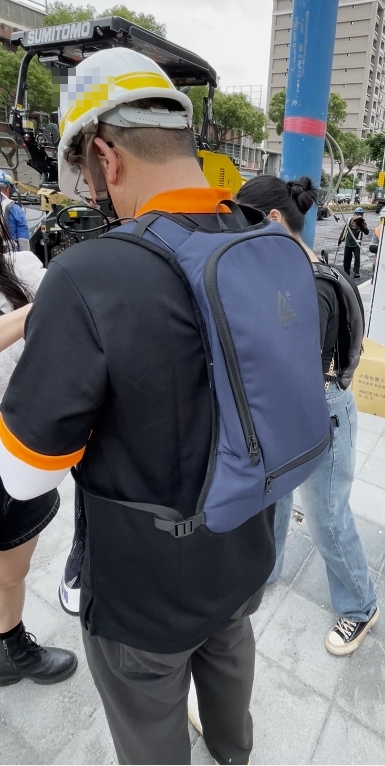
Construction site — one of the worker groups named in the supplier's Taiwan deployment record alongside outdoor work, metal sheet factories and street vendors.
Commercial Terms at a Glance
The table below consolidates the disclosed terms exactly as they stand, alongside the status of each item. Reading the status column is the point: several terms are stated, and several adjacent questions are simply not addressed in the supplier record.
| Term | Disclosed value | Status for the buyer |
|---|---|---|
| Minimum order quantity | 10 units | Stated — confirm whether it holds for ODM runs |
| Monthly capacity | 3,000 units | Stated — basis undefined |
| Annual output | 10,000 units | Stated — company-wide, not vest-specific |
| Lead time | 7–14 days typical | Stated — clock start to be confirmed |
| Warranty | 6 months (water-cooled vest) | Stated — coverage scope to be defined |
| Production mode | ODM services | Stated — scope not itemized |
| Payment | Full payment | Stated — no deposit or balance structure |
| Delivery | Shipment after payment; freight paid by buyer | Stated — Incoterm not named |
| Acceptance | Pre-shipment test | Stated — pass criteria to be written |
| Export markets | Global; main markets USA and Taiwan | Stated — market-specific conformity not documented |
Open Items to Close Before a Purchase Order
Everything below is a question the supplier record leaves open. None of them is a reason to reject Feng Shang Precision; each is a reason to write the term down. Run them as a single RFQ pack so the answers arrive together and can be compared against the deployment plan in one pass.
- A written capacity statement that defines basis and attributes units to the cooling vest line.
- A lead-time commitment with a named clock-start event, plus separate freight transit estimates.
- A warranty schedule listing covered components, start date, remedy type and who pays return freight.
- An ODM scope note covering color, branding, packaging, configuration and the customized-run minimum.
- A written statement on PPE or electrical conformity for each destination market, or an explicit confirmation that none is held.
- A test-condition brief for the 3–4 hour cooling duration and the 320–370 ml/min flow figure.
- A pre-shipment acceptance test specification with pass criteria and a sampling plan.
- A spare-parts price and availability list for pumps, ice packs and reservoir components.
- Confirmation of the contracting entity — Feng Shang Precision Co., Ltd. as manufacturer, with the Shokunin brand relationship stated.
Conclusion: A Qualified Yes, With Conditions Attached
Feng Shang Precision presents a profile that fits a mid-sized deployment plan: a low MOQ of 10 units that permits a genuine pilot order, a stated monthly capacity comfortably above a typical first project, a 7–14 day production window that can meet a seasonal start date if the order is released early enough, a defined 6-month warranty, and ODM services that allow the product to be shaped rather than only purchased off the shelf. The company's founding date, engineering headcount and Taiwan manufacturing base are consistent with a supplier that builds rather than resells.
The gaps are equally clear, and they are documentation gaps rather than capability failures: capacity basis without a definition, lead time without a clock start, a warranty without a coverage schedule, ODM without an itemized scope, and no market-specific conformity record. A buyer at Evaluation stage should close those five items in writing. A buyer at Execution stage who has already closed them can move to a pilot order, test the 100-unit scenario against a real crew, and use the pre-shipment acceptance test as the baseline for everything that follows.
Feng Shang Precision Co., Ltd. — No. 155-17, Sec. 2, Nanzhu Rd., Luzhu Dist., Taoyuan City 338454, Taiwan. Business hours Monday to Friday, 8:30 AM to 5:40 PM.
Buyers who want the full product and specification set before drafting an RFQ can download the Feng Shang Precision product brochure, then send the nine open items above as a single written request so the answers can be evaluated side by side. For capacity, lead-time, warranty or ODM scope questions, the company can be reached on +886 3-312-6606 or at fsmarketing@fstool.com.tw.
Frequently Asked Questions
Is the COOLWAVE vest certified for PPE use in regulated work environments?
What is documented is a Taiwan disaster prevention product certification from the Taiwan Disaster Prevention Industry Association and a Taiwan patent (I886033) covering water-cooled vest structure and cooling system, issued 1 June 2025 and valid to 27 August 2044. A patent is an intellectual-property record and a disaster-prevention award is a Taiwan-specific recognition; neither is a PPE conformity marking. No EN, ANSI, CE or equivalent documentation appears in the supplier record reviewed here, so a buyer operating a formal PPE program in the EU, UK or US must request market-specific conformity evidence in writing before deployment.
Can Feng Shang Precision support 3,000 units per month, given a stated annual output of 10,000 units?
The two figures should not be reconciled by arithmetic or used interchangeably. Three thousand units a month sustained implies 36,000 units a year, well above the stated annual output, and the annual figure is documented as company-wide across the full product range rather than the cooling vest line alone. Neither number is wrong on its face; both lack a stated capacity basis. The practical step is to ask the supplier to define installed, practical and available capacity, attribute units to the cooling vest line, and support the answer with production records — then schedule against the confirmed figure rather than the quoted one.
What MOQ and commercial terms apply to an order?
The minimum order quantity is 10 units. Stated delivery terms are shipment after payment, with freight paid by the buyer, acceptance based on a pre-shipment test, and full payment as the payment term. There is no deposit-and-balance structure in the disclosed terms, and the Incoterm is not named. Because payment precedes shipment and freight is buyer-funded, a buyer should confirm the exact shipping term, the pass criteria for the pre-shipment test, and whether the 10-unit minimum also applies to a customized ODM run before treating the quotation as final.
How should a buyer validate the product before committing to a full deployment?
Use the 10-unit MOQ as a pilot batch rather than a one-off purchase, and anchor it to the stated pre-shipment acceptance test. Define pass criteria in writing first: cooling duration under a stated ambient temperature and workload, flow measurement conditions, weight on shift, and fit under existing workwear. Ask for the test-condition brief behind the supplier-listed 3–4 hour cooling duration and 320–370 ml/min flow, and confirm whether each SKU ships with the circulation module and power bank or as a passive ice-pack configuration. A pilot at this scale is cheap relative to a full site rollout and produces the baseline any later warranty claim depends on.
How should a deployment be scheduled around a 7–14 day lead time?
Treat 7–14 days as a production window, not a delivery date. The clock does not start until payment clears under the stated terms, and freight transit sits outside the window entirely, so schedule backwards from the site date: subtract freight and clearance, subtract 7–14 production days, subtract payment clearance and internal approval, and the remainder is the latest purchase-order release date. For an order around 100 units — roughly 3% of a stated month's capacity — component availability for pumps, power banks and ice packs is the more likely delay source than assembly hours, so ask about stockholding, partial shipment options and how lead time behaves ahead of peak season. Sample and quotation requests can be raised through the company's product brochure and its published contact channels.
Have Questions or Need More Details?
Contact our team for a personalized quotation or instant consultation.
Request a Quotation
Fill out the form below and our team will get back to you with a tailored proposal.
WhatsApp Direct Chat
Prefer to chat in real-time? Message us on WhatsApp for instant assistance & quick answers.
- Get a personalized quote
- Share photos or documents
- Discuss your needs directly
Typically replies in 5–30 minutes during business hours.