
What Is a Construction Cooling Vest? Water-Circulation Technology and Heatstroke Prevention Basics
A construction cooling vest is a wearable personal cooling device that removes heat from the torso during hot-weather work. In the water-circulation type, a small pump moves chilled water from a water bag through a tube loop built into the vest, and the water absorbs heat from the wearer before returning to the bag. The COOLWAVE Water-Circulation Cooling Vest, an industrial PPE product from Shokunin (Feng Shang Precision Co., Ltd., Taiwan), is one representative example: its published specification lists a cooling duration of 3–4 hours, a system weight within 2 kg, and a pump rated at 5V 150 mA (max) with a flow rate of 320–370 ml/min.
This explainer is written for safety managers and procurement teams who are new to cooling apparel. It defines what the category is, how the water-circulation principle works, which structural components make up a vest, how the equipment runs through a shift, and which specification and compliance facts should be confirmed before a site standardises on one product.
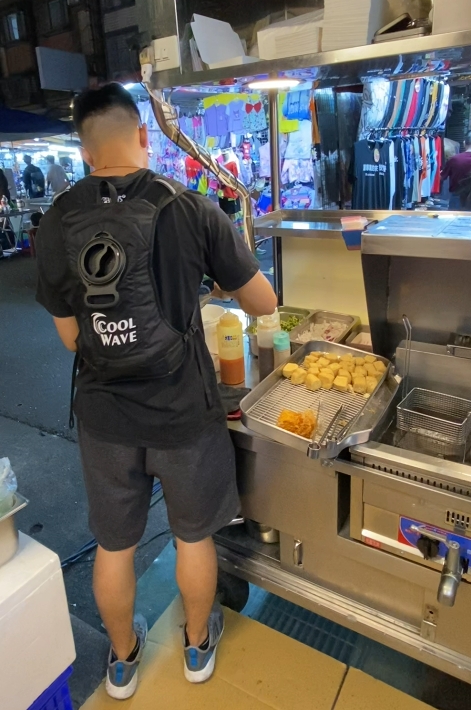
Water-circulation cooling vests are worn by people who work through heat rather than around it — including street vendors, construction crews and outdoor operators.
Problem definition: heat on site is a PPE decision, not only a weather problem
Construction heat exposure is not simply a question of outdoor temperature. NIOSH identifies outdoor operations such as construction as likely to cause heat stress, particularly where workers wear semi-permeable or impermeable protective clothing. OSHA makes the same point from the equipment side: respirators, impermeable clothing and head coverings can themselves increase the risk of heat-related illness. The protective equipment a site requires can therefore add to the heat burden the worker already carries.
Occupational guidance also sets an expectation that equipment will be provided when exposure is high. NIOSH states that where heat stress levels exceed the NIOSH recommended occupational exposure limit, some form of heat-protective clothing or equipment should be provided. That is not a mandate for a cooling vest specifically, but it places personal cooling inside the scope of a heat-illness prevention program rather than outside it.
The scale of the problem explains why the category exists. A 2026 compliance guide on the OSHA heat standard reports that construction workers account for about half of heat-related workplace fatalities in the U.S., and summarises the proposed rule's triggers as water and shade at 80 °F and 15-minute breaks every two hours at a 90 °F heat index. That rule is described as proposed rather than final, so those figures are best read as a planning signal for where heat programs are heading, not as an enforceable threshold today.
For a safety manager, the practical question therefore changes. It is rarely “do we need cooling?” It is “which cooling method survives our shift length, our PPE stack and our site infrastructure?” Answering that requires understanding the technology, not just the product name.
Industry background: where water circulation sits among cooling options
Personal cooling is a defined occupational category rather than a comfort accessory. NIOSH groups wearable heat-protection equipment into auxiliary cooling systems or personal cooling systems, and lists water-cooled garments, air-cooled garments, cooling vests and wetted overgarments among them. OSHA's heat guidance gives concrete device examples: vests receiving cooled air from a vortex tube, and vests with reusable ice packs or phase-change cooling packs.
Published guidance also sets expectations by technology type, and those expectations matter more than marketing claims when a buyer is screening options:
- Ice-pack cooling is time-limited. OSHA states that the cooling offered by ice packets lasts 2 to 4 hours at moderate to heavy heat loads, and that frequent replacement is necessary.
- Circulating-air systems are capable but demanding. OSHA describes circulating air as highly effective and also the most complicated personal cooling system, particularly when used with impermeable garments or double cotton overalls.
- Cooling effects are directional, not guaranteed. NIOSH notes that cooling vests may enable workers to work for longer periods, while adjustments are needed when additional protective gear is worn. A NIOSH research summary reports that participants wearing vests fitted with ice packs, phase-change materials or water hoses under PPE showed fewer signs of heat stress than participants without cooling devices; that summary does not publish the underlying study design, so it supports direction rather than a quantified performance claim.
- Demand is expanding. Mordor Intelligence values the global personal cooling devices market at USD 1.42 billion in 2025 and projects USD 3.77 billion by 2032.
Water circulation sits between the passive ice-pack category and the powered air-cooled category. It uses ice packs as the heat sink, as an ice vest does, but distributes the cooling through water moved by a small electric pump instead of relying on static packs held against the body. That changes the maintenance story: the buyer is no longer only buying and freezing packs, but also looking after a water bag, a tube loop and a pump.
What is inside a water-circulation cooling vest
Shokunin is a professional tool brand of Feng Shang Precision Co., Ltd., a Taiwan-based manufacturer founded in 2009 with a 1,000 m² facility, 30 employees, an annual output of 10,000 units and a five-engineer R&D team, exporting roughly 50% of output to the USA and ROC markets. Its COOLWAVE Water-Circulation Cooling Vest is one representative industrial PPE product in this category, offered as a Basic Model and as Professional Models in Blue, Gray and Black with the same published core specification.
The structure can be understood in plain language as seven parts:
- Vest body — PEVA. The garment the wearer puts on; the cooling tube runs across it against the torso.
- Water bag — TPU with a polypropylene cap. Holds the water that carries the cold from the ice packs to the body.
- Cooling tube — black sand rubber. The path the water travels while it is circulating.
- Pump — 5V, 150 mA maximum; flow rate up to 320–370 ml/min. Drives continuous circulation while the vest is running.
- Backpack. Carries the water bag and pump on the back so the liquid weight is not carried on the shoulders alone.
- Shoulder straps — 600D polyester, adjustable. The published configuration is one-size-fits-all.
- Ice packs — two supplied per unit. The reusable heat sink that chills the water in the bag.
Published specification of the COOLWAVE water-circulation vest
| Specification item | Published value |
|---|---|
| Product / models | COOLWAVE Water-Circulation Cooling Vest (Basic Model); Professional Models in Blue, Gray and Black |
| Type | Industrial cooling apparel / personal protective equipment (PPE) |
| Cooling duration | 3–4 hours |
| Weight | Within 2 kg |
| Suitable temperature (as published) | Below 10 °C |
| Pump output | 5V 150 mA (max) |
| Flow rate | Max 320–370 ml/min |
| Vest body material | PEVA |
| Water bag | TPU, with polypropylene cap |
| Cooling tube | Sand rubber (black) |
| Shoulder strap material | 600D polyester |
| Contents per unit | Water-cooled vest backpack ×1, ice packs ×2 |
| Intended industries | Construction workers, outdoor workers, food stall operators, street vendors, traffic controllers, metal sheet factories |
| Patent | ROC patent certificate I886033, Intellectual Property Office, Ministry of Economic Affairs |

The system is a vest, a water bag, a tube loop, a pump in a backpack, and two reusable ice packs — a total system weight within 2 kg.
Step-by-step: running the vest through a working shift
Understanding the principle is easy; planning around it is where safety managers add value. The sequence below follows the published components and duration.
Step 1 — Prepare the heat sink. Chill the two reusable ice packs supplied with each unit. The ice packs are the cooling source; without them the loop only moves water at ambient temperature.
Step 2 — Fill the water bag. Fill the TPU water bag and close it with the polypropylene cap. Water is the transport medium, so the bag has to be filled before the pump has anything to circulate.
Step 3 — Assemble the backpack. Place the water bag and pump into the water-cooled vest backpack and connect the black sand-rubber cooling tube.
Step 4 — Wear and adjust. Put on the vest, then adjust the 600D polyester shoulder straps so the tube path sits flat against the torso. The published one-size-fits-all configuration and the within-2-kg system weight keep this step short, but the straps still need to be set for each wearer.
Step 5 — Start circulation. Switch on the pump. At 5V and 150 mA maximum, the pump delivers up to 320–370 ml/min of flow, which is what makes the cooling continuous rather than localised.
Step 6 — Plan the changeover. The published cooling duration is 3–4 hours, so a shift longer than that window needs a re-chill plan for the ice packs and a place to store spares. This is the single planning item that most often decides whether a cooling program works in practice or only on paper.
Use cases: where this category is actually deployed
Water-circulation vests are specified where heat is continuous and where the wearer cannot simply step out of it. The published applicable industries for the COOLWAVE vest are construction workers, outdoor workers, food stall operators, street vendors, traffic controllers and metal sheet factories.
Construction and outdoor work. Ground crews, roofing and long-exposure outdoor tasks combine radiant heat with required PPE — the combination NIOSH highlights as a heat-stress risk. Here the vest functions as personal cooling inside an existing heat-illness prevention program, not as a replacement for water, shade and work-rest cycles.
Metal sheet and metal-roof workplaces. Enclosed or metal-roofed buildings trap heat and offer little air movement. In these settings the backpack-based design keeps the water weight off the shoulders and the tube loop delivers cooling along the torso while the wearer keeps working.
Street vending, food stalls and traffic control. These roles involve standing in sun for hours with no shaded recovery area. The adjustable one-size-fits-all configuration matters here, because one vest may be shared across shifts and wearers.
What operators report. Shokunin's own case record describes a Taiwan deployment of 100 units in high-temperature environments, in use for 10 years, with reported outcomes of effective body cooling, heatstroke prevention, improved worker comfort and improved work efficiency. Those results are company-reported rather than independently measured, so treat them as a reference point to test against, not as a performance guarantee.
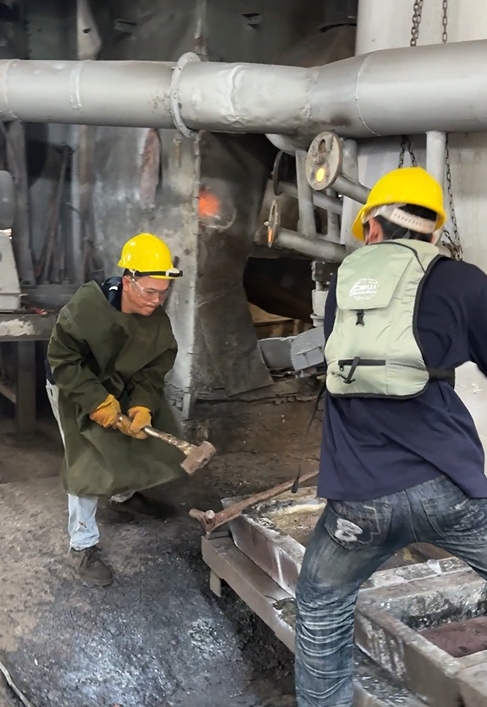
Metal sheet factories and metal-roof workplaces are a core use case: continuous heat, limited airflow, and PPE that adds to the heat burden.
Comparison table: how the main cooling approaches differ
| Approach | Cooling mechanism | Published duration reference | Replenishment and infrastructure |
|---|---|---|---|
| Ice-pack vest | Reusable ice packs held against the body | 2–4 hours at moderate to heavy heat loads (OSHA) | Frequent replacement of packs required (OSHA) |
| Phase-change (PCM) vest | Phase-change cooling packs | Not stated in the cited guidance | Pack re-conditioning between uses (OSHA lists the device type) |
| Air-cooled / vortex vest | Cooled air delivered from a vortex tube | Not stated in the cited guidance | Requires a compressed-air supply; OSHA describes circulating air as highly effective and also the most complicated personal cooling system |
| Water-circulation vest (COOLWAVE) | Ice packs chill water that a pump circulates through a tube loop | 3–4 hours (product specification) | Two reusable ice packs per unit, water bag refill, pump at 5V 150 mA (max), flow up to 320–370 ml/min |
Compliance and specification checks before you buy
Two documented credentials support the COOLWAVE vest, and both are worth reading precisely.
Patent. The COOLWAVE Water-Circulation Cooling Vest is protected under the Patent Act of the Republic of China by patent certificate number I886033, issued by the Intellectual Property Office of Taiwan's Ministry of Economic Affairs. The certificate carries an issue date of 1 June 2025 and an expiry date of 27 August 2044, and its scope covers the water-cooled vest structure and cooling system. It applies to the ROC market.
Disaster-prevention recognition. The company's water-cooled vest, marketed as COOLING, has received the Disaster Prevention Product and Service Certification Award from the Taiwan Disaster Prevention Industry Association. The product is described as designed for outdoor and high-temperature environments.
What these credentials do and do not cover matters for procurement. They document structural protection and disaster-prevention recognition in Taiwan. They do not, by themselves, certify compliance with every destination market's PPE requirements, and the available data does not contain a verified product-specific conformity assessment for other jurisdictions. Buyers exporting or reselling the product should therefore close three questions with the supplier before standardising: which test conditions produced the 3–4 hour duration figure; what operating envelope sits behind the published suitable temperature; and how the vest integrates with the site's mandatory PPE, since OSHA notes that additional protective equipment can add heat burden and NIOSH notes that adjustments are needed when extra gear is worn.
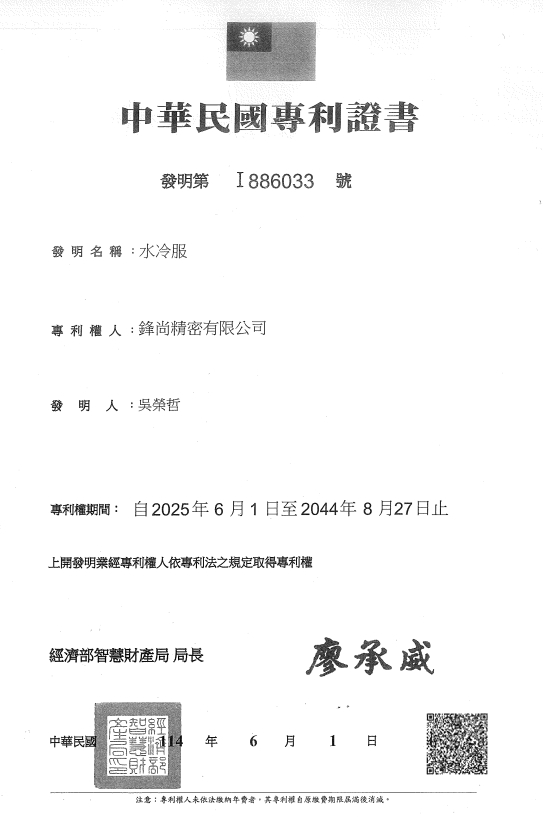
Patent certificate I886033 covers the water-cooled vest structure and cooling system and applies to the ROC market.
FAQ: specification, compliance and order questions
What certifications and intellectual property support the COOLWAVE water-circulation cooling vest?
Two credentials are documented. The vest is protected by patent certificate I886033, issued by the Intellectual Property Office of Taiwan's Ministry of Economic Affairs under the Patent Act of the Republic of China, with an issue date of 1 June 2025 and an expiry date of 27 August 2044; the protected scope is the water-cooled vest structure and cooling system, and the certificate applies to the ROC market. Separately, the company's COOLING water-cooled vest has received the Disaster Prevention Product and Service Certification Award from the Taiwan Disaster Prevention Industry Association. Both are Taiwan-scoped credentials.
What technical specifications are published for the vest?
Cooling duration 3–4 hours; system weight within 2 kg; suitable temperature published as below 10 °C; pump output 5V 150 mA (max); flow rate max 320–370 ml/min. Materials are a PEVA vest body, a TPU water bag with polypropylene cap, a black sand-rubber cooling tube and 600D polyester shoulder straps. Each unit ships with one water-cooled vest backpack and two ice packs.
What are the ordering terms — MOQ, capacity, lead time and warranty?
The published supplier data lists a minimum order quantity of 10 units, a monthly capacity of 3,000 units, a lead time of 7–14 days, ODM production mode, and a 6-month warranty on the water-cooled vest. No list price is published in the available product data, so pricing has to be confirmed by quotation for the specific model, quantity and destination.
Can we evaluate the vest before committing to a full rollout?
The 10-unit minimum order quantity makes a pilot feasible. Shokunin's case record describes a Taiwan deployment of 100 units in high-temperature environments with reported outcomes of effective body cooling, heatstroke prevention and improved worker comfort. Because the duration and temperature figures are published without stated test conditions, a pilot should record ambient temperature, humidity, workload, PPE layers and actual runtime per ice-pack set, so the result can be compared against the specification.
What should we plan for lead time and long-term support?
Lead time is published at 7–14 days against a monthly capacity of 3,000 units, and the vest carries a 6-month warranty. The two ice packs are reusable, but replacement stock should still be planned for multi-season programs, alongside a re-chill routine that matches the 3–4 hour cooling duration. To move from evaluation to a site trial, the specification sheet, patent record and full product catalogue are available in the Shokunin product brochure, and a quotation can be requested directly.
Conclusion: three facts to hold onto
A construction cooling vest is a defined piece of personal cooling equipment, and the water-circulation version works by pumping chilled water from a water bag through a tube loop in the vest rather than by holding static packs against the body. Three facts are worth keeping from this explainer.
First, the principle is simple and the specification is public: 3–4 hours of cooling, a system weight within 2 kg, a 5V 150 mA pump and a 320–370 ml/min flow rate, in a build of PEVA, TPU, 600D polyester and a sand-rubber tube. Second, the technology choice is a replenishment choice — OSHA's 2–4 hour ice-pack reference and the 3–4 hour water-circulation specification both point to the same planning requirement: someone has to own the re-chill cycle. Third, compliance has a scope: patent I886033 and the Taiwan disaster-prevention award are documented and verifiable, and they should be read alongside, not instead of, your own market's PPE requirements.
Next step: check the specification against your site
Review the full component list, materials and order terms, then request a quotation or a pilot-unit arrangement for your own heat conditions.
Download the Shokunin catalogue (PDF)Shokunin · Feng Shang Precision Co., Ltd. · www.fstool.com.tw · fsmarketing@fstool.com.tw
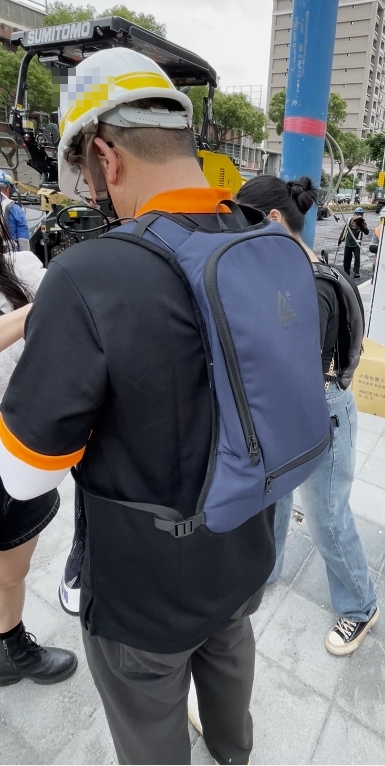
Construction sites remain the primary application: high radiant heat, required PPE, and shifts that outlast a single ice-pack set.
Have Questions or Need More Details?
Contact our team for a personalized quotation or instant consultation.
Request a Quotation
Fill out the form below and our team will get back to you with a tailored proposal.
WhatsApp Direct Chat
Prefer to chat in real-time? Message us on WhatsApp for instant assistance & quick answers.
- Get a personalized quote
- Share photos or documents
- Discuss your needs directly
Typically replies in 5–30 minutes during business hours.