
Water-Circulation Cooling Vests 101: How the COOLWAVE Dual Cooling Water Cooling Vest Works
Water-Circulation Cooling Vests 101: How the COOLWAVE Dual Cooling Water Cooling Vest Works
A dual cooling water cooling vest is industrial cooling apparel that removes body heat through two cooling sources working together: chilled water circulating through tubing built into the vest, and ice packs that keep that water cold. The COOLWAVE Water-Circulation Cooling Vest is made by Shokunin, the professional e-commerce brand of Taiwan-based Feng Shang Precision Co., Ltd. It runs a 5 V / 150 mA pump at a maximum flow rate of 320–370 ml/min, delivers 3–4 hours of cooling, weighs within 2 kg, and ships as a set containing one water-cooled vest backpack and two ice packs. This 101 guide explains the category, the mechanism, the materials, and the points buyers check before adding it to a shortlist.
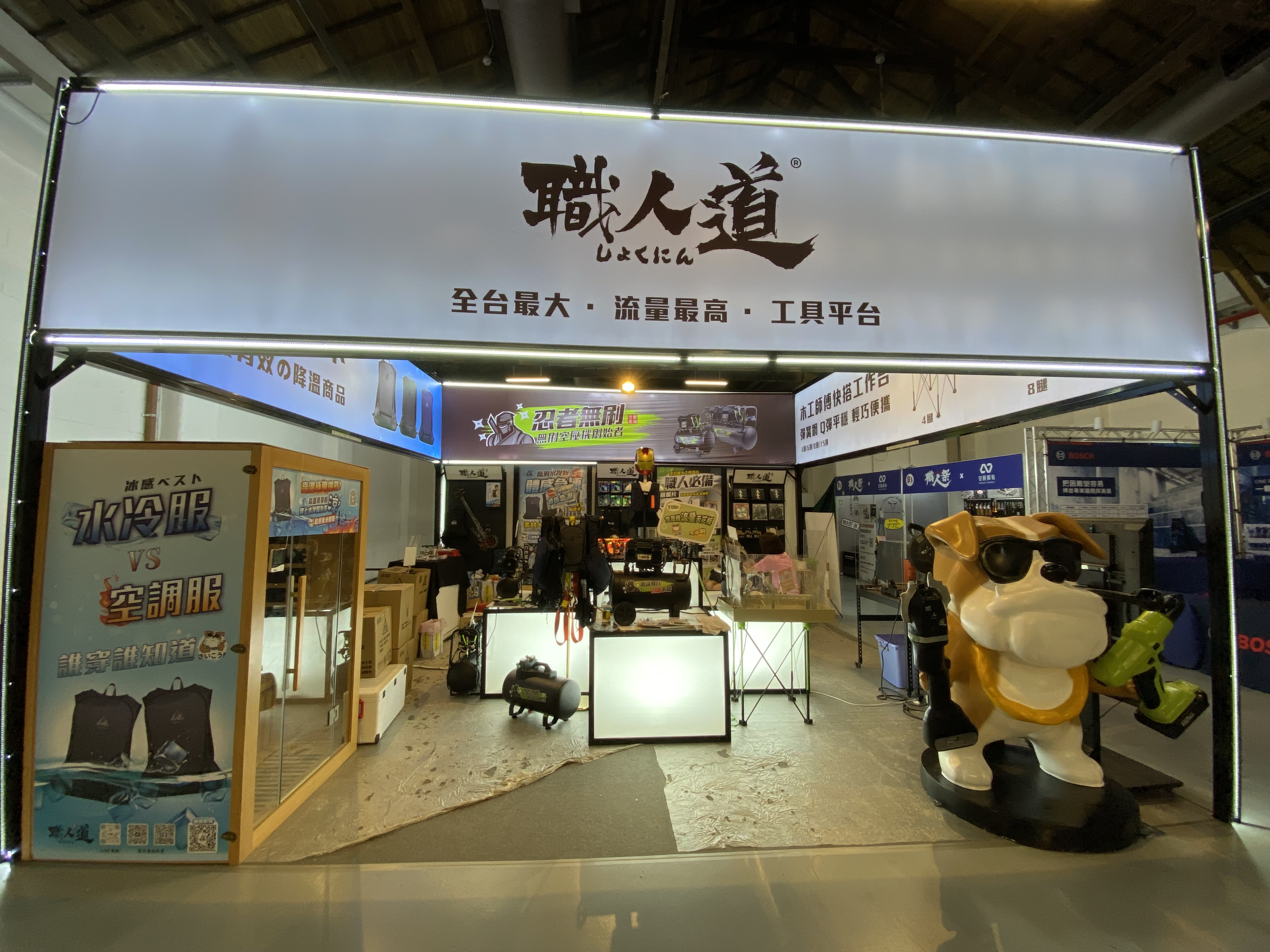
Problem Definition: What Standard PPE Cannot Do
Standard personal protective equipment is built to block a hazard, not to remove heat. A helmet, a high-visibility vest, a long-sleeved work shirt, or a welding layer all reduce airflow against the skin. In direct sun or radiant heat, that trapped heat has nowhere to go, and the worker keeps accumulating it for the length of the shift.
The practical problem is not the first hour. It is hour four, when a worker in a metal sheet factory, a traffic control post, or a night market stall has already absorbed heat and still has tasks to finish. Two cooling approaches exist in the market:
- Passive ice-pack cooling. Ice packs sit against the body, require no power source, and depend entirely on the pack still being frozen.
- Pump-driven water circulation. A small pump moves chilled water through a closed loop of tubing inside the vest, so the cold is distributed across the torso instead of sitting in one spot.
Dual cooling water cooling vests combine both. Ice packs act as the cold reservoir; the pump turns that reservoir into a moving coolant loop. If the pump is not running, the ice packs still provide passive cooling — the passive mode is documented as a feature of this product, alongside the powered circulation mode.
Industry Background: Cooling Apparel Is Now a Procurement Line
Cooling apparel has moved from a summer accessory to a budgeted item in industrial procurement. According to Market Research Future, the global personal cooling device market was valued at USD 25.16 billion in 2024 and is projected to reach USD 94.85 billion by 2035. The narrower cooling vest segment is smaller but growing in the same direction: Dataintelo values it at approximately USD 215 million in 2024, projected to reach USD 385 million by 2033.
Growth is not evenly spread. Spherical Insights identifies Asia Pacific as the fastest-growing region for cooling vests, driven by rapid industrialization and large outdoor work populations. Within the category, Dataintelo reports that industrial applications — including construction and manufacturing — held the largest market share in 2025 at 34.5%. On the technology side, the same source notes that Phase Change Material (PCM) vests captured 28.7% of market share in 2025 and represent the fastest-growing technology segment, while Strategic Market Research observes that active circulatory mechanisms such as ice water circulation are increasingly deployed in industrial sectors to mitigate occupational heat stress.
The competitive landscape is established. Spherical Insights lists key global participants in cooling vests as Techniche International, Glacier Tek, Polar Products Inc., and Ergodyne. For buyers, this matters for a simple reason: the category is no longer experimental, so evaluation criteria — cooling duration, weight, materials, power draw, and documented compliance — can be compared directly rather than judged on marketing language.
How the COOLWAVE Dual Cooling Water Cooling Vest Works
The COOLWAVE Water-Circulation Cooling Vest (Basic Model) is classified as industrial cooling apparel and as personal protective equipment (PPE). Its mechanism is a closed water loop, and every part of that loop is specified by material.
The water loop and its materials
- Water bag — TPU. The TPU water bag holds the chilled water that the pump circulates.
- Water bag cap — polypropylene. The polypropylene cap closes the reservoir, so the loop can be filled and sealed.
- Cooling tube — sand rubber (black). The sand rubber cooling tube carries chilled water across the body and returns it to the bag.
- Vest material — PEVA, with a 600D polyester shoulder strap. The 600D polyester shoulder strap carries the weight of the loaded backpack across the shoulders rather than the neck.
The pump and the flow rate
The circulation is powered by a pump rated at 5 V / 150 mA (max). Flow rate is specified at a maximum of 320–370 ml/min. In practice, flow rate is the number that separates a circulating vest from an ice vest: it determines how quickly chilled water is exchanged between the reservoir and the tubing. Because the pump is a low-voltage DC unit, this class of gear is often searched as a power-bank cooling vest, a portable cooling vest, or an ice water circulation cooling vest.
Duration, weight, and what is in the box
Cooling duration is specified at 3–4 hours, and total weight stays within 2 kg. The product is supplied as a complete set: water-cooled vest backpack ×1 and ice packs ×2. The practical consequence of that package is that a single unit does not require a separate purchase to start a cooling cycle — two ice packs are included, so one set can be in use while the other is refreezing.
| Specification | COOLWAVE Water-Circulation Cooling Vest (Basic Model) |
|---|---|
| Product type | Industrial Cooling Apparel / Personal Protective Equipment (PPE) |
| Cooling duration | 3–4 hours |
| Weight | Within 2 kg |
| Suitable temperature | Below 10 °C |
| Pump output | 5 V 150 mA (max) |
| Flow rate | Max 320–370 ml/min |
| Water bag material | TPU |
| Water bag cap | Polypropylene |
| Cooling tube | Sand rubber (black) |
| Shoulder strap material | 600D polyester |
| Vest material | PEVA |
| Contents | Water-cooled vest backpack ×1, ice packs ×2 |
| Typical industries | Construction workers, outdoor workers, food stall operators, street vendors, traffic controllers, metal sheet factories |
Step-by-Step Breakdown: One Cooling Cycle From Prep to End of Shift
The workflow below follows the components listed in the product specification and the way the dual cooling system is designed to be used.
- Prepare the ice packs. The two included ice packs are the cold reservoir. Cooling performance and duration depend on the packs being properly frozen before the shift starts.
- Fill the water bag. Open the polypropylene cap and fill the TPU water bag. The specification lists a suitable temperature below 10 °C, so the water and the ice packs are prepared as a chilled system rather than filled at ambient temperature.
- Seal and load the backpack. Close the cap firmly and place the bag into the water-cooled vest backpack. A sealed loop is what keeps the pump circulating water instead of air.
- Connect the sand rubber cooling tube. Route the black sand rubber cooling tube through the vest so it sits against the torso. Even distribution is the point of circulation.
- Fit the vest and adjust the 600D polyester shoulder straps. The shoulder strap carries the loaded backpack. Adjusting it before the shift prevents the loop from shifting while the worker bends, reaches, or walks.
- Choose the cooling mode. Start the 5 V / 150 mA pump for active circulation at a maximum flow of 320–370 ml/min, or leave the pump off and run the vest on ice packs alone as a passive cooling mode that requires no power.
- Rotate ice packs across long shifts. With a 3–4 hour cooling duration, a second set of frozen packs extends coverage past a single cycle. The included pair allows one set to be in use while the other refreezes.
- Drain and dry after use. Empty the TPU water bag, dry the loop and the polypropylene cap, and store the vest flat so the sand rubber tube does not kink between shifts.
Use Cases: Where the Vest Fits on Site
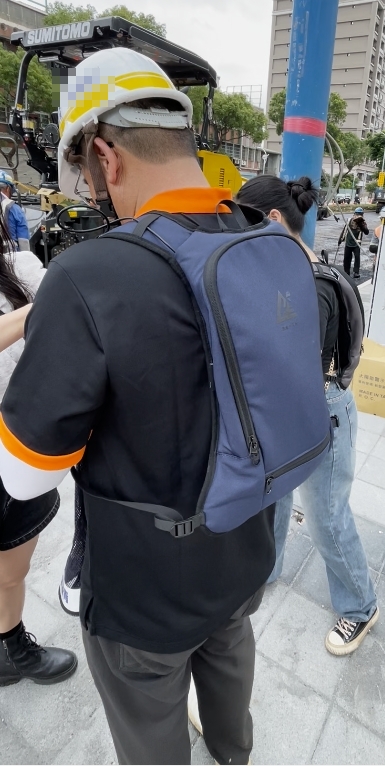
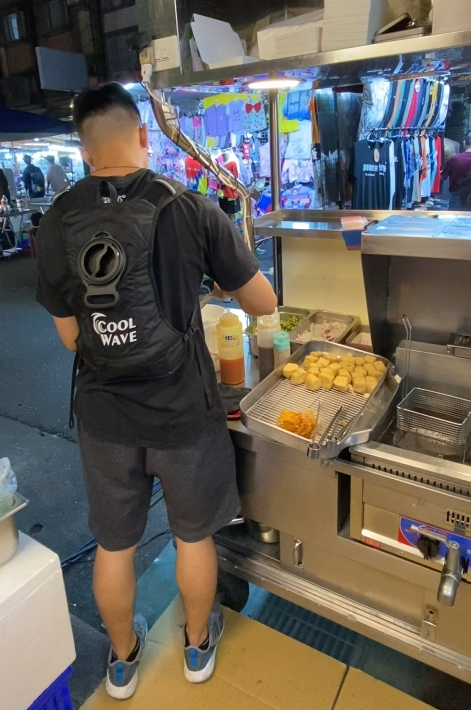
The applicable industries listed for the COOLWAVE Water-Circulation Cooling Vest are construction workers, outdoor workers, food stall operators, street vendors, traffic controllers, and metal sheet factories. Each of these settings applies a different constraint to cooling gear.
Construction and outdoor work
Site work combines direct sun, radiant heat from surfaces, and continuous movement. The 600D polyester shoulder strap and a total weight within 2 kg matter here, because a cooling vest that shifts or drags gets removed before the shift ends.
Traffic control
Traffic controllers stand in position rather than move between shaded areas. A circulating loop distributes cooling across the torso, which suits long stationary exposure better than a single ice pack resting in one place.
Metal sheet factories
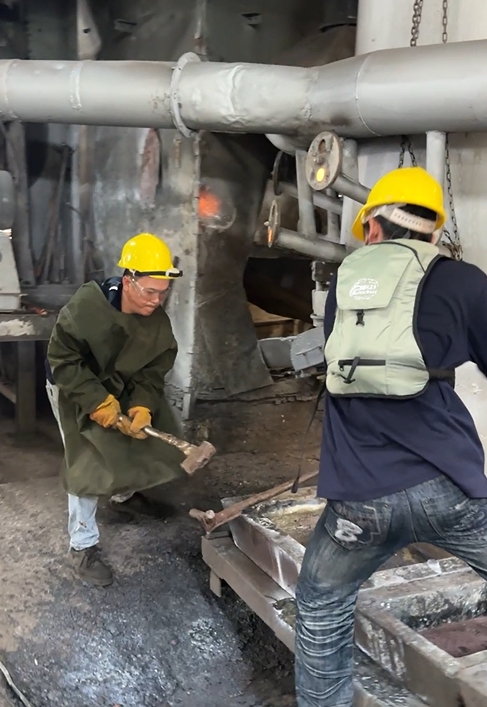
Metal sheet and metal-roof environments add radiant heat to ambient heat. The applicable-industry list explicitly includes metal sheet factories, where cooling is a heat-stress control measure rather than a comfort item.
Street vending, food stalls, and night markets
Vendors work next to heat sources — grills, fryers, and cooking equipment — for the full trading window. The passive mode is useful when a power source is not convenient, and the powered mode adds circulation when the work session is long.
Comparison Table: Ice Packs, Water Circulation, and PCM
Buyers evaluating cooling apparel are usually choosing between three mechanisms. The table below uses only verified category data and the COOLWAVE specification.
| Mechanism | How cooling is delivered | Power requirement | Documented points |
|---|---|---|---|
| Passive ice-pack only | Frozen packs placed against the body | No power required | Documented as a passive cooling mode with no power requirement; performance depends on the pack remaining frozen |
| Pump-driven water circulation (COOLWAVE dual cooling) | Ice packs chill the water; a pump circulates chilled water through the loop | 5 V / 150 mA (max) pump; passive mode available with the pump off | Flow rate max 320–370 ml/min; cooling duration 3–4 hours; weight within 2 kg; TPU water bag, polypropylene cap, sand rubber cooling tube, 600D polyester shoulder strap, PEVA vest material; contents include backpack ×1 and ice packs ×2 |
| Phase Change Material (PCM) | PCM packs absorb heat as the material changes phase | Depends on the specific configuration | 28.7% of market share in 2025 and the fastest-growing technology segment (Dataintelo) |
Two additional category facts are relevant when comparing mechanisms. Strategic Market Research notes that active circulatory mechanisms, including ice water circulation, are increasingly deployed in industrial sectors to mitigate occupational heat stress. Separately, ISO 9001:2015 is the quality management standard relevant to cooling systems, and electrical components often require CE or UL marks — a reminder that a circulating vest contains both apparel and an electrical pump, so both sides of the product carry evaluation criteria.
How Buyers Shortlist a Water-Circulation Cooling Vest
For an evaluation-stage buyer, shortlisting usually comes down to six checkable items rather than brand claims.
- Verified cooling duration. The COOLWAVE specification states 3–4 hours, which sets the expectation for how many ice-pack rotations a shift needs.
- Weight on the body. Within 2 kg for the complete unit keeps the vest wearable across a full shift.
- Named materials. TPU water bag, polypropylene cap, sand rubber cooling tube, 600D polyester shoulder strap, and PEVA vest material are all specified rather than described generically.
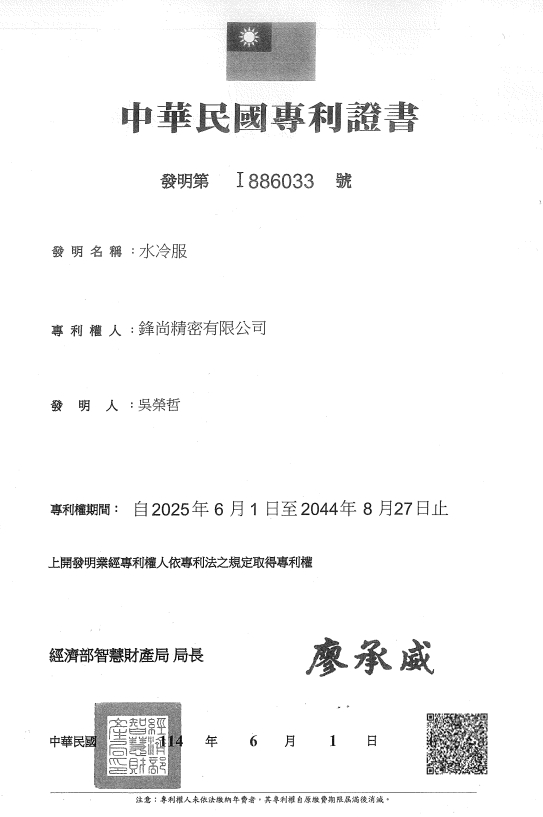
- Documented compliance. The water-cooled vest patent certificate I886033 was issued by the Intellectual Property Office, Ministry of Economic Affairs on 2025-06-01, with an expiry date of 2044-08-27, covering the water-cooled vest structure and cooling system under the Patent Act of the Republic of China. The vest has also received the Disaster Prevention Product and Service Certification Award issued by the Taiwan Disaster Prevention Industry Association.
- Supply capability. Shokunin operates an ODM production model with a monthly capacity of 3,000 units and a lead time of 7–14 days.
- After-sales terms. A 6-month warranty applies to the water-cooled vest.
Shokunin itself is the professional e-commerce brand launched by Feng Shang Precision Co., Ltd., a Taiwan-based manufacturer founded in 2009 with a 1,000 m² facility and a 5-engineer R&D team. The company exports to global markets with a 50% export ratio, and its main markets are the USA and the ROC.
FAQ
What certifications and patent coverage does the COOLWAVE water-circulation cooling vest have?
The COOLWAVE Water-Circulation Cooling Vest is covered by a water-cooled vest patent certificate, number I886033, issued by the Intellectual Property Office, Ministry of Economic Affairs. The certificate was issued on 2025-06-01 and expires on 2044-08-27, and its scope is the water-cooled vest structure and cooling system under the Patent Act of the Republic of China. The wider COOLING water-cooled vest range has also received the Disaster Prevention Product and Service Certification Award issued by the Taiwan Disaster Prevention Industry Association. Because a circulating vest contains a pump as well as textile components, buyers should also apply the general expectations for cooling systems, where ISO 9001:2015 is the quality management standard and CE or UL marks are often required for electrical components.
What are the core capabilities behind this dual cooling water cooling vest?
Shokunin produces the vest under an ODM production model with a monthly capacity of 3,000 units. The product itself combines two cooling sources in one system: two included ice packs act as the cold reservoir, and a 5 V / 150 mA (max) pump circulates chilled water at a maximum flow rate of 320–370 ml/min through a sand rubber cooling tube. Cooling duration is specified at 3–4 hours, total weight stays within 2 kg, and the water loop uses a TPU water bag with a polypropylene cap. Customization is not part of the current basic-model program, so the standard configuration is the one specified.
What drives the cost of a water-circulation cooling vest program?
Cost in this category is driven by structure rather than by a single figure. Each unit is supplied as a complete set with a water-cooled vest backpack ×1 and ice packs ×2, so planned unit count determines the base order. Beyond the units themselves, the variables that change total cost are the number of ice-pack sets needed per worker to cover shifts longer than the 3–4 hour cooling duration, replacement parts such as the TPU water bag, polypropylene cap, and sand rubber cooling tube, and the level of after-sales coverage — a 6-month warranty applies to the water-cooled vest. Buyers should build the budget on units plus ice-pack rotations plus spare parts rather than on unit price alone.
How can buyers validate the vest before a full rollout?
Validation is done through a trial order. The minimum order quantity for this vest is 10 units, and the lead time is 7–14 days, so a small batch can be placed and tested on site before a larger commitment. A practical trial checks fit under the 600D polyester shoulder straps, whether the loaded unit stays within the comfortable range of its stated sub-2 kg weight, how the 3–4 hour cooling duration maps onto the actual shift length, and whether passive ice-pack mode or pump-driven circulation suits the work position. The Taiwan case provides a reference point for scale: 100 units were deployed for workers in high-temperature environments, and the recorded result was effective body cooling, heatstroke prevention, improved work efficiency, and enhanced worker comfort across construction sites, outdoor work, metal sheet factories, and street vendors. To start a sample or quotation request, contact fsmarketing@fstool.com.tw or send a message through the Shokunin WhatsApp channel.
What is the lead time and order quantity for the COOLWAVE Water-Circulation Cooling Vest?
The lead time for the COOLWAVE Water-Circulation Cooling Vest is 7–14 days, with a minimum order quantity of 10 units and a monthly production capacity of 3,000 units under an ODM production model. Feng Shang Precision Co., Ltd., the manufacturer behind the Shokunin brand, was founded in 2009, operates a 1,000 m² facility, and exports to global markets with a 50% export ratio, with the USA and the ROC as its main markets.
Conclusion: What a 101-Level Buyer Should Take Away
A water-circulation cooling vest is not a heavier ice vest. It is a small closed cooling system: ice packs act as the reservoir, a 5 V / 150 mA pump moves chilled water at up to 320–370 ml/min through a sand rubber tube, and the result is 3–4 hours of distributed cooling in a unit that stays within 2 kg. The COOLWAVE Water-Circulation Cooling Vest keeps both modes available — powered circulation when the situation allows it, passive ice-pack cooling when it does not.
For evaluation-stage buyers, the decision usually rests on four checkable items: a documented cooling duration, named materials, traceable compliance such as patent certificate I886033 and the disaster prevention product certification, and a supply chain capable of supporting rollout. The remaining question is fit: how long the shift runs, whether the work is stationary or mobile, and how many ice-pack rotations a crew actually needs.
Next step: sample, quotation, or catalog
If you are evaluating industrial cooling apparel for construction, traffic control, street vending, food stalls, or sheet metal work, request a sample unit or a quotation. The minimum order quantity is 10 units and the lead time is 7–14 days.
Download the company brochure: Shokunin / Feng Shang Precision product brochure (PDF)
Email: fsmarketing@fstool.com.tw | WhatsApp: +86 18858260055 | Phone: +886 3-312-6606
Website: www.fstool.com.tw | Address: No. 155-17, Sec. 2, Nanzhu Rd., Luzhu Dist., Taoyuan City 338454, Taiwan
Have Questions or Need More Details?
Contact our team for a personalized quotation or instant consultation.
Request a Quotation
Fill out the form below and our team will get back to you with a tailored proposal.
WhatsApp Direct Chat
Prefer to chat in real-time? Message us on WhatsApp for instant assistance & quick answers.
- Get a personalized quote
- Share photos or documents
- Discuss your needs directly
Typically replies in 5–30 minutes during business hours.