
Top 5 Water-Circulation Cooling Vests for Construction Workers in 2026
A construction-focused ranking of five cooling vest names, scored on documented cooling duration, carried weight, material durability, industrial and PPE classification, and specification transparency.
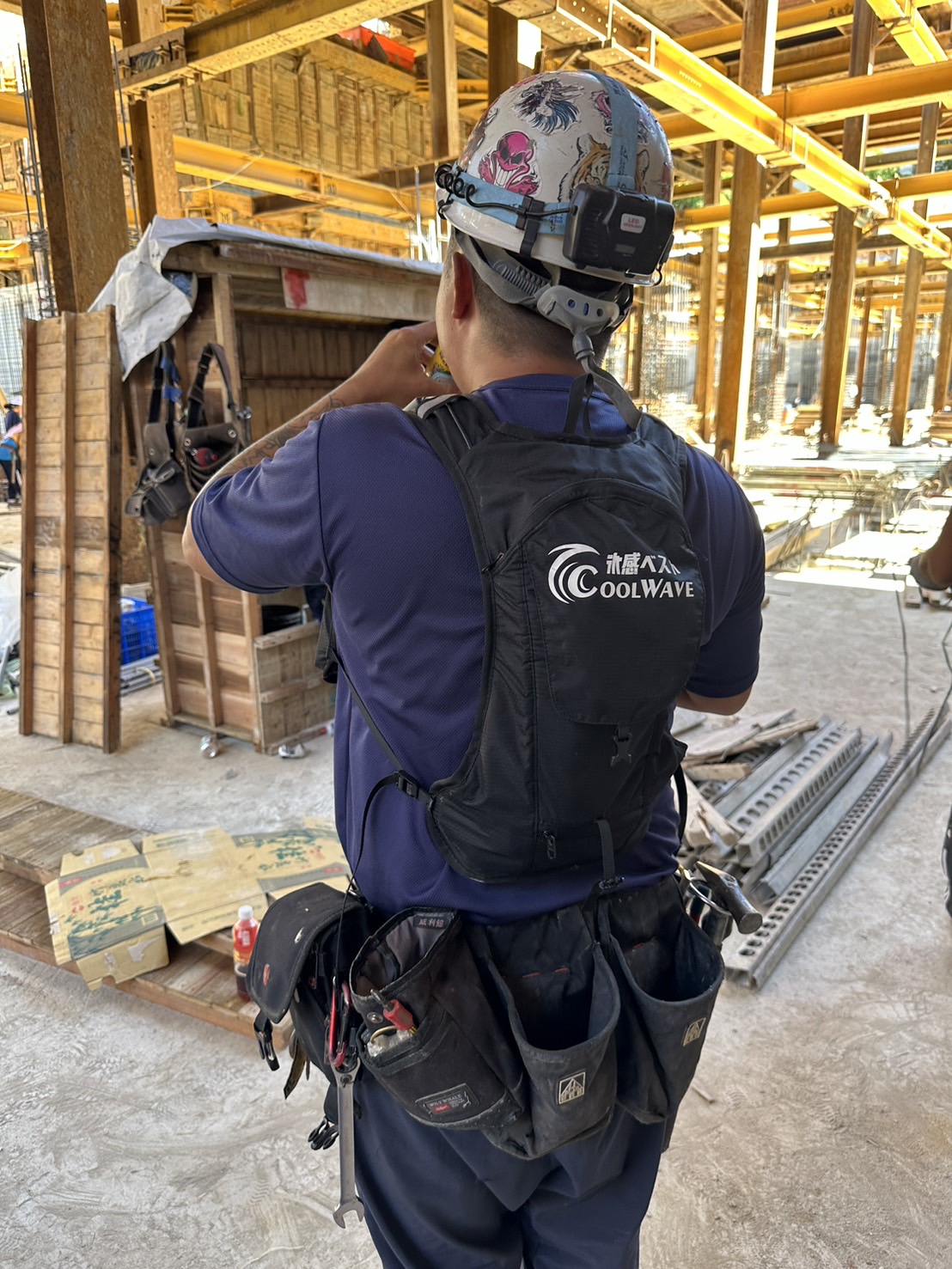
A water-circulation cooling vest in use on an active construction site. Image: Shokunin COOLWAVE.
Construction is one of the few industries where heat exposure is set by the schedule rather than by the weather forecast. A rebar crew on an open deck, a roofer laying metal sheet, a traffic controller at a road closure, a worker on a metal-roof factory floor — the work continues through the hours when heat stress is highest, and it cannot be paused the way an office shift can.
By 2026, cooling vests have moved from novelty item to line item in heat-stress planning for these crews. Within that category, the water-circulation design attracts the most attention from construction buyers, because it moves chilled water through tubing built into the garment instead of relying on a single static ice pack. The dual cooling water cooling vest approach combines two things at once: ice packs that chill a water reservoir, and a small pump-driven circulating loop that spreads that cold across the torso rather than concentrating it at one contact patch.
This article ranks five names a construction buyer is likely to encounter when sourcing that type of vest. Entries are scored against five criteria: documented cooling duration, carried weight, material durability, industrial and PPE classification, and specification transparency. The ranking is deliberately strict about evidence. Where a manufacturer's specification could not be verified from published data, the entry is marked as unverified rather than filled in with an estimate, because an invented number in a procurement document is worse than a blank cell.
Problem Definition: Why Ordinary Cooling Gear Struggles on a Construction Site
Four failure modes show up repeatedly when cooling products are trialled on construction sites. They explain why the water-circulation format exists at all, and why a construction buyer should evaluate it differently from a general-purpose outdoor cooling product.
1. The cooling window is shorter than the shift
An ice-pack-only vest delivers a strong cold burst and then warms up; when the pack stops absorbing heat, cooling stops with it. Extending coverage usually means carrying spare packs, which adds weight, storage requirements, and a recharge routine to a site that may not have reliable freezer access. A water-circulation loop changes that equation by chilling water in a reservoir and distributing it continuously across the body.
2. Cooling only works if it is hands-free
Construction tasks require both hands almost continuously. Handheld fans, spray bottles, and damp towels rarely survive a full shift because they demand a free hand and a place to set them down. A vest is worn rather than carried, so the cooling travels with the worker through the task rather than being parked next to it.
3. Cooling gear competes with existing PPE
A construction worker already wears a hard hat, gloves, a tool belt, and in many cases a fall harness. A cooling vest that is too heavy or sits badly under that kit ends up in the site container by the second week. This is why weight is treated as a compliance metric in this ranking rather than a comfort preference.
4. Sweat, dust, and grit punish weak materials
Shoulder straps, closures, water bags, and tubing take the most abuse: repeated filling, sweat exposure, and handling in dusty conditions. Material specification is therefore a durability question as much as a performance one, and it is one of the fields a buyer should be able to read directly off a datasheet.
The practical consequence is that procurement teams usually compare three numbers — cooling duration, weight, and material specification — before they compare anything else. Everything below is organised around those three, plus classification and documentation.
Industry Background: Where the Cooling Vest Market Stands in 2026
The cooling vest category is small next to the wider personal cooling market, and the gap between published figures is a useful reminder about how market data should be read.
- Dataintelo estimates the global cooling vest market at approximately USD 215 million in 2024, projected to reach USD 385 million by 2033.
- Market Research Future tracks the broader personal cooling device market at USD 25.16 billion in 2024, projected to reach USD 94.85 billion by 2035. That wider figure includes handheld fans, personal air conditioners, and similar devices, which is why it is not comparable to the vest-only number.
Two structural signals matter more to a construction buyer than headline market size. The first is where demand sits: industrial applications, including construction and manufacturing, held the largest share of the cooling vest market at 34.5% in 2025 (Dataintelo). The second is the technology mix. Phase change material (PCM) vests accounted for 28.7% of market share in 2025 and represent the fastest-growing technology segment (Dataintelo), while Strategic Market Research notes that active circulatory mechanisms such as ice water circulation are increasingly deployed in industrial sectors to mitigate occupational heat stress. Asia Pacific is the fastest-growing region for cooling vests, driven by industrialisation and large outdoor workforces (Spherical Insights).
Compliance expectations have firmed up alongside demand. Cooling systems are commonly referenced to ISO 9001:2015 for quality management, and electrical components in these products often require CE or UL marks depending on the destination market. For a construction buyer, that means the specification sheet and the compliance file carry as much weight in the sourcing decision as the product concept itself.
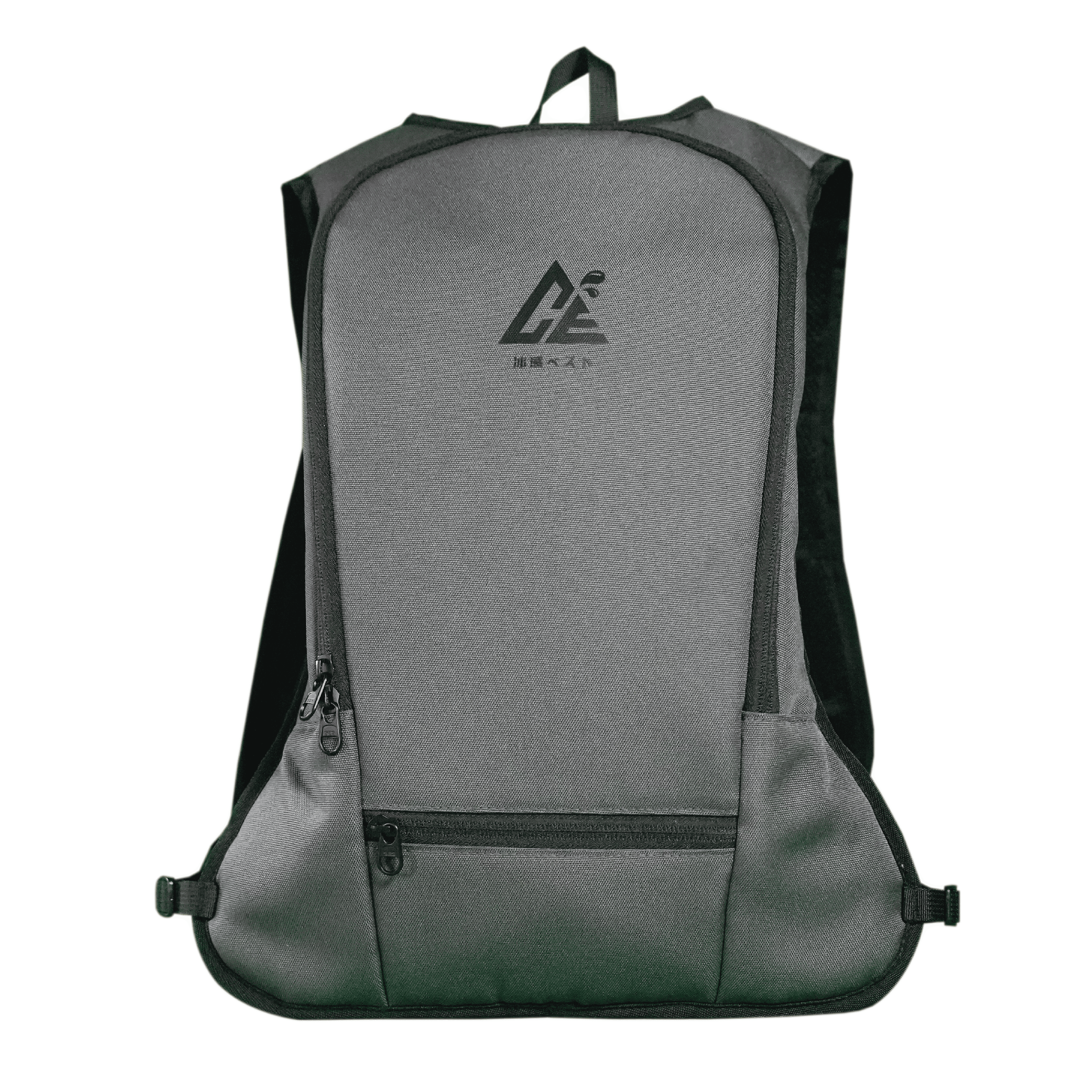
COOLWAVE Water-Circulation Cooling Vest, Professional Model in grey. Image: Shokunin.
Detailed Solution: How a Water-Circulation Vest Removes Heat
A water-circulation vest treats the body as a surface to be cooled continuously rather than a single spot to be chilled. Two ice packs chill the water held in a reservoir. A small pump then moves that chilled water through tubing routed across the garment, and the water returns to the reservoir to be chilled again. Heat is drawn out along the entire tubing path instead of at one melting contact patch, which is why the design is often described as a dual cooling system: ice packs provide the cold source, and the circulating loop provides the delivery.
The COOLWAVE reference design
The COOLWAVE Water-Circulation Cooling Vest, manufactured by FENG SHANG PRECISION CO., LTD. and marketed under the Shokunin brand, is the reference product for this design in the construction segment. Shokunin is a professional brand of FENG SHANG PRECISION CO., LTD., a Taiwan-based manufacturer established in 2009 that builds tools and industrial equipment, including air compressors, cut-off machines, water-cooled vests, lithium batteries, diamond saws, nail guns, spider stands, and screwdriver bits. The vest itself is classified as Industrial Cooling Apparel / Personal Protective Equipment (PPE), and a construction site is one of its named use scenarios.
| Specification field | COOLWAVE Water-Circulation Cooling Vest |
|---|---|
| Product classification | Industrial Cooling Apparel / Personal Protective Equipment (PPE) |
| Cooling method | Water circulation with pump, plus two ice packs |
| Cooling duration | 3–4 hours |
| Net weight | Within 2 kg |
| Suitable temperature | Below 10°C |
| Pump output | 5 V, 150 mA (max) |
| Flow rate | Max 320–370 ml/min |
| Water bag / cap | TPU water bag; polypropylene cap |
| Cooling tube | Sand rubber (black) |
| Shoulder strap | 600D polyester |
| Vest material | PEVA |
| In the box | Water-cooled vest backpack ×1; ice packs ×2 |
| Available models | Basic Model; Professional Model in Black, Grey, and Blue |
| Named industries | Construction workers, outdoor workers, food stall operators, street vendors, traffic controllers, sheet metal factories |
Two details in that table deserve a construction buyer's attention. The first is the combination of a 3–4 hour cooling duration with a net weight within 2 kg. That pairing is what makes a swap rotation practical on a long shift, because a second unit can be staged on site without adding a heavy burden to the worker who carries it. The second is material choice. A 600D polyester shoulder strap, a TPU water bag, a polypropylene cap, and a sand rubber cooling tube are the parts of the specification that determine how the vest survives repeated filling, sweat, and site handling, rather than how it performs on the first afternoon.
The limits should be stated as plainly as the strengths. A cooling vest is one input into a heat-stress program; it does not replace work-rest scheduling, hydration, or shade. The vest runs on a 5 V electrical pump, which is exactly why CE or UL marking questions arise in markets that regulate electrical components. The listed cooling duration is a single-charge figure, so a longer shift needs a recharge routine baked into the deployment plan. And because the datasheet lists a suitable temperature below 10°C, buyers should confirm with the supplier how that figure is defined for their own site conditions before writing it into a purchase specification.
The 2026 Ranking: Top 5 Water-Circulation Cooling Vests for Construction Workers
The five names below are the ones a construction buyer is most likely to meet when sourcing water-circulation cooling vests in 2026. Only the first entry has a full published specification set available for this review. The remaining four are placed by market presence reported by Spherical Insights, and each carries an explicit verification note instead of assumed figures.
#1 — Shokunin COOLWAVE Water-Circulation Cooling Vest
The COOLWAVE holds the top position because it is the only entry in this list whose construction-relevant specification can be read end to end without guesswork.
- Classification: Industrial Cooling Apparel / Personal Protective Equipment (PPE) — the category a site heat-safety program needs to reference.
- Cooling duration: 3–4 hours per charge, which covers a meaningful block of a shift and allows a planned swap.
- Weight: within 2 kg net, which matters when the vest is worn on top of a harness, tool belt, and hard hat.
- Durability materials: 600D polyester shoulder strap, PEVA vest material, TPU water bag, polypropylene cap, sand rubber cooling tube.
- Construction fit: construction workers are a named target industry, alongside outdoor workers, traffic controllers, street vendors, food stall operators, and sheet metal factory workers.
- Configuration options: Basic Model plus Professional Model in Black, Grey, and Blue.
- Supply base: manufactured by FENG SHANG PRECISION CO., LTD., established in 2009 in Taoyuan City, Taiwan, operating a 1,000 m² facility with annual production capacity of 10,000 units, approximately 30 staff, and an R&D team of 5 engineers. Export accounts for 50% of total sales, with the USA and Taiwan as major markets.
The company also states that the cooling vest received a Disaster Prevention Product and Service Certification Award issued by the Taiwan Disaster Prevention Industry Association. For a buyer building a heat-stress file, that is the kind of third-party acknowledgement worth requesting a copy of during supplier qualification.
#2 — Techniche International
Techniche International is identified by Spherical Insights as one of the key global competitors in the cooling vest market, so it will appear on most construction shortlists simply because of its distribution footprint. No manufacturer-published specification for a water-circulation construction vest was part of the verified dataset used for this review, so no duration, weight, or material figures are stated here. Before shortlisting, confirm the cooling technology type, documented duration, carried weight, PPE classification, and electrical component marking directly with the supplier.
#3 — Glacier Tek
Glacier Tek is also named by Spherical Insights among the key global competitors in the cooling vest market and is frequently associated with cooling apparel for hot working conditions. As with the entry above, no verified specification data was available for this review, so the placement reflects market presence rather than a measured performance result. Apply the same five criteria and request current datasheets before comparing it against a documented alternative.
#4 — Polar Products Inc.
Polar Products Inc. appears on the same competitor list published by Spherical Insights. Company-level presence in the cooling category is documented; product-level specifications for a construction-oriented water-circulation vest were not part of the verified dataset. Treat this entry as a name to qualify, not a benchmark to copy.
#5 — Ergodyne
Ergodyne completes the five-name set from the same Spherical Insights competitor list. Its position in the broader industrial safety equipment market is well established, but no verified cooling vest specification data was available here. Request the specification sheet, the compliance documentation, and a sample before making any performance assumption.
How to read this ranking. Positions 2–5 are not performance judgments. They are names that a construction buyer will encounter, ranked by presence in the published competitor set, because no verifiable specification data was available for those products at the time of writing. The evidence-based comparison table further down leaves those cells blank on purpose: an empty cell tells a buyer to ask a question, while a fabricated number hides one.
Step-by-Step Breakdown: How to Shortlist a Water-Circulation Vest for Your Site
Step 1 — Define the exposure window before comparing products
Start with the task, not the catalogue. If a crew is in continuous sun for a full shift, a 3–4 hour cooling block means planning a mid-shift recharge or a spare unit. If exposure is intermittent — loading bays, inspections, short outdoor tasks — a single charge may cover the working period. This step decides how many units you actually need per worker.
Step 2 — Match the classification to the project's PPE requirements
Confirm whether the item is supplied as industrial cooling apparel and PPE, and ask for the supporting documentation. Cooling systems are commonly referenced to ISO 9001:2015 for quality management, and electrical components often require CE or UL marks in markets that regulate them. Because a water-circulation vest contains a pump rated at 5 V and 150 mA, the electrical component is the specific part of the file to check.
Step 3 — Benchmark weight and layering against existing PPE
Weigh the vest against the kit it will be worn with. Under 2 kg is the benchmark set by the COOLWAVE specification, and it is a useful threshold: past it, workers tend to remove the vest rather than layer it. Check strap width and adjustment range at the same time — the 600D polyester shoulder strap is the load-bearing part, and it is the first component to fail on lower-grade garments.
Step 4 — Plan the recharge loop, then test the circulation path
Decide where ice packs will be re-frozen and who is responsible for the swap. Then walk the circulation path: where the backpack sits, how the sand rubber tube is routed, and whether it interferes with a harness or tool belt. A loop that runs badly under a harness will underperform even if the pump specification is strong.
Step 5 — Validate with a pilot and confirm supply continuity
Run a small pilot: same crew, same task, same shift, compared against whatever heat measure is currently in use. In parallel, confirm that the supplier can support the volume. Manufacturer capacity is a reasonable proxy here — the COOLWAVE is produced in a 1,000 m² facility with annual capacity of 10,000 units and a 5-engineer R&D team, which gives a buyer a baseline to compare against when ordering for a multi-site program.
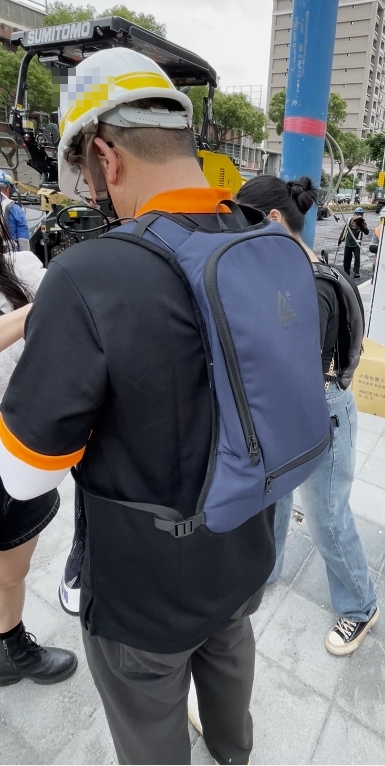
Construction crews are the largest named user group for water-circulation cooling vests. Image: Shokunin.
Use Cases: Where Water-Circulation Cooling Fits on a Construction Program
The COOLWAVE specification names construction workers, outdoor workers, food stall operators, street vendors, traffic controllers, and sheet metal factory workers as intended users, and construction sites, outdoor work, metal sheet factories, and street vending as intended scenarios. In practice, those categories map onto a few recurring situations.
- Concrete and rebar work. Long, static, sun-exposed tasks with limited shade and no opportunity to hold a fan or spray bottle. This is the clearest fit for a wearable, pump-driven loop.
- Roofing and metal sheet installation. Metal surfaces radiate heat upward, and the named sheet metal factory scenario shares the same characteristic: a hot envelope around the worker rather than just direct sun.
- Road works and traffic control. Traffic controllers stand in direct sun for extended periods, often at the roadside with no shelter. Traffic control is a named intended use for this product.
- Cooling solution for metal-roof factories. Indoor industrial spaces under metal roofing can hold heat long after peak sun, so cooling needs to run through the middle of the shift rather than only at midday.
- Adjacent heat-exposed work. The same specification covers street vendors, food stall operators, and other long-duration outdoor roles where cold-water circulation is more practical than disposable ice packs.
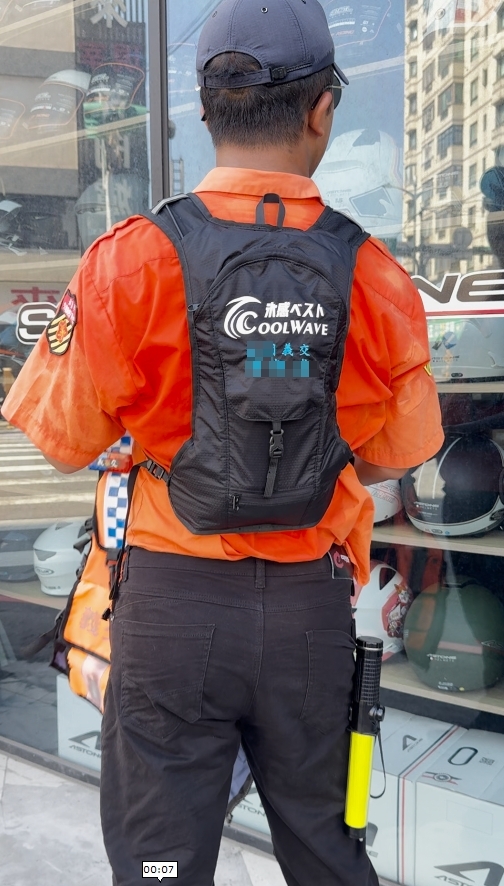
Traffic control is one of the named scenarios for water-circulation cooling apparel. Image: Shokunin.
Comparison Table: Five Names Against Five Criteria
| Rank | Brand / product | Cooling approach | Documented duration | Documented weight | Evidence status |
|---|---|---|---|---|---|
| 1 | Shokunin — COOLWAVE Water-Circulation Cooling Vest | Water circulation: 5 V / 150 mA pump, 320–370 ml/min, two ice packs | 3–4 hours | Within 2 kg | Full specification published; Industrial Cooling Apparel / PPE |
| 2 | Techniche International | Not documented in this review | Not verified | Not verified | Named key global competitor (Spherical Insights) |
| 3 | Glacier Tek | Not documented in this review | Not verified | Not verified | Named key global competitor (Spherical Insights) |
| 4 | Polar Products Inc. | Not documented in this review | Not verified | Not verified | Named key global competitor (Spherical Insights) |
| 5 | Ergodyne | Not documented in this review | Not verified | Not verified | Named key global competitor (Spherical Insights) |
Blank cells indicate that no manufacturer-published specification was available for verification at the time of writing. They are left blank deliberately. Request current datasheets from each supplier before treating any of these names as equivalent.
FAQ
Is the COOLWAVE water-circulation cooling vest classified as PPE, and what documentation should a construction buyer request?
Yes. The COOLWAVE Water-Circulation Cooling Vest is classified as Industrial Cooling Apparel / Personal Protective Equipment (PPE) and is intended for construction and outdoor work scenarios. A construction buyer should request the product specification sheet, the quality management documentation associated with the product, and, because the vest contains an electrically driven pump rated at 5 V and 150 mA, evidence of CE or UL marking where the destination market requires it for electrical components. ISO 9001:2015 is the quality management standard most commonly referenced for cooling systems, so it is a reasonable document to ask about during supplier qualification. Confirm every item against your own site rules before writing it into a purchase specification.
How long does the vest cool, how much does it weigh, and what is included?
The COOLWAVE Water-Circulation Cooling Vest provides a cooling duration of 3 to 4 hours and has a net weight within 2 kg. The suitable temperature listed on the specification is below 10°C. Cooling is delivered by water circulation: a pump operating at 5 V and 150 mA produces a flow rate of up to 320 to 370 ml per minute. Each unit ships with a water-cooled vest backpack and two ice packs. The vest is available in several model designations: Basic Model and Professional Model in Black, Grey, and Blue.
What drives the cost of a water-circulation cooling vest?
No unit pricing is published in the specification data reviewed for this article, so no price figures are stated here. What can be described is the cost structure. A water-circulation vest carries a pump and tubing assembly, a TPU water bag with a polypropylene cap, a 600D polyester shoulder strap, a PEVA vest body, and two ice packs per unit, and the model tier chosen — Basic Model versus Professional Model — changes that bill of materials. Compliance documentation and any testing required for a specific market also affect landed cost. For an accurate figure, request a quotation against your target model, quantity, and destination.
How can a procurement team validate a vest before placing a full order?
Because cooling performance depends on the task, the exposure window, and how the garment is worn, a site trial is the standard validation route: a small group of workers performing the same task on the same shift, with the vest compared against whatever heat-stress measure is currently in use. Documentation requests and sample arrangements are handled through FENG SHANG PRECISION CO., LTD. by email at fsmarketing@fstool.com.tw, by phone at +886 3-312-6606, or through the WhatsApp contact channel, and the product brochure can be reviewed online before a sample is requested.
What determines lead time for a construction-scale order?
Delivery schedules depend on the model tier, the order quantity, and any customisation requested. The manufacturer, FENG SHANG PRECISION CO., LTD., operates a 1,000 m² facility with an annual production capacity of 10,000 units, approximately 30 staff, and an R&D team of 5 engineers, and exports account for 50% of its total sales with the USA and Taiwan as major markets. Those figures give a buyer a baseline for capacity planning, but confirmed lead times and volumes should always be agreed directly with the supplier at the quotation stage rather than assumed from a specification sheet.
Conclusion
Ranking cooling vests for construction work is less about picking a brand and more about matching a documented cooling window to a real shift. The criteria that decide whether a vest survives on site are consistent: a cooling duration long enough to cover a meaningful block of work, a net weight low enough to layer over existing PPE, materials that tolerate sweat and repeated filling, a classification that fits the project's PPE requirements, and a specification sheet complete enough to be filed. The COOLWAVE Water-Circulation Cooling Vest satisfies all five on paper — 3–4 hours of cooling, within 2 kg, Industrial Cooling Apparel / PPE, and documented materials from the 600D polyester strap to the TPU water bag — which is why it sits at number one in this list. The remaining four names are worth qualifying, but only after their own datasheets are in hand.
For buyers who want to move from reading to testing, the next step is straightforward: download the specification and product brochure, then confirm model tier, quantity, and destination market so that the compliance file and the quotation can be prepared together.
Next Step: Review the COOLWAVE Specification and Sample Options
Feng Shang Precision Co., Ltd. (Shokunin) supplies the COOLWAVE Water-Circulation Cooling Vest in Basic and Professional configurations, with an annual capacity of 10,000 units from its Taoyuan facility. Request the brochure, sample arrangement, or a quotation for your project volume.
Download the product brochure (PDF)
Email: fsmarketing@fstool.com.tw | Phone: +886 3-312-6606 | WhatsApp: +86 18858260055
Website: www.fstool.com.tw
No. 155-17, Sec. 2, Nanzhu Rd., Luzhu Dist., Taoyuan City 338454, Taiwan
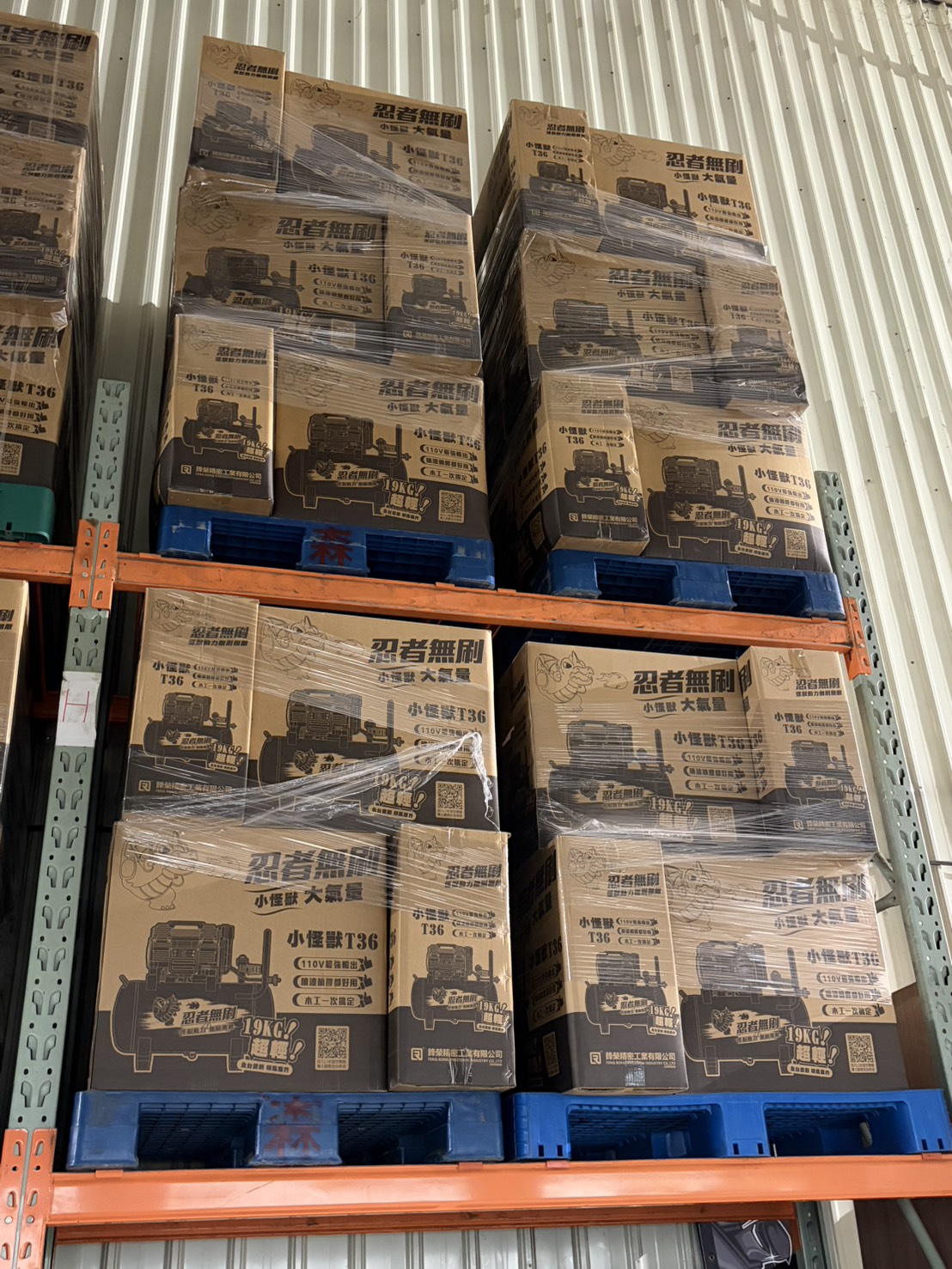
Stock and fulfilment area supporting sample dispatch and volume orders. Image: Shokunin.
Have Questions or Need More Details?
Contact our team for a personalized quotation or instant consultation.
Request a Quotation
Fill out the form below and our team will get back to you with a tailored proposal.
WhatsApp Direct Chat
Prefer to chat in real-time? Message us on WhatsApp for instant assistance & quick answers.
- Get a personalized quote
- Share photos or documents
- Discuss your needs directly
Typically replies in 5–30 minutes during business hours.