
Industrial Cooling Vest Warranty and After-Sales: A Dual Cooling Fleet Guide
Short answer: a usable after-sales structure for industrial cooling vests rests on three published commitments — how long the manufacturer stands behind the unit, how small a replacement order can be, and how quickly that order arrives. For the COOLWAVE water-circulation cooling vest, those commitments read: a 6-month warranty for the water-cooled vest, a minimum order quantity of 10 units, and a 7–14 day lead time.
Fleets rarely fail because the vest stops cooling. They fail because nobody wrote down what happens on the day a vest, a water bag, an ice pack or a pump does not perform. Warranty and after-sales support is therefore a documentation problem before it is a service problem, and the documentation can be built from four facts a buyer can verify before the first purchase order.
This guide is written for the people who buy and maintain cooling vests in quantity — safety officers, procurement teams at sheet metal factories and construction contractors, and distributors who stock the line for resale. It uses the COOLWAVE water-circulation cooling vest, made by FENG SHANG PRECISION CO., LTD. (a Taoyuan, Taiwan manufacturer founded in 2009) and sold under the Shokunin brand, as the reference case, because its support terms are published rather than implied.
Problem Definition: Where Cooling-Vest Support Breaks Down
Individual units fail, not whole product categories. An ice pack splits after a season of daily freezing. A tube kinks against a tool belt. A pump stops moving water. A strap wears through at the shoulder. The question that decides whether a heat-safety programme survives its second summer is not how good the cooling is — it is whether those individual failures have a defined route to resolution.
Three failure points account for most of the gap between a purchased vest and a supported vest.
- An unanchored warranty clock. A warranty term that is not tied to a delivery date, an issue date and a unit identifier cannot be claimed against with confidence. Six months passes quickly in a seasonal operation; six months measured from an unknown date passes invisibly.
- Replenishment priced by the pallet. If the smallest acceptable order is a container, a manager facing one worn vest has two bad options: buy stock that will sit unused, or send the worker back out without a vest. Neither is a support policy.
- Timing that misses the season. A replacement that arrives three weeks after the heat wave has already cost the shifts it was supposed to protect. Lead time is a support parameter, not a logistics footnote.
The fix is unglamorous: a unit register, a defined component list, a replacement threshold and a reorder date. All four can be written on a single page, and all four depend on the supplier publishing terms specific enough to plan against.
Industry Background: Cooling Vests Are PPE With Serviceable Parts
Occupational-safety guidance treats wearable cooling as a category of personal protective equipment rather than a comfort accessory. NIOSH describes water-cooled garments, air-cooled garments, cooling vests and wetted overgarments as examples of auxiliary or personal cooling systems for heat exposure. That classification carries an expectation of documented performance, a definable service life and a traceable replacement path — the same expectations applied to other heat-exposure PPE.
The commercial side of the category points in the same direction. Dataintelo's cooling vests market report put the global market at USD 342 million in 2025, with industrial applications accounting for 34.5% of revenue that year. Read together, those two data points describe a category whose revenue is concentrated in workplaces: buyers who compare service terms, not only unit specifications, and who carry a maintenance obligation across several seasons.
A powered water-circulation vest is also a small water circuit, and that is what makes after-sales structurally different from ordinary workwear. The COOLWAVE specification lists 600D polyester shoulder straps, a PEVA body material, a TPU water bag with a polypropylene cap, a black sand-rubber cooling tube, and a pump rated at 5V 150mA (max) with a flow rate of 320–370 ml/min. Each set ships as a water-cooled vest backpack plus two ice packs. A support file therefore has to cover both a textile and a water circuit, and it has to say which of those parts is a warranty item and which is a consumable.
Service life in this category is not theoretical. A documented deployment of 100 COOLWAVE units in Taiwan, spanning construction sites, outdoor work, sheet metal factories and street vendors, carries a ten-year service history, with reported outcomes of effective body cooling, heatstroke prevention, and improved worker comfort and work efficiency. Ten years of use is precisely the condition under which a fleet accumulates mixed vintages — and mixed vintages are what break undocumented support models.
Detailed Solution: Five Layers That Make a Warranty Usable
A warranty term on its own is a sentence. It becomes a support structure when it is attached to a configuration record, a replacement threshold, a lead time and a contact path. The five layers below are the ones a fleet manager can assemble before the first order, using published terms rather than assumptions.
Layer 1 — A warranty period with a start date
The published commitment for this product line is a 6-month warranty for the water-cooled vest. A six-month term is only operative if the clock is attached to something concrete, so the first administrative act after delivery is to bind the term to three data points: the delivery date of the batch, the issue date to a named worker or crew, and the unit identifier that ties the physical vest to the record.
Because the product is delivered as a set — backpack plus two ice packs — the component split should also be fixed at order stage rather than argued at failure stage. Write down which items sit inside the warranty and which are treated as replacements, then keep that statement with the purchase documentation. A monthly check that lists units approaching the end of their term turns the warranty from a claim into a plan.
Layer 2 — A documented configuration that replacements can match
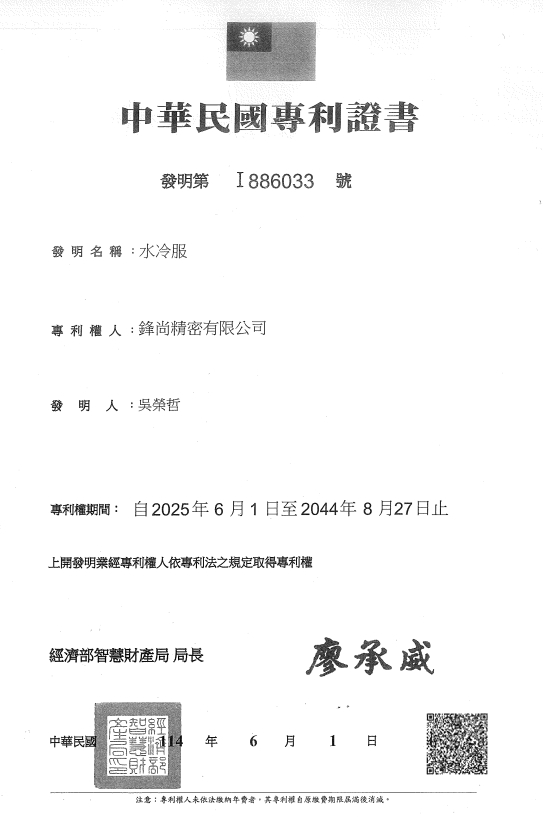
Spare parts and warranty claims are only meaningful where the build is fixed and identifiable. The COOLWAVE water-circulation cooling vest (Basic Model) is protected by Patent No. I886033, issued by the Intellectual Property Office, Ministry of Economic Affairs under the Patent Act of the Republic of China, with a term running to 27 August 2044 and scope covering the water-cooled vest structure and cooling system. The patent applies to the ROC market, so buyers operating elsewhere should treat it as evidence of a documented design rather than as a local legal instrument.
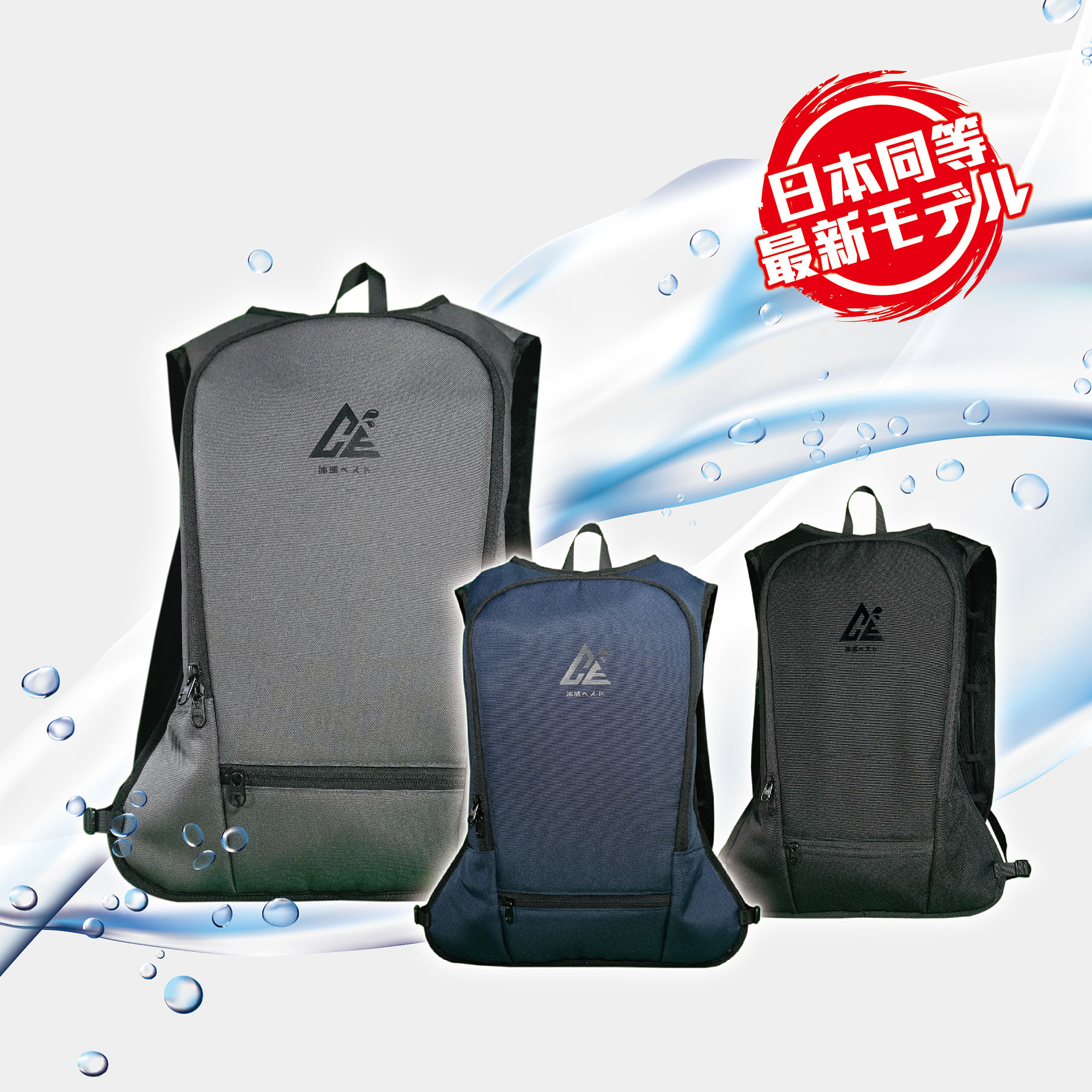
The line is listed in four variants — Professional Model in blue, gray and black, plus the Basic Model — and all share the same published parameter set: a cooling duration of 3–4 hours, weight within 2 kg, pump output of 5V 150mA (max), and flow rate of 320–370 ml/min. For a fleet, the practical value of that consistency is matching: when a replacement arrives two seasons later, the configuration record (model, colour, parameter set) is what keeps forty vests behaving like one system instead of forty individual purchases.
Layer 3 — A replacement threshold small enough for unit-level wear
The minimum order quantity for this line is 10 units. That number is what makes unit-level replacement possible: one worn vest does not force a container decision, it becomes a crew-sized replenishment. For a buyer, the consequence is that the spare buffer can be sized in vests rather than in pallets — keep replacement units and a spare set of ice packs at the scale of the largest single shift that cannot be left uncovered.
Across multiple sites, the same threshold supports a different arrangement: a shared buffer held centrally, drawn down by whichever site reports a failure first. Both models work, but only the second one needs a written rule about who pays for the shared stock, which is why the rule belongs in the support file rather than in a conversation.
Layer 4 — A lead time that defines the reorder trigger
The published lead time is 7–14 days, against a stated monthly capacity of 3,000 units. Lead time converts a stock level into a policy: if worst-case replenishment is 14 days and the season opens in June, the last safe order date falls in the second half of May. That date is the single most useful line in a support file, because it is the one that prevents a replacement from arriving after the heat has already done its work.
Distributors and multi-site operators should compare the stated monthly capacity against their own peak-month draw rather than their average, since heat-safety demand clusters into the same weeks across most markets. Where peak demand sits close to the available capacity, the buffer has to absorb the difference — not the lead time.
Layer 5 — A named contact path, tested before it is needed
Support terms are only as good as the route used to invoke them. Feng Shang Precision publishes a contact path that includes business hours of Monday to Friday, 8:30 AM – 5:40 PM, telephone +886 3-312-6606, email fsmarketing@fstool.com.tw, WhatsApp +86 18858260055, and a postal address at No. 155-17, Sec. 2, Nanzhu Rd., Luzhu Dist., Taoyuan City 338454, Taiwan.
Test that path once in the off-season: send a warranty question when nothing is at stake and record how long the answer takes. A support channel that has never been used is not a support channel; it is an assumption. The measured response time then becomes the internal escalation standard for the season ahead.
Step-by-Step Breakdown: Building the Support File in Six Steps
Step 1 — Register every unit
Record six fields per vest: model and colour variant, unit identifier, delivery date, issue date, assigned worker or crew, and warranty expiry calculated from the issue date plus the 6-month term. A spreadsheet is sufficient; the discipline matters more than the tool.
Step 2 — Separate durable parts from consumables
List the durable items — vest body, water bag, cap, cooling tube, pump, shoulder straps — against the consumable items, principally the two ice packs supplied with each set. Only after that split exists can a failure be routed correctly: to a warranty claim, to a replenishment order, or to the ice-pack rotation pool.
Step 3 — Define failure categories and the evidence each one needs
Four categories cover most field reports: cooling below expectation, leakage, pump not circulating, and physical damage to straps or tubing. For each, define the evidence required — unit identifier, date, operating hours before failure, a photograph, and a one-line description. A claim is only as strong as the record behind it, and records are cheapest to collect at the moment of failure rather than a month later.
Step 4 — Set the replenishment trigger
Set the trigger at the number of spare units needed to cover the largest single shift, then test it against the 10-unit minimum order quantity. If the MOQ is larger than the trigger, either consolidate the buffer across sites or accept a slightly deeper stock position; either way the decision should be written down before the season, not improvised during it. Order placement then follows the 7–14 day lead time, counted backwards from the last acceptable delivery date.
Step 5 — Record the operating condition behind performance claims
Published figures are only comparable when the conditions are recorded. The COOLWAVE specification states a cooling duration of 3–4 hours, weight within 2 kg, and a suitable temperature condition listed as below 10°C, alongside the pump and flow ratings. During validation, note the ambient temperature, workload and measurement basis behind observed runtime, and clarify what the listed temperature condition refers to — ambient operating temperature or cold-source condition — so field expectations match the test basis. Those notes become the baseline against which a later warranty conversation is held.
Step 6 — Review at season end
Three numbers make the review: failures per fleet block, ice packs lost or replaced per crew, and elapsed days between a reported failure and a replacement arriving. Together they size next season's buffer and show whether the contact path performed as tested in Layer 5.
Use Cases: Where This Structure Earns Its Keep
Sheet metal factories and metal-roof workshops
Fixed posts with sustained radiant heat produce steady wear rather than spikes. The ten-year, 100-unit Taiwan deployment referenced earlier covers exactly this setting, alongside construction and outdoor work. The support priority here is a unit register tied to stations rather than people, plus an ice-pack rotation pool sized to the number of shifts per day.
Construction contractors with rotating crews
When workers move between sites, vouchers and vests move with them. Registering units by worker rather than by site keeps the warranty clock attached to the person who actually wore the vest, and the 10-unit minimum order quantity matches a crew-sized replenishment far better than a site-sized one.
Street vendors and market operators
Single-operator businesses rarely hold spares. A 10-unit minimum order suits a market association or a small reseller assembling a shared purchase, while the 6-month warranty term needs to be explained at the point of sale rather than discovered later. Ice packs, not vest bodies, are the recurring after-sales item in this group.
Traffic control and fixed outdoor posts
Long stationary exposure at a fixed post means continuous runtime and predictable consumable use. Fleet planning here is dominated by ice-pack logistics and by the cooling duration per cycle, with vest replacement handled as an exception through the same support file.
Comparison: Documented Support Terms and the Buyer's Own Checklist
The table below pairs each published support term with the internal decision it should trigger. It does not rank suppliers; it converts terms into actions.
| Support element | COOLWAVE (Shokunin) documented value | What to write into your own support file |
|---|---|---|
| Warranty period | 6-month warranty for the water-cooled vest | Issue date, unit identifier, and the component list the term is applied to |
| Minimum replenishment order | 10 units | Buffer size per site, or a written rule for a shared central buffer |
| Lead time | 7–14 days | Last safe order date, counted back from the season start |
| Stated monthly capacity | 3,000 units | Peak-month draw check for multi-site or resale volumes |
| Protection status | Patent No. I886033 (IPO, MOEA; ROC market; term to 27 Aug 2044); Disaster Prevention Product and Service Certification Award from the Taiwan Disaster Prevention Industry Association | Which documents your own market requires, and which market each document applies to |
| Set contents | Water-cooled vest backpack ×1, ice packs ×2 | Ice-pack rotation pool and consumable replacement cycle |
| Contact path | Phone +886 3-312-6606, email fsmarketing@fstool.com.tw, WhatsApp +86 18858260055; Mon–Fri 8:30 AM – 5:40 PM | Internal escalation owner and a response-time expectation measured in the off-season |
The variant table below serves a narrower purpose: keeping a mixed fleet identifiable when replacement orders are placed months after the original delivery.
| Listed variant | Model designation | Colour | Support note |
|---|---|---|---|
| Professional Model | COOLWAVE Water-Circulation Cooling Vest (Professional Model) | Blue, Gray, Black | Assign one colour per site or crew to simplify returns and matching |
| Basic Model | COOLWAVE Water-Circulation Cooling Vest (Basic Model) | As listed | Patent No. I886033 is recorded against the Basic Model |
| Shared parameters | All listed variants | — | Cooling duration 3–4 hours; weight within 2 kg; pump 5V 150mA (max); flow rate 320–370 ml/min |
FAQ: Warranty and After-Sales Questions Buyers Ask Before Ordering
1. Is the COOLWAVE water-circulation cooling vest backed by a documented certification or patent?
Yes, with a defined geographic scope. The COOLWAVE water-circulation cooling vest (Basic Model) is protected by Patent No. I886033, issued by the Intellectual Property Office, Ministry of Economic Affairs under the Patent Act of the Republic of China, applicable to the ROC market, with a term running to 27 August 2044 and scope covering the water-cooled vest structure and cooling system. Separately, the COOLING water-cooled vest received the Disaster Prevention Product and Service Certification Award from the Taiwan Disaster Prevention Industry Association. Buyers outside Taiwan and the ROC should read both as evidence of a documented design and an awarded product, and confirm separately which documents their own market requires.
2. What does the manufacturer warranty actually commit to?
The published commitment is a 6-month warranty for the water-cooled vest. Because the product ships as a set — water-cooled vest backpack ×1 plus ice packs ×2 — a fleet manager should confirm in writing which components the term covers and which are treated as consumable replacements, then anchor the six months to a delivery date and an issue date per unit. A warranty term without those anchors is difficult to administer regardless of its length.
3. How does a 10-unit minimum order quantity affect a maintenance budget?
The 10-unit minimum sets a floor on each replenishment order, so it defines the smallest sensible stock position rather than a per-unit cost. In practice, a buyer sizes the spare buffer at the number of vests needed to cover the largest single shift, then checks whether that figure sits above or below 10 units. Where it sits below, sites can share a central buffer; where it sits above, the minimum is not a constraint on normal replacement at all.
4. What should a validation unit prove before a fleet-wide commitment?
Four things, all checkable against published specifications: that observed runtime is consistent with the stated 3–4 hour cooling duration under your own ambient and workload conditions; that the vest stays within the stated weight of 2 kg when worn; that the pump performs at its rated 5V 150mA (max) with a flow rate of 320–370 ml/min; and that the listed suitable temperature condition of below 10°C is understood in the same sense the manufacturer intends. Record the answers next to the unit identifier — those notes become the reference point for every later warranty discussion.
5. How quickly can replacement units arrive, and when should orders be placed?
The published lead time is 7–14 days, supported by a stated monthly capacity of 3,000 units. Count backwards from the date you need vests in service rather than forwards from the day a failure is reported: with a 14-day worst case, the order has to be placed at least two weeks before the last acceptable delivery date, and earlier where peak-season demand is concentrated. For a fleet profile and a written quotation, contact the manufacturer directly at fsmarketing@fstool.com.tw or via WhatsApp on +86 18858260055.
Conclusion: Support Is a Document, Not a Promise
For industrial cooling vests, the difference between a purchase and a supported fleet comes down to four written items: a warranty term anchored to a date, a configuration record that replacements can match, a replenishment threshold expressed in units, and a reorder date derived from lead time. On the COOLWAVE water-circulation cooling vest, the published inputs for those items are a 6-month warranty, a 10-unit minimum order quantity, a 7–14 day lead time and a stated monthly capacity of 3,000 units — a set of terms specific enough to plan a season around rather than to hope about.
The rest is administration: a register, a component list, a failure log and a season-end review. None of it requires new technology. All of it requires that the terms exist in the first place, and that the contact path behind them has been tested once before a heat wave makes the test expensive.
Next step: put the terms on paper before the season does it for you
Download the COOLWAVE product brochure for the full specification set, or send your fleet profile — number of vests, sites and shifts — and ask for a written quotation covering warranty terms, replenishment quantities and delivery dates.
Brochure: COOLWAVE product brochure (PDF)
Email: fsmarketing@fstool.com.tw · Phone: +886 3-312-6606 · WhatsApp: +86 18858260055
Website: fstool.com.tw · Blog: blog.fstool.com.tw
Have Questions or Need More Details?
Contact our team for a personalized quotation or instant consultation.
Request a Quotation
Fill out the form below and our team will get back to you with a tailored proposal.
WhatsApp Direct Chat
Prefer to chat in real-time? Message us on WhatsApp for instant assistance & quick answers.
- Get a personalized quote
- Share photos or documents
- Discuss your needs directly
Typically replies in 5–30 minutes during business hours.