
Dual Cooling Water Cooling Vest: PPE & Taiwan Disaster Prevention Compliance Guide
Dual Cooling Water Cooling Vest: PPE & Taiwan Disaster Prevention Compliance Guide
Why “PPE Classification” Is a Claim, Not a Certificate
In cooling-apparel sourcing, the word “PPE” is used in two very different senses, and buyers regularly conflate them. The first is categorical: the product belongs to the family of wearable heat-exposure equipment. The second is regulatory: the product has passed a defined conformity assessment in a defined jurisdiction. Only the second sense produces a certificate that a safety officer can file against a legal requirement.
Categorical classification is well established. The U.S. National Institute for Occupational Safety and Health (NIOSH) describes auxiliary or personal cooling systems as wearable equipment that protects against heat exposure, and names water-cooled garments, air-cooled garments, cooling vests, and wetted overgarments as examples. That framing places an industrial cooling vest inside occupational heat-stress planning — it does not by itself certify any individual product.
Regulatory conformity is market-specific. A cooling vest sold into the European Union, the United Kingdom, the United States, Japan, or Taiwan will each be assessed under a different framework, and frequently under more than one requirement at once, because a powered water-circulation vest combines three separate risk areas: protective clothing, a low-voltage pump, and a battery or power-bank power source.
The practical consequence for evaluation-stage buyers is this: whenever a supplier describes a vest as “PPE,” the next question must be “under which scheme, issued by which body, for which scope?” Without that follow-up, a category statement gets recorded in a tender document as if it were a conformity certificate. That is the single most common documentation error in heat-relief procurement.
The Taiwan Disaster Prevention Framework in Context
Taiwan approaches disaster prevention as an industry ecosystem rather than a single regulator. The Taiwan Disaster Prevention Industry Association issues a Disaster Prevention Product and Service Certification Award to products and services that the association recognizes as contributing to disaster prevention and emergency-response capability. For a cooling vest, that award places the product inside a category that Taiwanese public buyers, construction contractors, and industrial site operators already recognize: equipment that reduces heat-injury risk for people working in high-temperature environments.
That positioning matters commercially. It means a Taiwanese site manager evaluating heatstroke prevention gear can point to a domestic industry-association recognition rather than to a foreign standard the site is not audited against. It also means the recognition is written at the level of product purpose and disaster-prevention relevance, not at the level of a technical test protocol.
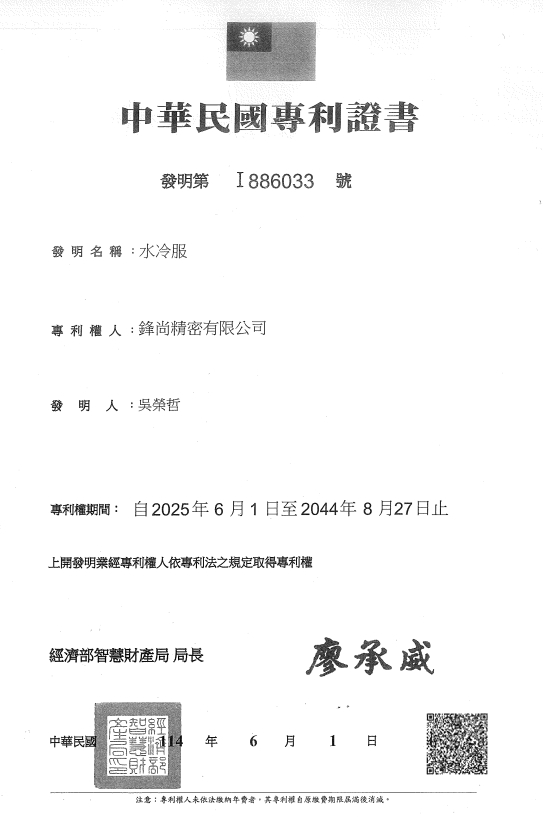
Separately, Feng Shang Precision holds water-cooled vest patent I886033, granted by the Intellectual Property Office, Ministry of Economic Affairs, with an issue date of 1 June 2025 and an expiry date of 27 August 2044. The patent covers the water-cooled vest structure and cooling system. It is an intellectual-property instrument: it establishes that the structure and circulation design are protected, and it establishes nothing about thermal performance, electrical safety, or conformity with protective-clothing standards.
Keeping these two instruments apart is the core discipline of this guide. The disaster-prevention award speaks to product category and application relevance. The patent speaks to design ownership. Neither is a PPE conformity certificate, and a supplier pack that presents them as interchangeable is a pack that has not been prepared by someone who understands procurement review.
What the COOLWAVE Evidence Pack Contains
For evaluation purposes, it helps to list what a buyer can actually obtain today. The facts below are the documented ones; anything not listed here should be treated as an open question to raise in the RFQ rather than assumed.
Product identity and classification
- Product name: COOLWAVE Water-Circulation Cooling Vest (Basic Model).
- Brand: Shokunin, the professional e-commerce brand launched by Feng Shang Precision Co., Ltd.
- Category: industrial cooling apparel / personal cooling system, positioned for construction, outdoor work, metal sheet factories, and street vending.
- Cooling architecture: a dual cooling design combining reusable ice packs as the cold source with a pump-driven water-circulation loop powered by a power bank.
Manufacturer and facility facts
- Feng Shang Precision Co., Ltd. was founded in 2009 and operates a 1,000 m² facility with 30 employees, including a 5-engineer R&D team.
- Documented company-wide annual output is 10,000 units; export ratio is 50%, with the USA and Taiwan listed as main markets.
- Address: No. 155-17, Sec. 2, Nanzhu Rd., Luzhu Dist., Taoyuan City 338454, Taiwan.
Commercial and after-sales terms
- Production mode: ODM.
- Minimum order quantity: 10 units.
- Lead time: 7–14 days.
- Monthly capacity: 3,000 units.
- Warranty: 6-month warranty for the water-cooled vest.
Supplier-published performance specifications
- Cooling duration: 3–4 hours per charge / ice-pack cycle.
- Weight: within 2 kg.
- Pump input: 5V, 150 mA (max).
- Flow rate: 320–370 ml/min.
Field deployment record
- A Taiwan deployment of 100 units across construction sites, outdoor work, metal sheet factories, and street vendors.
- Reported duration of use in that application context: 10 years.
- Reported outcomes: effective body cooling, heatstroke prevention, improved work efficiency, and improved worker comfort.
- Product characteristics noted in that record: passive ice-pack cooling, no power requirement for the cold source, lightweight and portable construction, adjustable one-size-fits-all design, and disaster-prevention product certification.
What the Certification Covers — and What It Does Not
This is the section most buyer reviews get wrong, in both directions: some teams treat the Taiwan award as a global PPE passport, and others dismiss it as commercially meaningless. Both readings are inaccurate.
What the Disaster Prevention Product and Service Certification Award establishes
- The product has been recognized by the Taiwan Disaster Prevention Industry Association within its disaster-prevention product and service category.
- The product's intended role — reducing heat exposure for people working in high-temperature environments — is consistent with a disaster-prevention and heat-injury-prevention purpose.
- For Taiwan-based procurement, including public-sector and contractor purchasing that references domestic disaster-prevention product categories, the award supplies a locally recognizable evidence point.
- It supports the product's placement in heatstroke prevention programs, which is the framing under which the Taiwan deployment record reports its outcomes.
What it does not establish
- It is not a conformity assessment against EU PPE Regulation (EU) 2016/425, and it does not produce an EU type-examination certificate.
- It is not a UKCA or ANSI/ISEA conformity approval, nor does it certify compliance with any named national protective-clothing standard.
- It is not an electrical-safety certification for the 5V pump or for the power bank that drives it.
- It is not a textile or material test report covering the vest shell, tubing, reservoir, or connectors.
- It does not quantify cooling performance under defined ambient temperature, humidity, or workload conditions.
- It does not transfer into another jurisdiction's legal framework automatically.
Stated positively: the award tells a buyer that an industry body in the manufacturer's home market recognized the product as disaster-prevention equipment. It does not tell a buyer that a safety regulator in the buyer's market has cleared it. Those are different claims, made by different bodies, for different purposes, and a credible supplier will say so without being pushed.
A Document Request Sequence for Procurement Teams
The following sequence works because each step produces a document that the next step depends on. Requesting them out of order is what produces the familiar situation where a supplier sends a certificate image and the buyer still cannot close the file.
Mapping Taiwan Evidence Into Local PPE Reviews
Regional buyers can use the same document set in materially different ways. The mapping below keeps the evidence honest in each case.
Taiwan and wider Asia-Pacific procurement
Here the disaster-prevention award carries the most direct weight, because it is issued inside the market where the purchase is being made and inside a category local buyers already recognize. Combined with the 10-year, 100-unit Taiwan deployment across construction, outdoor work, metal sheet factories, and street vending, the pack supports both the category claim and the application claim. Buyers in this region should still record that the award is an industry-association recognition and not a regulator's conformity certificate.
United States procurement
Use NIOSH's classification of water-cooled garments and cooling vests as personal cooling systems to establish the product category in occupational heat-stress planning. Then present the Taiwan award as home-market recognition and the patent as design evidence. Neither should be entered in a compliance column that implies a US protective-clothing standard has been met. Where a US site requires specific documentation, that requirement has to be raised explicitly and answered explicitly.
European Union and United Kingdom procurement
These markets route protective clothing through their own conformity-assessment structures, and a powered vest adds an electrical-safety dimension on top. The Taiwan award therefore functions as a supplier-credibility signal rather than a conformity input. The correct action is to ask the supplier directly what assessment path, if any, has been completed for the target market, and to plan the review around the answer rather than around an assumption.
The general rule
Never convert an unrecognized standard into a recognized one during internal write-up. If a certificate names a body, quote that body. If it does not name a body, do not supply one. Reviewers who inherit your file six months later will rely on the precision you recorded, not on the intent you had.
Where This Evidence Pack Matters on Site
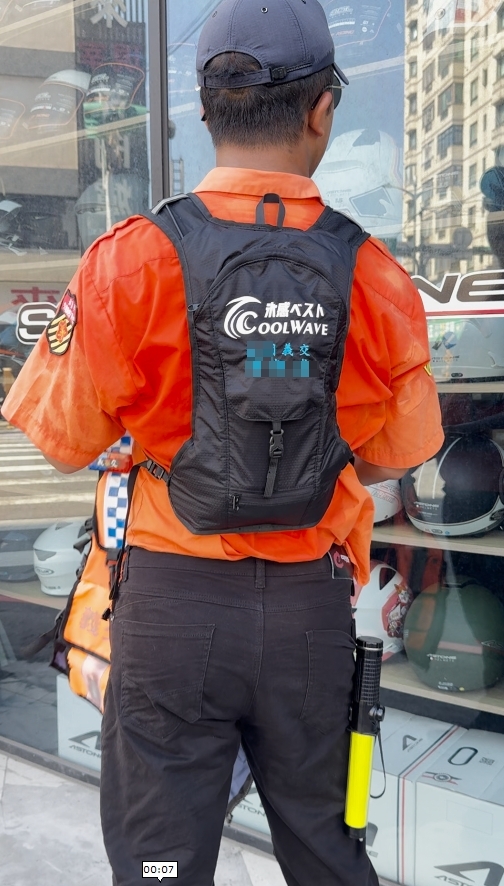
Compliance documentation only earns its place if it maps onto real working conditions. The four application categories in the Taiwan deployment record illustrate where the pack is most useful.
Construction sites
Construction work combines sustained heat exposure with restricted freedom to stop. A vest that runs on a passive ice-pack cold source with pump-assisted circulation, weighs within 2 kg, and uses an adjustable one-size-fits-all design can be issued across a mixed crew without individual sizing. For site managers, the disaster-prevention award is the document that lets the vest sit inside an existing heatstroke prevention program rather than being treated as an unclassified comfort item.
Traffic control and road works
Direct sun exposure over long shifts makes radiant heat the dominant load. Here the relevant evaluation questions are runtime per cycle and whether a spare ice pack can be swapped mid-shift. The published 3–4 hour cooling duration per cycle is the figure to test against your own shift pattern, not to accept at face value.
Metal sheet factories and metal-roof buildings
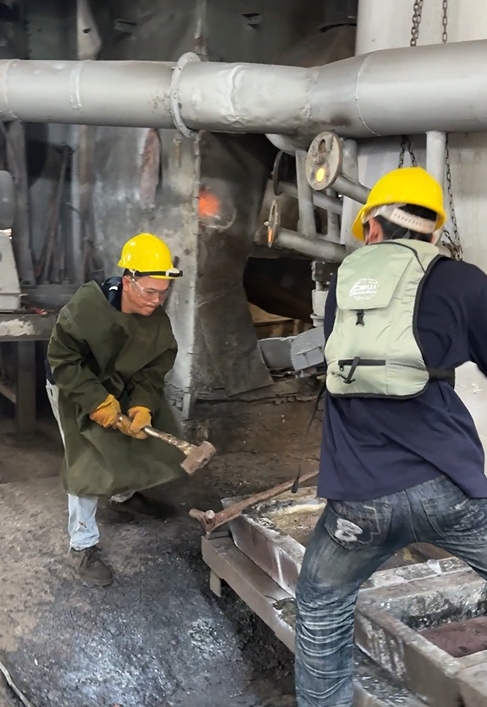
Radiant heat from metal surfaces produces conditions that passive evaporative products handle poorly. A water-circulation design with a reusable ice-pack cold source is the appropriate architecture to evaluate, and the factory setting is also where the 6-month warranty and the ODM supply terms become operational questions rather than commercial footnotes.
Outdoor vendors and prolonged sun exposure
For street vendors and other self-employed outdoor workers, portability and the absence of a power requirement for the cold source are the deciding characteristics. The adjustable one-size-fits-all design also matters where a single unit is shared across a family or a small stall team.
Evidence Comparison: What Each Document Proves
The table below lists only documents and facts that the manufacturer has published. Use it as the skeleton of your own evaluation sheet, and add a column for your market's specific requirement.
| Evidence Document | Issued or Stated By | What It Establishes | What It Does Not Establish |
|---|---|---|---|
| Disaster Prevention Product and Service Certification Award | Taiwan Disaster Prevention Industry Association | Recognition of the product within Taiwan's disaster-prevention product and service category | Conformity with EU, UK, US, or any other national protective-clothing standard |
| Water-cooled vest patent I886033 (issued 1 June 2025; expires 27 August 2044) | Intellectual Property Office, Ministry of Economic Affairs, Taiwan | Protection of the water-cooled vest structure and cooling system | Product safety, thermal performance, or electrical safety |
| ODM production terms: MOQ 10 units, 7–14 day lead time, 3,000 units monthly capacity, 6-month warranty | Feng Shang Precision Co., Ltd. | Commercial terms, delivery planning range, and after-sales coverage period | Certified quality-management system or audited production yield |
| Supplier-published specifications: 3–4 hours cooling per cycle, within 2 kg, 5V/150 mA pump, 320–370 ml/min flow | Manufacturer product documentation | Design targets for runtime, wearable weight, and pump performance | Independently measured performance under a defined test method |
| Taiwan deployment record: 100 units, 10-year usage context, four user categories | Manufacturer case record | Real application context and the user categories the product has served | Quantified thermal reduction or injury-rate outcomes |
Frequently Asked Questions
It is a recognition issued by the Taiwan Disaster Prevention Industry Association to products and services the association places within its disaster-prevention category. For the COOLWAVE Water-Circulation Cooling Vest, it establishes that the product has been recognized as disaster-prevention equipment in the manufacturer's home market and that its intended role — reducing heat exposure for people working in high-temperature environments — fits that category. It is an industry-association recognition, and it should be filed as category and application evidence rather than as a protective-clothing conformity certificate.
No. The award does not constitute a conformity assessment against EU PPE Regulation (EU) 2016/425, does not produce a UKCA approval, and does not certify against any named national protective-clothing standard. It also does not cover electrical safety for the 5V pump or the power bank that drives the circulation loop. Buyers in those markets should treat the Taiwan award as home-market recognition and design evidence, and then ask the supplier directly what, if anything, has been completed for the target market. A separate point worth noting: patent I886033, registered with Taiwan's Intellectual Property Office and valid from 1 June 2025 to 27 August 2044, protects the vest structure and cooling system, and is an intellectual-property instrument rather than a safety document.
Feng Shang Precision states a 6-month warranty for the water-cooled vest. Because the cooling system depends on a 5V, 150 mA pump rated at a 320–370 ml/min flow rate, buyers should confirm in the RFQ whether the pump, tubing, and reservoir sit inside the same 6-month window and what replacement parts are available. The warranty term is a documented commercial fact; the component-level coverage detail should be confirmed in writing before purchase orders are issued, since it determines your spare-parts stock and maintenance plan across a season.
Feng Shang Precision operates an ODM production model with a minimum order quantity of 10 units, a lead time of 7–14 days, and a monthly capacity of 3,000 units. Documented company-wide annual output is 10,000 units from a 1,000 m² facility with 30 employees and a 5-engineer R&D team. When comparing these figures against other suppliers, confirm whether a quoted capacity refers to installed, practical, or currently available capacity, because the three produce very different delivery-risk profiles for a multi-season program.
Yes. The practical request set is: the written classification statement, the disaster-prevention award document, the I886033 patent record, written ODM and warranty terms, the technical specification sheet with test conditions, and the Taiwan deployment reference details covering 100 units across construction sites, outdoor work, metal sheet factories, and street vendors. A sample then allows you to test the published 3–4 hour cooling duration against your own ambient conditions, humidity, and activity pattern — the step that converts supplier-published design targets into site-specific evidence your safety reviewer can act on.
Conclusion: Record the Scope, Not Just the Logo
The COOLWAVE water cooling vest brings a coherent, honestly bounded evidence pack to an evaluation: a Disaster Prevention Product and Service Certification Award from the Taiwan Disaster Prevention Industry Association, a water-cooled vest structure and cooling system patent (I886033) valid to 2044, a 10-year Taiwan deployment across four heat-exposed user categories, and manufacturing terms that support small-batch ODM purchasing at a 10-unit MOQ with 7–14 day lead times and 3,000-unit monthly capacity.
None of those facts needs inflating. What a procurement team must do is record each one at its correct scope: category recognition is not conformity assessment, patent protection is not safety certification, a 6-month warranty is not a reliability forecast, and a published cooling duration is not a measured result until you have run it under your own conditions. Buyers who hold that line get a defensible approval file. Buyers who blur it inherit a compliance risk that surfaces later, usually at the worst moment.
Next Step for Evaluation Teams
Download the product brochure for the full specification set, or request a sample and the documentation pack through the contact channel below. Certificates, patent record, warranty terms, and ODM terms can be issued together so your review can proceed in one pass instead of three.
Download the COOLWAVE product brochure (PDF)
Shokunin — a brand of Feng Shang Precision Co., Ltd. Phone: +886 3-312-6606 | Email: fsmarketing@fstool.com.tw | WhatsApp: +86 18858260055 | Business hours: Monday to Friday, 8:30 AM – 5:40 PM
Have Questions or Need More Details?
Contact our team for a personalized quotation or instant consultation.
Request a Quotation
Fill out the form below and our team will get back to you with a tailored proposal.
WhatsApp Direct Chat
Prefer to chat in real-time? Message us on WhatsApp for instant assistance & quick answers.
- Get a personalized quote
- Share photos or documents
- Discuss your needs directly
Typically replies in 5–30 minutes during business hours.