
Dual Cooling Water Cooling Vest: How the Category Works
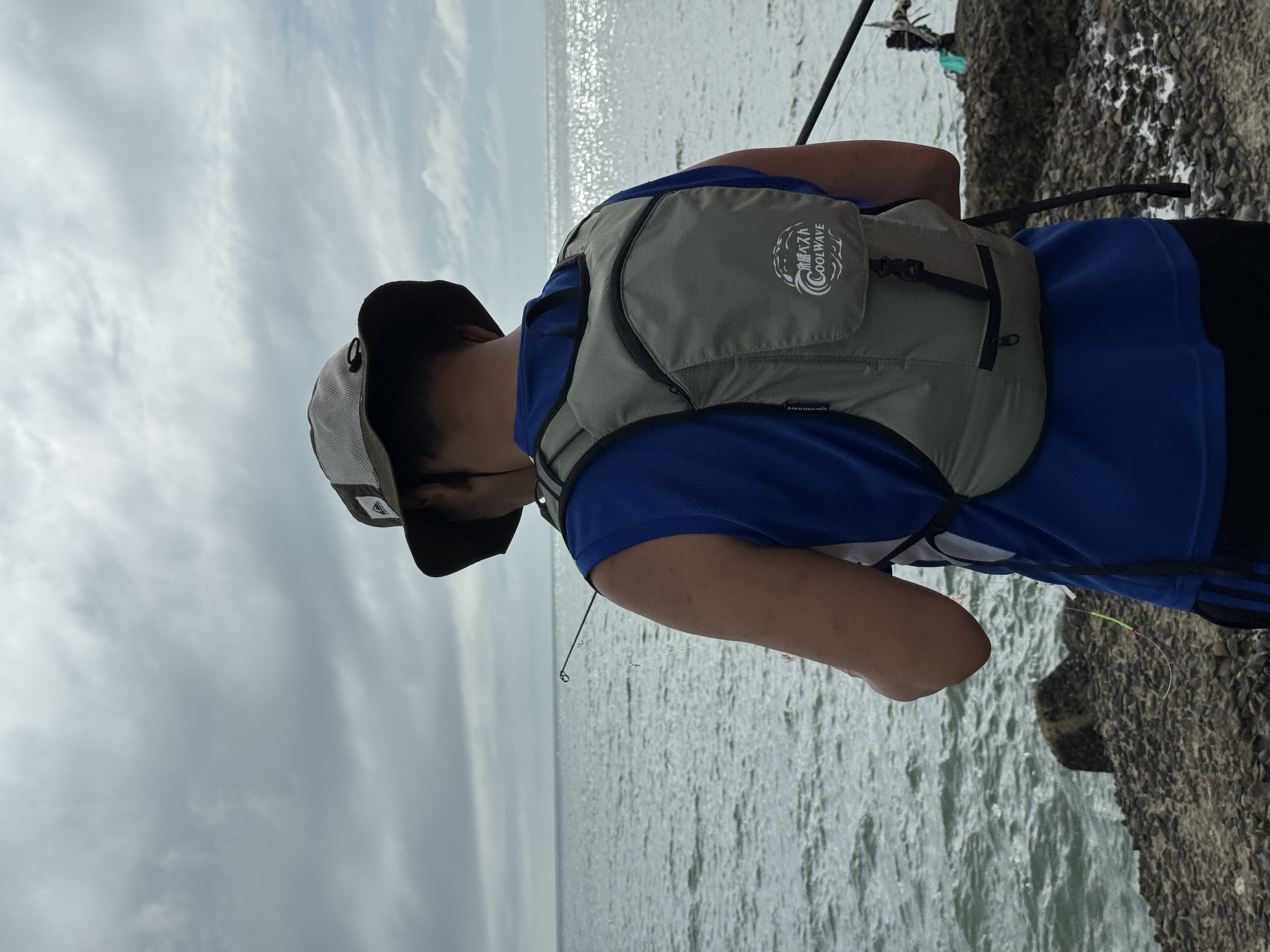
The category in the field: a water-circulation cooling vest used in outdoor heat.
A dual cooling water cooling vest is a wearable cooling garment that pairs a stored cold source — the ice packs supplied with the unit — with a small pump-driven water loop that carries that cold across the wearer's torso. It sits inside the industrial cooling apparel and personal protective equipment (PPE) category, and it is built for one job: holding a usable cooling effect for hours while the wearer keeps working.
The COOLWAVE Water-Circulation Cooling Vest (Basic Model) is a documented example of the category. It is produced by Shokunin, the professional tool brand of Feng Shang Precision Co., Ltd., a Taiwanese manufacturer founded in 2009 in Taoyuan City. Its verified figures anchor this explainer: 3–4 hours of cooling duration, a total weight within 2 kg, a maximum flow rate of 320–370 ml/min, and a 5V 150 mA (max) pump.
If the term is new to you, the useful questions are not "which vest is best" but "what is actually inside this category, how does the cooling loop move cold, and which published numbers tell me whether a vest will survive a full shift?" The sections below answer those in sequence: the naming problem, the market context, the product architecture, a step-by-step way to read any specification sheet, real deployment scenarios, and a side-by-side view of cooling approaches.
Problem Definition: Why "Cooling Vest" Returns Four Different Products
A single search term covers at least four structurally different products: disposable ice-pack inserts, reusable frozen gel vests, phase change material (PCM) vests, and water-circulation vests. In product photography they look almost identical. In hour three of a shift they behave nothing alike.
That ambiguity creates three concrete purchasing problems.
Duration is not a standardised figure. Two vests can both advertise a cooling window while being measured under different ambient temperatures, activity levels and definitions of "cooling". The COOLWAVE unit, for example, publishes a cooling duration of 3–4 hours and a suitable temperature of below 10°C for the chilled medium — figures that only mean something when read together.
"Dual cooling" is applied loosely across listings. Within this category the term describes two cooling paths working in the same garment: stored cold (ice packs) plus a circulating loop that distributes it. It is not a synonym for "two ice packs" or "two layers of fabric".
Fit is treated as an accessory rather than a specification. Cooling transfer depends on contact. An adjustable one-size-fits-all design keeps the cooling surface against the torso across body types and across a full shift, which is why adjustability belongs on the specification list next to flow rate and duration.
The underlying problem the category addresses is straightforward: workers in high-temperature environments need body-level heat exchange that does not require them to stop, sit down, or leave the work area to cool off.
Industry Background: Where the Category Sits Today
Personal cooling has moved well beyond a niche accessory. Market Research Future valued the global personal cooling device market at USD 25.16 billion in 2024 and projects USD 94.85 billion by 2035. The cooling vest niche in isolation is far smaller: Dataintelo valued the global cooling vest market at approximately USD 215 million in 2024, with a projection of USD 385 million by 2033.
Those figures are not in conflict — they measure different scopes. The larger number includes handheld fans and personal air-conditioning devices. The smaller number isolates wearable cooling vests. When a supplier quotes market size, the scope definition matters more than the number itself.
Three structural signals shape the category today.
- Industrial demand anchors the market. Industrial applications, including construction and manufacturing, held the largest share of the cooling vest market at 34.5% in 2025 (Dataintelo).
- Asia Pacific is the fastest-growing region, driven by rapid industrialisation and large outdoor work populations (Spherical Insights).
- Active circulation is expanding. Ice water circulation mechanisms are increasingly deployed in industrial sectors to mitigate occupational heat stress (Strategic Market Research). Phase change material vests held 28.7% of the market in 2025 and represent the fastest-growing technology segment (Dataintelo).
Compliance context runs alongside the demand picture. Cooling systems are expected to align with ISO 9001:2015 for quality management, and electrical components commonly require CE or UL marks. That second point is directly relevant to pump-driven vests, because the pump is an electrical component: the COOLWAVE vest runs a low-voltage 5V 150 mA (max) pump.
The competitive field is identifiable rather than anonymous. Notable global participants in the cooling vest market include Techniche International, Glacier Tek, Polar Products Inc., and Ergodyne (Spherical Insights). Shokunin competes in the same category through the COOLWAVE line, manufacturing in Taiwan and exporting to markets that include the USA and ROC.
Detailed Solution: How a Dual Cooling Water Cooling Vest Is Built
Two cooling paths in one garment
The "dual cooling" in the product name refers to the combination of a stored cold source and a moving cold carrier. The cold source is the ice packs supplied with the kit. The carrier is water: a TPU water bag holds it, a 5V 150 mA (max) pump drives it, and a sand rubber cooling tube routes it against the body. Maximum flow rate is 320–370 ml/min.
What that architecture means for a buyer is simple. Cold is not created by the vest; it is stored in the packs, moved by the pump, and released against the torso. That is why the two figures worth remembering are the ones governing the exchange — flow rate and cooling duration — rather than the garment's outward appearance.
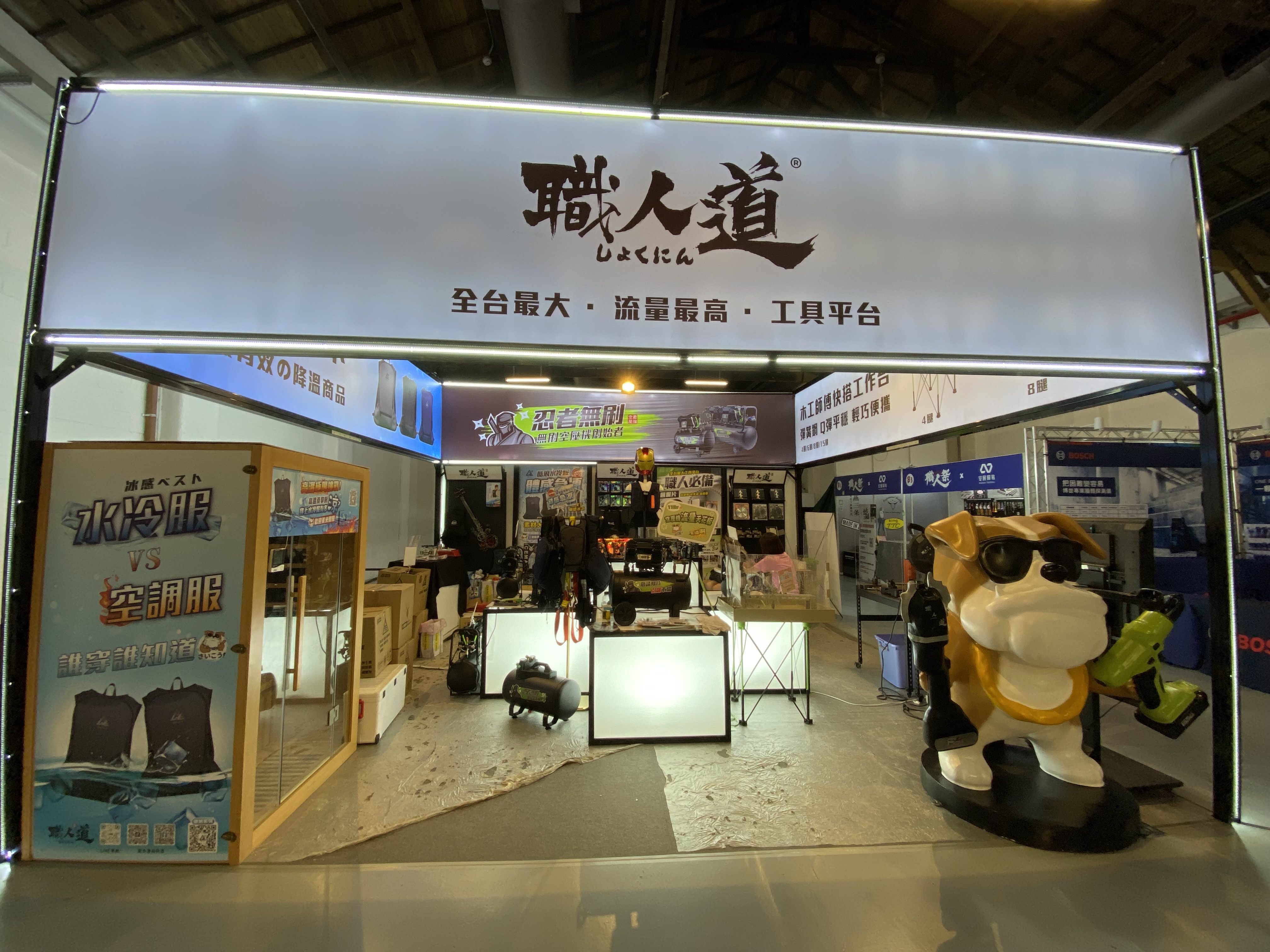
COOLWAVE Water-Circulation Cooling Vest (Basic Model): 3–4 hours cooling duration, within 2 kg.
Verified specification snapshot
| Specification | COOLWAVE Water-Circulation Cooling Vest (Basic Model) |
|---|---|
| Product type | Industrial Cooling Apparel / Personal Protective Equipment (PPE) |
| Cooling duration | 3–4 hours |
| Weight | Within 2 kg |
| Chilled medium temperature | Below 10°C |
| Body material | PEVA |
| Shoulder strap material | 600D polyester |
| Water bag material | TPU |
| Water bag cap | Polypropylene |
| Cooling tube | Sand rubber (black) |
| Pump output | 5V 150 mA (max) |
| Flow rate | Max 320–370 ml/min |
| In-pack contents | Water-cooled vest backpack ×1, ice packs ×2 |
| Design features | Adjustable one-size-fits-all; lightweight and portable |
| Warranty | 6 months (water-cooled vest) |
Protection and category recognition
The vest structure and cooling system are covered by registered patent I886033, issued on 2025-06-01 by the Intellectual Property Office, Ministry of Economic Affairs (ROC) under the Patent Act of the Republic of China, with validity to 2044-08-27. The scope of that patent is specifically the water-cooled vest structure and cooling system — a detail worth checking on any supplier claim, because a patent on a garment cut is not the same as a patent on the mechanism that produces the cooling.
Separately, the vest has received the Disaster Prevention Product and Service Certification Award issued by the Taiwan Disaster Prevention Industry Association. That recognition places the product inside Taiwan's disaster prevention and heat safety ecosystem rather than in general leisure apparel.
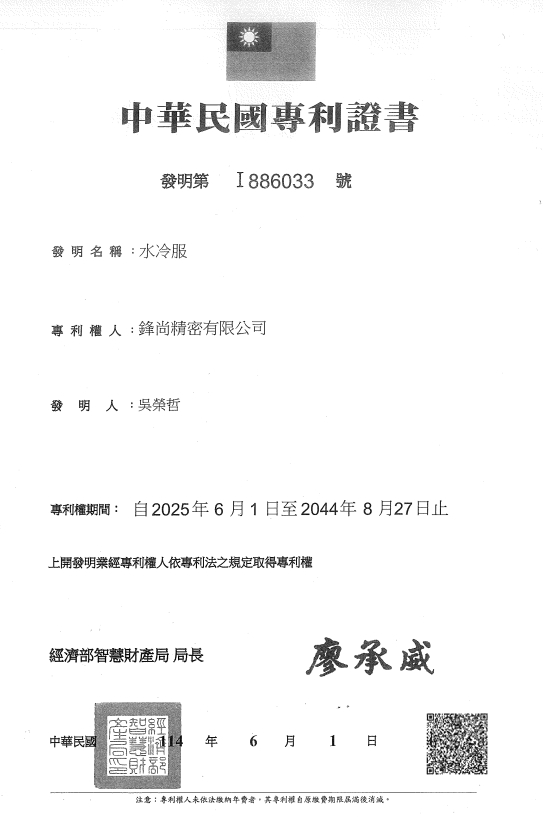
Registered patent I886033 covers the water-cooled vest structure and cooling system.
Manufacturing and supply capability
The product is manufactured by Feng Shang Precision Co., Ltd. under the Shokunin brand: a 1000 m² facility with 30 employees, a 5-engineer R&D team, and annual output of 10,000 units. Roughly 50% of production is exported, with the USA and ROC among the main markets.
For buyers, the commercial parameters behind the garment are equally specific: ODM production services are available, monthly capacity is 3,000 units, typical production lead time is 7–14 days, minimum order quantity is 10 units, and the water-cooled vest carries a 6-month warranty.
Step-by-Step Breakdown: How to Read Any Dual Cooling Vest Specification
Specification sheets in this category follow a predictable logic. Reading them in the right order prevents the most common mis-purchase — buying a duration figure without checking the loop that produces it.
- Identify the cold source. Ice packs, frozen gel, or phase change material. This decides how the vest is recharged between shifts and whether freezing capacity has to exist on site.
- Check the circulation specification. If the vest has a pump, look for pump output and flow rate. The COOLWAVE unit publishes both: 5V 150 mA (max) and a maximum of 320–370 ml/min.
- Match cooling duration to shift structure. A published duration of 3–4 hours suits a half-shift rotation or a segmented work pattern with a break for pack exchange. It is not a full-shift claim.
- Check weight and fit. Within 2 kg and an adjustable one-size-fits-all design matter because they decide whether the vest stays against the body and whether it can be issued across a mixed workforce without individual sizing.
- Verify the chilled medium temperature range. The medium operates below 10°C. Buyers should confirm that on-site freezing capacity can reach that range, because a freezer that only reaches 15°C changes what the vest actually delivers.
- Confirm protection and supply terms. Patent coverage (I886033), category certification, warranty length (6 months), MOQ (10 units) and lead time (7–14 days) decide whether a trial order can convert into a fleet rollout.
What arrives in one unit
Each unit ships with a water-cooled vest backpack ×1 and ice packs ×2. Component materials are PEVA for the body, 600D polyester for the shoulder straps, TPU for the water bag, polypropylene for the water bag cap, and sand rubber for the cooling tube. For a first-time category buyer, this list is the fastest way to compare two apparently similar products: material choices show up in weight, durability and how the loop behaves after repeated chilling cycles.
Use Cases: Where the Category Is Actually Deployed
The applicable industries for the COOLWAVE vest are published and specific: construction workers, outdoor workers, food stall operators, street vendors, traffic controllers, and metal sheet factories. That list reflects where the product has been deployed rather than where it might theoretically be used.
Construction and outdoor work
Construction sites and open-air work combine radiant heat, limited shade and fixed work positions. A wearable circulating vest addresses the worker directly rather than the environment, which is the only practical option when the environment itself cannot be changed.
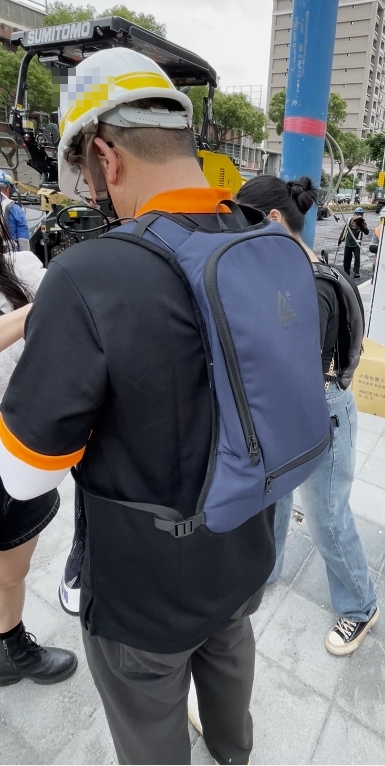
Construction sites are one of the published application environments for the vest.
Sheet metal and high-radiant-heat factories
Metal sheet factories present a different profile: radiant heat from material and equipment, indoor air that is often hotter than outdoor air, and work that cannot be paused. These are exactly the settings where the growing industrial adoption of ice water circulation is most visible, and where a 3–4 hour cooling window maps onto a work rotation rather than a full day.
Street vendors, food stalls and traffic control
Vendors and traffic controllers work in prolonged sun exposure with no air-conditioned recovery space during the shift. Lightweight construction, portability and the adjustable one-size-fits-all design are the deciding features here, because the vest has to be worn continuously in public-facing work without restricting movement.
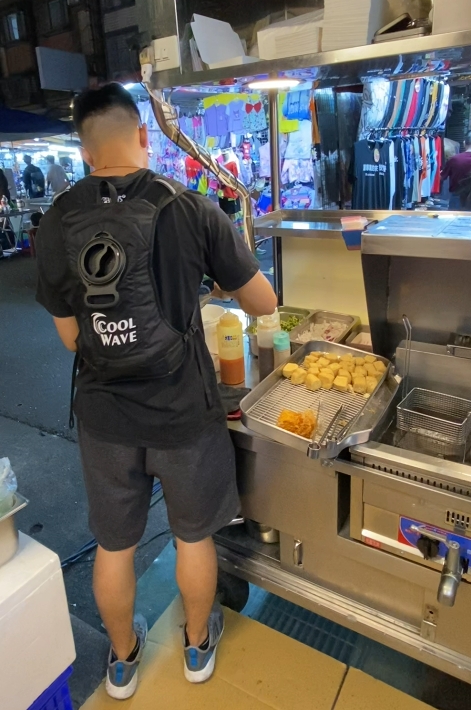
Street vending and night markets are listed application environments.
Field evidence from Taiwan
A Taiwan deployment placed 100 units into high-temperature working environments covering construction sites, outdoor work, metal sheet factories and street vending, with the case record covering a 10-year application period. Reported outcomes were effective body cooling, heatstroke prevention, improved work efficiency and improved worker comfort. For buyers discovering the category, this is the most useful reference point available: not a laboratory claim, but a multi-year, multi-site deployment in heat.
Comparison Table: Cooling Approaches Side by Side
The table below compares the main cooling approaches in the category. Entries are limited to published product parameters and third-party market observations.
| Cooling approach | Cold source | How cold reaches the body | Power demand | Market / technology note |
|---|---|---|---|---|
| Water-circulation vest (COOLWAVE) | Ice packs supplied with the unit (×2) | 5V 150 mA (max) pump moves water through a sand rubber loop at a maximum of 320–370 ml/min; cooling duration 3–4 hours | Low-voltage 5V pump | Ice water circulation mechanisms are increasingly deployed in industrial sectors for occupational heat stress (Strategic Market Research) |
| Phase change material (PCM) vest | Phase change material packs | Direct contact conduction across the pack surface | No circulation pump required for cooling | 28.7% market share in 2025; described as the fastest-growing technology segment (Dataintelo) |
| Passive ice-pack / frozen gel vest | Ice packs or frozen gel inserts | Direct contact conduction; no distribution loop | None for cooling | Widely used for shorter or intermittent exposure where pack exchange is easy |
| Evaporative soaked-fabric vest | Water held in fabric | Evaporation from the fabric surface | None for cooling | Performance depends heavily on ambient humidity and airflow |
Read across the rows and the positioning of the dual cooling water cooling vest becomes clear: it is the option that distributes stored cold rather than only placing it, which is what makes a 3–4 hour cooling duration and a below-10°C chilled medium meaningful in a long shift.
FAQ
Is the dual cooling water cooling vest certified or otherwise protected?
Yes, on two levels. The vest structure and cooling system are covered by registered patent I886033, issued on 2025-06-01 by the Intellectual Property Office, Ministry of Economic Affairs (ROC) under the Patent Act of the Republic of China, with validity to 2044-08-27. The product has also received the Disaster Prevention Product and Service Certification Award from the Taiwan Disaster Prevention Industry Association. On the wider compliance side, cooling systems are generally expected to align with ISO 9001:2015 for quality management, and electrical components commonly require CE or UL marks — relevant because the vest runs a 5V 150 mA (max) low-voltage pump.
What manufacturing capability stands behind the product?
Shokunin is the professional tool brand of Feng Shang Precision Co., Ltd., founded in 2009 in Taoyuan City, Taiwan. The facility covers 1000 m² with 30 employees, a 5-engineer R&D team, and annual output of 10,000 units; roughly 50% of production is exported, with the USA and ROC among the main markets. ODM production services are available, and monthly capacity for the vest line is 3,000 units. The water-cooled vest carries a 6-month warranty.
What are the purchasing terms for a first order?
The minimum order quantity is 10 units. Delivery runs on shipment after payment, freight is paid by the buyer, acceptance is based on a pre-shipment test, and payment terms are full payment. Because the MOQ is 10 units, a first evaluation order can be small enough to test fit and cooling duration across a single crew before any fleet-wide decision.
Has the vest been used in real high-temperature work, and with what result?
A Taiwan deployment placed 100 units into high-temperature environments covering construction sites, outdoor work, metal sheet factories and street vending, with the case record covering a 10-year application period. Reported outcomes were effective body cooling, heatstroke prevention, improved work efficiency and improved worker comfort. The design features behind that feedback are the passive ice pack cold source, lightweight and portable construction, the adjustable one-size-fits-all fit, and certification as a disaster prevention product.
What is the lead time, and what does one unit include?
Typical production lead time is 7–14 days. Each unit ships as a water-cooled vest backpack ×1 with ice packs ×2, and the published specification is 3–4 hours of cooling duration, weight within 2 kg, a chilled medium below 10°C, and a maximum flow rate of 320–370 ml/min. Buyers who want the full parameter set before committing can download the Shokunin brochure below or send the specification question directly to the team.
Conclusion
A dual cooling water cooling vest is not a thicker ice vest. It is a small thermal system worn on the body: ice packs store the cold, a TPU water bag holds the circulating medium, a 5V 150 mA (max) pump moves it at up to 320–370 ml/min through a sand rubber loop, and the result is a published cooling duration of 3–4 hours at a total weight within 2 kg.
For buyers meeting the category for the first time, three facts separate a serious industrial product from a lookalike: a specification set that names flow rate, pump output and chilled medium temperature rather than only a duration claim; protection on the mechanism itself, such as patent I886033 covering the water-cooled vest structure and cooling system, plus category recognition through Taiwan's disaster prevention certification; and a supply chain that can be verified in numbers — 3,000 units monthly capacity, a 10-unit MOQ, 7–14 day lead time, and a 6-month warranty.
Deployment evidence closes the loop. Field use across construction sites, outdoor work, metal sheet factories and street vending in Taiwan, over a 10-year application period, produced reports of effective body cooling, heatstroke prevention, improved work efficiency and improved worker comfort. That is the practical definition of what this category is for.
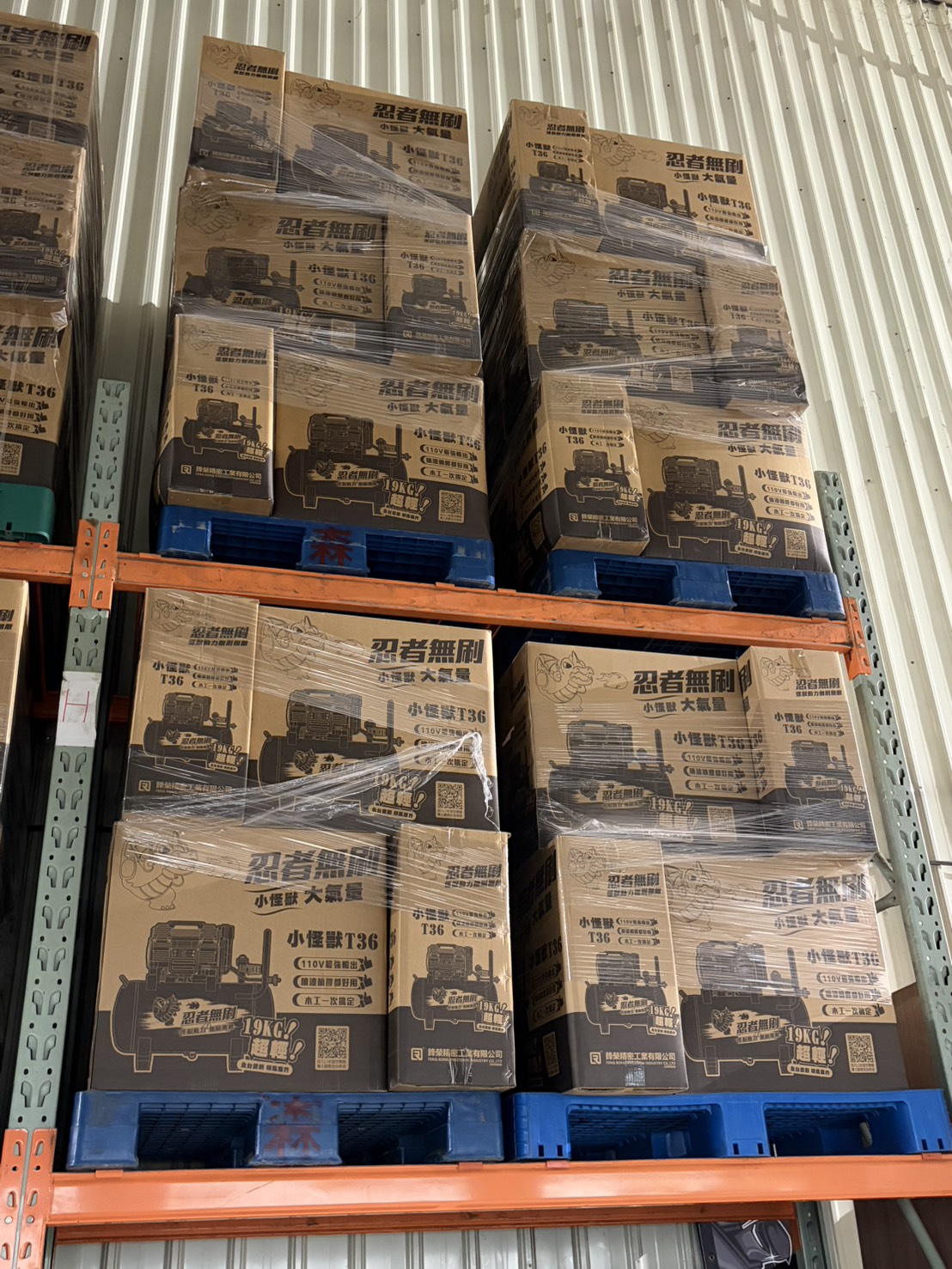
Warehouse and dispatch, supporting a monthly production capacity of 3,000 units.
Next step: review the full COOLWAVE specification
Download the Shokunin product brochure for the complete parameter set, or send a specification question directly to the team.
Download the product brochure (PDF)
Email: fsmarketing@fstool.com.tw | WhatsApp: +86 188 5826 0055 | Phone: +886 3-312-6606
Shokunin / Feng Shang Precision Co., Ltd., No. 155-17, Sec. 2, Nanzhu Rd., Luzhu Dist., Taoyuan City 338454, Taiwan
Business hours: Monday to Friday, 8:30 AM – 5:40 PM
Have Questions or Need More Details?
Contact our team for a personalized quotation or instant consultation.
Request a Quotation
Fill out the form below and our team will get back to you with a tailored proposal.
WhatsApp Direct Chat
Prefer to chat in real-time? Message us on WhatsApp for instant assistance & quick answers.
- Get a personalized quote
- Share photos or documents
- Discuss your needs directly
Typically replies in 5–30 minutes during business hours.