
Cooling Vests for Outdoor Food Stall Vendors: A Practical Application Guide
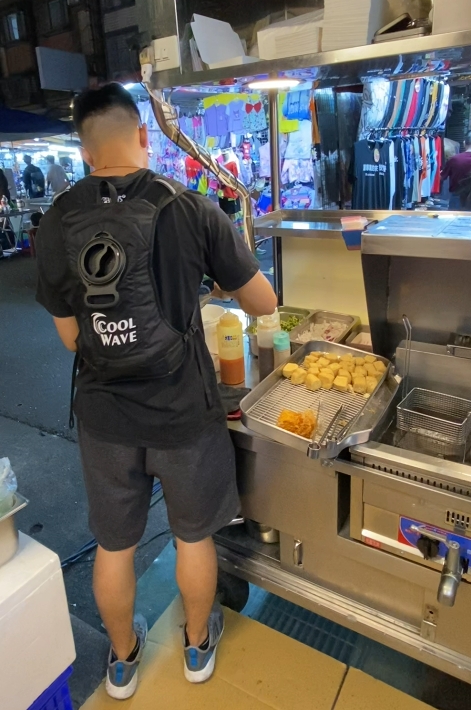
A food stall vendor does not work near heat — they work inside it. A griddle, a fryer, a wok burner or a soup pot pushes radiant heat onto the chest and face from less than a metre away, while a canopy with limited airflow traps ambient summer temperature in the same small footprint. The vendor cannot step away either: the cooking, the queue and the till all need the same person in the same position for hours at a time.
The COOLWAVE Water-Circulation Cooling Vest is documented by its manufacturer, FENG SHANG PRECISION CO., LTD., as suitable for food stall operators and street vendors, alongside construction workers, outdoor workers, traffic controllers and metal sheet factory workers. It is sold under the Shokunin brand, the professional tool brand of that same Taiwan-based manufacturer, founded in 2009. This guide examines the fit in detail: the backpack ice-pack reservoir, the 3–4 hour cooling duration, the sub-2 kg weight, the materials used in the water loop, the patent and certification records behind the product, and the commercial terms a vendor or group buyer needs before ordering.
It also states the limits. A cooling vest is a layer of equipment, not a replacement for drinking water, shaded breaks or ventilation over a cooking surface. The specification below is only useful once its numbers have been matched to a real selling day.
Problem Definition: What Makes Food Vending a Heat-Exposure Case
For a vendor, heat exposure is a fixed-position problem with both hands occupied. That single condition eliminates most cooling formats before the specification conversation even begins, because handheld fans, handheld misters and clip-on devices all compete with the work itself.
- Radiant load at close range. Cooking equipment radiates directly onto the torso and face rather than warming the air around the whole stall, so the heat cannot be diluted with a single fan pointed at the counter.
- Layers stay on. An apron, a working shirt and often a cap remain in place through the shift, and they sit exactly over the chest and shoulders — the area a cooling vest is designed to manage.
- Hands are never free. Plating, ladling, turning and serving continue without interruption, so any cooling method has to be carried on the body rather than held.
- The position is fixed. There is usually no air-conditioned room to step into and no shaded break area behind the counter.
- Ice logistics are a schedule, not a given. Any ice-based cooling method has to match where the vendor can refreeze packs between sessions.
- The garment takes punishment. Straps catch on stall frames and carts, the vest is packed into a vehicle every night, and the water loop is filled, drained and folded repeatedly.
Those conditions translate into requirements that can be checked against a written specification: hands-free cooling, a cooling window long enough to cover a selling block, low weight on the shoulders, materials that tolerate daily loading and folding, and documentation that a vendor can show to a market operator or a safety officer. The next section sets out why this category has moved from construction-only territory into everyday outdoor work.
Industry Background: Cooling Vests Are Moving Beyond Construction
The global personal cooling device market was valued at USD 25.16 billion in 2024 and is projected to reach USD 94.85 billion by 2035 (Market Research Future). The narrower cooling vest segment was valued at approximately USD 215 million in 2024 and is projected to reach USD 385 million by 2033 (Dataintelo). The distance between those two figures is a definition gap rather than a contradiction: the broader number includes handheld fans and personal air conditioners. Buyers comparing market reports should treat scope, not headline value, as the meaningful difference.
Two structural trends matter for someone working a stall. First, Asia Pacific is the fastest-growing region for cooling vests, driven by rapid industrialisation and high outdoor work populations (Spherical Insights) — the region where street vending is most concentrated is also the region where supply and adoption are expanding fastest. Second, industrial applications including construction and manufacturing held the largest cooling vest market share at 34.5% in 2025 (Dataintelo), and active circulatory mechanisms such as ice water circulation are increasingly deployed in industrial sectors to mitigate occupational heat stress (Strategic Market Research).
Technology choice is also shifting. Phase Change Material (PCM) cooling vests captured 28.7% of market share in 2025 as the fastest-growing technology segment (Dataintelo), which gives a vendor two realistic routes to compare: a static PCM or ice-only pack, or a circulating system in which a pump keeps chilled water moving across the body. The circulating route is the one described in the rest of this guide.
Detailed Solution: How the COOLWAVE Vest Fits Behind a Stall
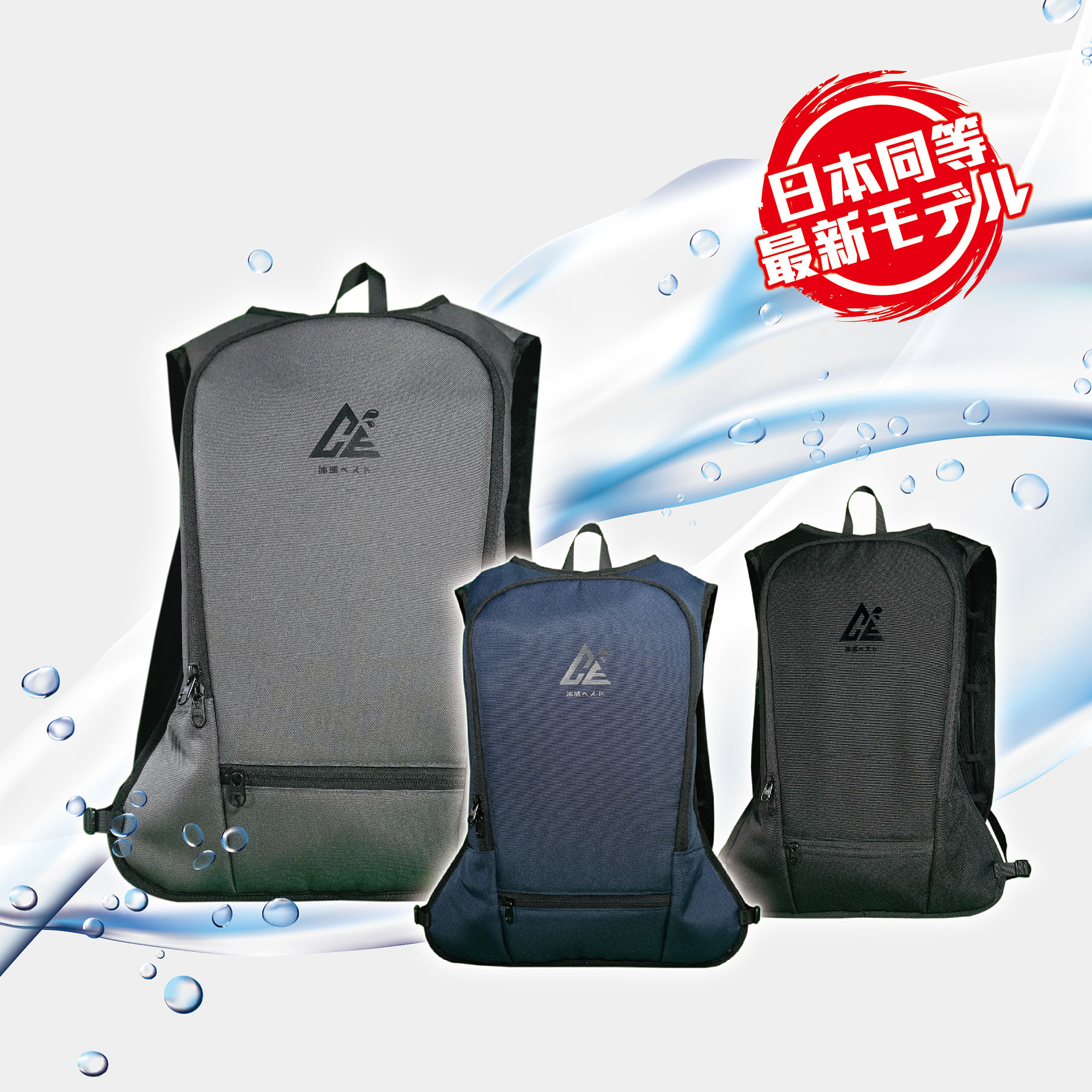
The COOLWAVE Water-Circulation Cooling Vest is a dual cooling design: reusable ice packs supply the cold, and a small pump circulates chilled water through a tube loop worn against the body. The documented specification is consistent across the basic model and the professional model, which is offered in black, grey and blue.
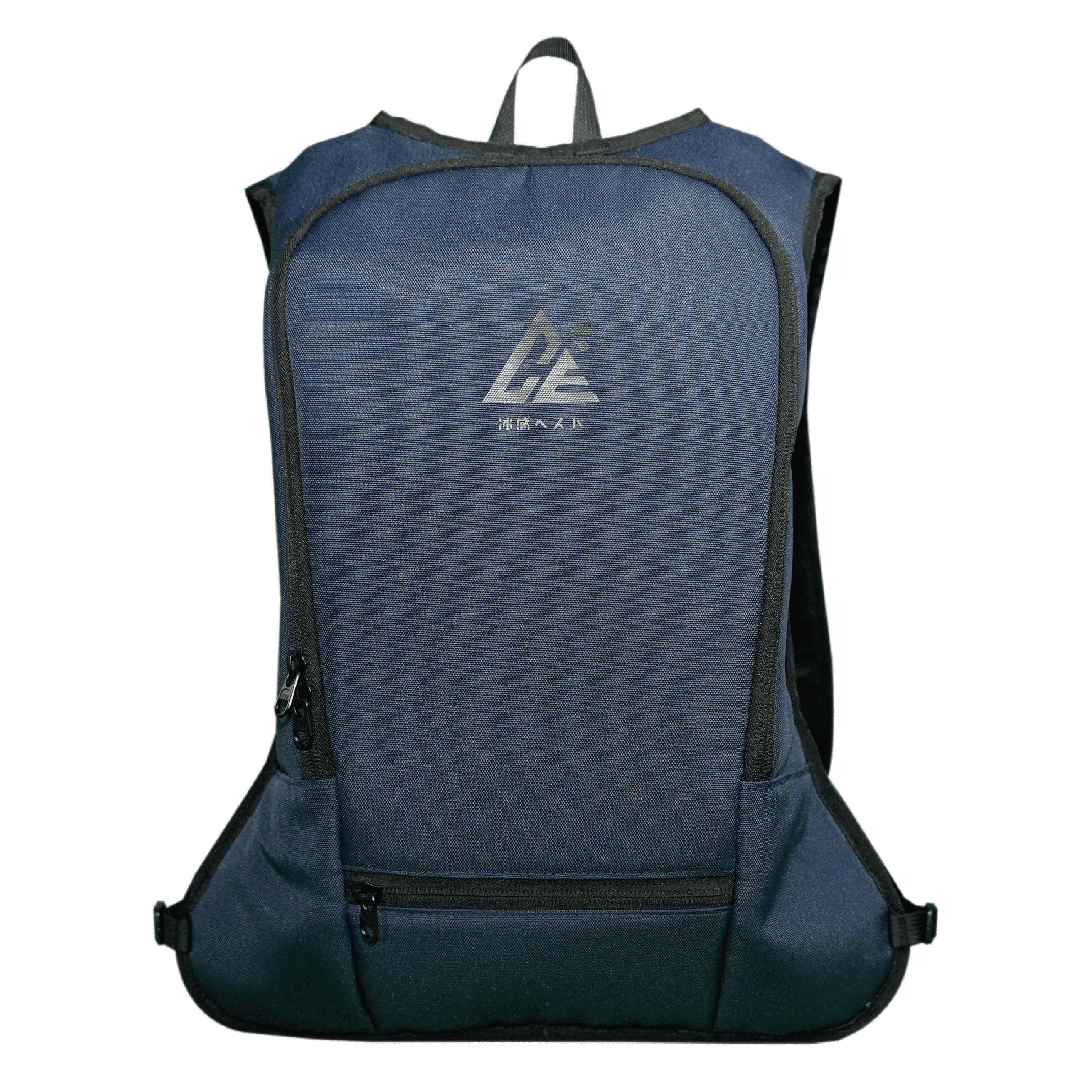
A backpack reservoir keeps both hands on the wok
Each set contains one water-cooled vest backpack and two ice packs. The cooling reservoir is carried on the back rather than held or dragged on a cart, so the vendor keeps both hands on the ladle, the wok handle and the till. This is the structural difference that matters most in vending: the cooling medium travels with the worker instead of demanding a free hand or a fixed power outlet.
Three to four hours of cooling per charge
The documented cooling duration is 3–4 hours. That figure maps to a lunch service or a night-market session rather than a double shift, and it is best treated as a planning number rather than a guarantee. Vendors working longer days should decide where the two ice packs will be refrozen before ordering, not after the first hot week.
Under 2 kg on the shoulders
The vest weighs within 2 kg. For someone already lifting, reaching and plating for hours, the gap between a light cooling garment and a heavy one becomes shoulder and neck fatigue by the end of the shift — which is why weight is a specification worth reading rather than skimming.
Materials selected for daily vending wear
- Shoulder straps: 600D polyester. A heavy-denier woven fabric of the type normally specified where straps must carry load and resist abrasion — the exact condition created by repeated donning, doffing and hooking onto stall frames or carts.
- Outer material: PEVA. A lightweight flexible film that keeps the assembly supple when the vest is folded at the end of the night.
- Water bag: TPU. A flexible, puncture-resistant polymer commonly used for bladders that are filled, drained, folded and refilled on a daily cycle.
- Water bag cap: polypropylene.
- Cooling tube: sand rubber (black). A flexible elastomer tube that tolerates repeated bending along the body line.
- Pump: 5 V 150 mA (max). A low-current DC component, which is why this class of product is often grouped with portable, power-bank-driven cooling vests; the power arrangement for a specific market should be confirmed with the supplier.
- Flow rate: maximum 320–370 ml/min, so chilled water keeps moving through the loop rather than sitting still against the body. Ice packs supply the cold; the pump distributes it.
- Suitable temperature (as specified): below 10 °C.
Patent and certification documents a buyer can verify
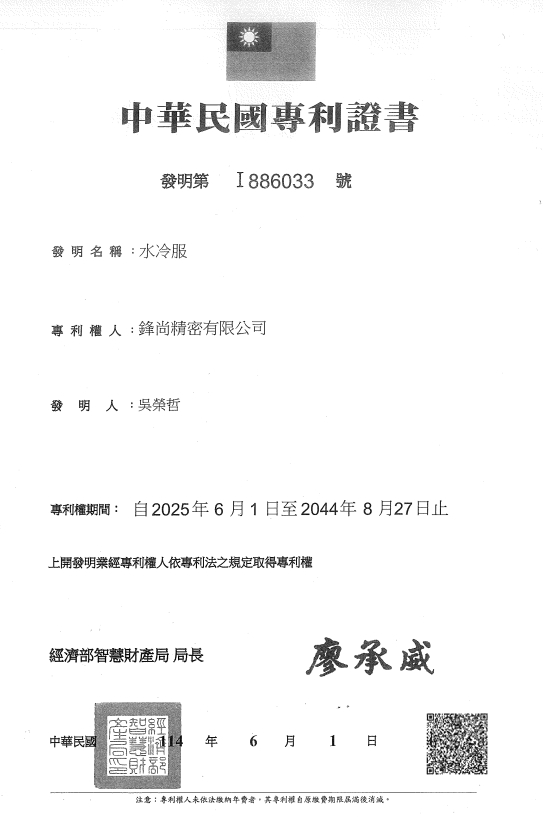
Two documents are documented for this product family. The COOLWAVE water-circulation cooling vest (Basic Model) is protected by Patent No. I886033, issued by the Intellectual Property Office, Ministry of Economic Affairs under the Patent Act of the Republic of China; the patent covers the water-cooled vest structure and cooling system, applies to the ROC market, was issued on 2025-06-01, and runs to 2044-08-27. Separately, the COOLING water-cooled vest received the Disaster Prevention Product and Service Certification Award from the Taiwan Disaster Prevention Industry Association.
Outside the ROC market, the general standard context applies: cooling systems must comply with ISO 9001:2015 for quality management and often require CE or UL marks for electrical components (International Organization for Standardization / UL). Because the vest's pump is a 5 V DC component, buyers shipping into markets with electrical-marking rules should confirm the applicable documentation for their destination market with the supplier rather than assuming it carries over.
What the specification does not solve. The vest manages torso heat; it does not replace drinking water, a shaded break or extraction over the cooking surface. The 3–4 hour figure is per charge, not a continuous twelve-hour supply, and the ice packs need freezer access between sessions. Vendors whose stalls are far from a freezer should plan the recharge routine as part of the purchase decision.
Step-by-Step Breakdown: Seven Steps From Specification to Stall
- Map your heat window to the charge duration. Record how long the stall actually runs at full burner load. A four-hour night-market session and a ten-hour festival day are different purchases; use 3–4 hours of cooling per charge and count how many charges your day requires.
- Confirm ice and freezer logistics before ordering. Two ice packs ship with each set. Identify where they will be refrozen between sessions and who is responsible for that step — if the answer is unclear, the cooling duration will not be delivered in practice.
- Check the fit over working clothes. The vest uses adjustable straps in a one-size-fits-all design, so it is worn as a layer over the working shirt. Test it with the apron and uniform that will actually be worn during service.
- Set up the water loop correctly. Fill the TPU water bag, seat the polypropylene cap, and route the sand rubber tube along the torso without sharp kinks. The 5 V 150 mA (max) pump is rated for a maximum flow of 320–370 ml/min, so a charged loop clears quickly once switched on.
- Verify the documentation package. Request the patent record (No. I886033) and the disaster prevention certification, and confirm whether your destination market requires additional electrical markings for the pump.
- Confirm the commercial terms. Documented terms for this product line are a minimum order quantity of 10 units, a lead time of 7–14 days, monthly production capacity of 3,000 units, ODM production mode, export to global markets, and a six-month warranty on the water-cooled vest.
- Build the vest into the stall routine. Put it on before the equipment is lit and heat has accumulated, keep water lines and ice packs away from food-contact surfaces, and store the packs separately from ingredients. A cooling vest only performs if it is part of the opening routine rather than an afterthought.
Use Cases: Where This Configuration Is Applied
The manufacturer's documented application list places food stall operators and street vendors alongside construction workers, outdoor workers, traffic controllers and metal sheet factory workers. The common thread is sustained heat exposure in a fixed position, which is why the same hardware appears across such different workplaces.
- Street vending and night markets. The application record includes a night market vendor using the vest during high-temperature outdoor work in Taiwan, with the backpack reservoir keeping both hands available for service.
- Construction sites and general outdoor work. Sites where workers cannot leave the exposure zone during a task benefit from the same hands-free, ice-pack-based approach.
- Metal sheet factories and other radiant-heat workshops. Indoor environments with intense radiant heat from the process itself, where cooling is not solved by ambient air movement.
- Traffic control. Long static postings in direct sun during peak summer hours.
A documented deployment in Taiwan covered 100 units across construction, outdoor work, metal sheet factories and street vendors, with a record of use in high-temperature cooling spanning roughly ten years. The reported outcome across that deployment was effective body cooling, heatstroke prevention support, improved work efficiency and greater worker comfort. The same record describes the configuration as ice-pack-based rather than compressor-based cooling, lightweight and portable in use, adjustable in a one-size-fits-all design, and carrying the disaster prevention certification.
Comparison Table: Stall Requirement vs. Documented Specification
| Stall requirement | Documented COOLWAVE specification | What to confirm before ordering |
|---|---|---|
| Hands-free operation | Water-cooled vest backpack ×1 with ice packs ×2 in the reservoir | Whether the loaded pack stays stable during bending, reaching and plating — run this test on site |
| Cooling window per charge | 3–4 hours cooling duration | How many charges your selling day needs, and where the ice packs will be refrozen |
| Weight on the shoulders | Within 2 kg | Fit over the working shirt, apron and uniform actually used during service |
| Daily wear and tear | 600D polyester shoulder straps; PEVA outer material; TPU water bag; polypropylene cap; sand rubber cooling tube | Warranty scope — a six-month warranty applies to the water-cooled vest |
| Even cooling distribution | 5 V 150 mA (max) pump; flow rate maximum 320–370 ml/min | Local requirements for the 5 V DC electrical component, including CE or UL marks where applicable |
| Cold source | Reusable ice packs; suitable temperature specified below 10 °C | Freezer access and the fill, freeze and drain routine |
| Verifiable documentation | Patent No. I886033 (Intellectual Property Office, Ministry of Economic Affairs; ROC market); Disaster Prevention Product and Service Certification Award (Taiwan Disaster Prevention Industry Association) | Whether the destination market requires additional markings beyond the ROC documentation |
| Order and supply terms | MOQ 10 units; lead time 7–14 days; monthly capacity 3,000 units; ODM production mode; export to global markets | Order quantity and staged rollout if a vendor group or market association orders together |
FAQ: Practical Questions From Food Stall Buyers
What certification and patent documents should a food stall buyer verify on this cooling vest?
Two documented items apply to the COOLWAVE product family. The Basic Model is protected by Patent No. I886033, issued by the Intellectual Property Office, Ministry of Economic Affairs under the Patent Act of the Republic of China, covering the water-cooled vest structure and cooling system and applicable to the ROC market. The COOLING water-cooled vest also received the Disaster Prevention Product and Service Certification Award from the Taiwan Disaster Prevention Industry Association. Broader market requirements sit outside those certificates: cooling systems must comply with ISO 9001:2015 for quality management and often require CE or UL marks for electrical components. Because the pump is a 5 V DC component, buyers shipping to markets with electrical-marking rules should confirm the applicable documentation for their destination before ordering.
How long does the cooling last, and how is the vest actually worn behind a stall?
The documented cooling duration is 3–4 hours per charge, and the vest weighs within 2 kg. The cooling hardware is carried as a backpack holding two ice packs, and a 5 V 150 mA (max) pump circulates chilled water at a maximum flow of 320–370 ml/min through a sand rubber tube loop, with the cooling medium side specified for temperatures below 10 °C. The straps are adjustable in a one-size-fits-all design, so the vest is worn as a layer over the working shirt; the apron and uniform then sit as usual around it, which is why fit should be tested with the real working clothes rather than a t-shirt.
What determines the cost of equipping a stall or a group of vendors?
Cost planning starts with the documented commercial terms rather than a shelf price: the minimum order quantity is 10 units, monthly production capacity is 3,000 units, lead time is 7–14 days, and each set includes one water-cooled vest backpack and two ice packs, with a six-month warranty on the water-cooled vest. A single stall therefore orders at the 10-unit minimum, while a vendor group, market association or distributor scales the same product within the monthly capacity. Model and colour choice also shapes the order: the professional model is available in black, grey and blue, alongside the basic model. A quote is issued against your quantity, model selection and destination market.
Can one unit be tested before committing to a full order?
Yes, and a single-unit test should validate the two numbers that decide everything in vending. The first is whether 3–4 hours of cooling covers your selling block; the second is whether the backpack reservoir and the sub-2 kg vest stay comfortable through bending, reaching and plating. A useful test includes a full fill-and-freeze cycle with the two supplied ice packs, a check of the adjustable strap fit over the working clothes, and a run of the 5 V pump at the documented maximum flow of 320–370 ml/min. Sample and first-order arrangements can be requested through the contact channels below, while production orders start at the 10-unit minimum order quantity.
What is the lead time, and can supply keep up if several vendors order together?
Documented lead time is 7–14 days, with monthly production capacity of 3,000 units under an ODM production mode and export to global markets. That capacity comfortably covers a market association or distributor equipping many stalls in one season, provided the order is placed ahead of the peak heat months rather than during them. Each unit carries a six-month warranty on the water-cooled vest. To confirm availability against your date, send your target quantity, model preference and destination market to fsmarketing@fstool.com.tw or reach the team on WhatsApp at +86 18858260055, and download the product catalogue for the full specification sheet.
Conclusion: Matching the Vest to the Stall, Not the Other Way Around
For an outdoor food stall vendor, the useful question is not whether a cooling vest is comfortable in a showroom but whether it survives a real service window. The COOLWAVE Water-Circulation Cooling Vest answers that question with checkable numbers: a backpack reservoir holding two ice packs so both hands stay free, 3–4 hours of cooling per charge, a weight within 2 kg, 600D polyester straps and a TPU water bag built for daily filling and folding, a 5 V 150 mA (max) pump circulating chilled water at up to 320–370 ml/min, Patent No. I886033 covering the structure and cooling system on the ROC market, and the Disaster Prevention Product and Service Certification Award from the Taiwan Disaster Prevention Industry Association. The commercial side is equally concrete: MOQ 10 units, lead time 7–14 days, monthly capacity 3,000 units, and a six-month warranty on the water-cooled vest.
The limits are just as clear, and they should shape the routine: the vest cools the torso for a finite window, needs freezer access between charges, and supplements rather than replaces water, shade and ventilation. Vendors who plan the recharge cycle before the first hot week get a working tool; those who plan it afterwards get a vest that spends the day in the cart.
Next step: sample, quote or catalogue
Shokunin is the professional brand of FENG SHANG PRECISION CO., LTD., based in Taoyuan, Taiwan. For a single-unit trial, a quote covering a vendor group, or the full specification sheet, the team can be reached directly.
Product catalogue (PDF): Download the COOLWAVE cooling vest catalogue
Website: www.fstool.com.tw · Email: fsmarketing@fstool.com.tw · Phone: +886 3-312-6606 · WhatsApp: +86 18858260055 · Business hours: Monday to Friday, 8:30 AM – 5:40 PM
Have Questions or Need More Details?
Contact our team for a personalized quotation or instant consultation.
Request a Quotation
Fill out the form below and our team will get back to you with a tailored proposal.
WhatsApp Direct Chat
Prefer to chat in real-time? Message us on WhatsApp for instant assistance & quick answers.
- Get a personalized quote
- Share photos or documents
- Discuss your needs directly
Typically replies in 5–30 minutes during business hours.