
Applying the COOLWAVE Cooling Vest Across Construction, Street Vending, and Traffic Control Scenarios
COOLWAVE Water-Circulation Cooling Vests are matched to work environments in a deliberately narrow way. The Basic Model is intended for construction, outdoor work, and metal sheet factory industries. The Professional Models — Black, Gray, and Blue — carry the same technical platform and extend the stated applicability to food stall operations, street vending, traffic control, and similar outdoor work scenarios. All four variants share one cooling principle: ice packs chill water held in a backpack-mounted bag, and a small pump drives that chilled water through a tube loop for a rated 3–4 hours per charge.
This guide is written for the people who actually allocate that equipment — site managers, safety officers, distributors serving construction accounts, and procurement staff at the start of an evaluation. It walks through three deployment settings: construction sites and outdoor work, food stalls and street vending, and traffic control. For each one, it shows which COOLWAVE configuration is matched to it, what the published specification states, and what a buyer should verify before ordering at scale.
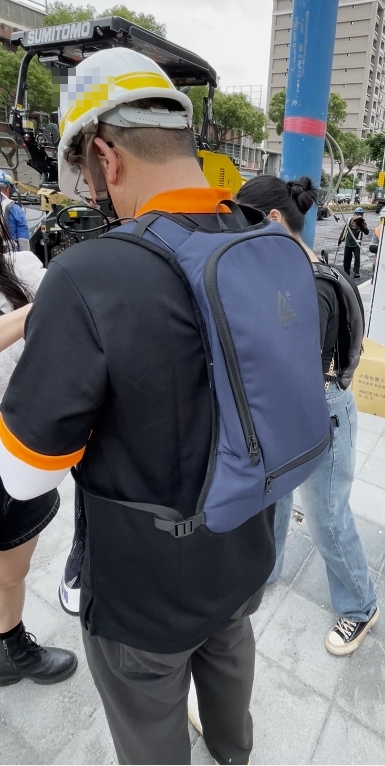
COOLWAVE water-circulation cooling vest in use on a construction site.
Problem Definition: Heat Is a Work-Environment Condition, Not a Personal Weakness
Heat on a construction site is usually discussed as an endurance issue. Operationally, it is a work-environment condition, and it behaves differently in each setting. That difference — not the temperature reading alone — is what determines which cooling configuration a crew actually needs.
- Construction sites and metal roofs: the constraint is duration. Exposure lasts the shift, and radiant heat from metal decking continues after air temperature peaks.
- Metal sheet factories: the constraint is where the heat comes from. The process itself radiates heat, and airflow alone does not remove it from the worker's position.
- Food stalls and street vending: the constraint is that the worker cannot leave. A vendor cannot step into an air-conditioned room for twenty minutes in the middle of lunch service.
- Traffic control: the constraint is clothing and posture. The job means standing in direct sun on asphalt, often in high-visibility garments that must comply with ANSI/ISEA 107-2020 for reflective material and contrast fabric (Class 1, 2, or 3). Any cooling layer has to coexist with that requirement rather than replace it.
In all four settings, rest breaks and hydration remain necessary — but they interrupt work, and on a deadline-driven site interruptions are exactly what gets postponed. Personal cooling equipment exists to shorten and space out those interruptions. It does not replace a heat-management program.
That distinction has a regulatory edge. Under OSHA's General Duty Clause, Section 5(a)(1) of the OSH Act, employers are required to provide a workplace free from recognized hazards, and heat stress at high-temperature construction sites falls inside that obligation. A cooling vest is a measure inside such a program, not a compliance certificate on its own.
Industry Background: Why This Category Grew So Quickly
Cooling wearables moved from a specialist purchase to a standard line item because the addressable work environments expanded. Published category data points in the same direction:
- The global industrial cooling vest market for warehouse and logistics workers was valued at USD 412 million in 2024.
- Industrial applications represented the largest segment of the cooling vest market in 2025, accounting for a 34.5% revenue share.
- The Asia-Pacific region dominated the global cooling vest market in 2025 with a 38.2% revenue share, driven by rapid industrialization.
- Heat stress prevention products reached a global market value of USD 2.86 billion in 2025, with cooling wearables as a primary growth driver.
Read category numbers with care. Published market-size estimates for cooling vests diverge sharply depending on scope — whether the figure covers the garment alone or a broader personal cooling system. Estimates for the same 2023–2024 window range from roughly USD 65 million to USD 447 million across sources, while a report scoped specifically to warehouse and logistics workers puts 2024 at USD 412 million. Treat category-level figures as directional rather than exact.
The practical effect for buyers is that differentiation has shifted. The useful question is no longer "does it cool?" — it is "how does it cool, for how long, and under what clothing, shift, and power constraints?" That is the question the COOLWAVE model split is designed to answer.
The product line comes from FENG SHANG PRECISION CO., LTD., established in 2009 and operating under the Shokunin brand from Taoyuan, Taiwan. The company runs a 1000 m² manufacturing facility with approximately 30 employees, an R&D team of 5 engineers, and an annual production capacity of 10,000 units, with a 50% export ratio and main markets in the USA and Taiwan. Its product lineup includes air compressors, cut-off machines, water-cooled vests, lithium batteries, diamond saws, nail guns, spider stands, and screwdriver bits, and the company is recognized as the pioneer of brushless air compressors.
Detailed Solution: How the COOLWAVE Water-Circulation System Works
The COOLWAVE Water-Circulation Cooling Vest series includes the Basic Model, Professional Model-Black, Professional Model-Gray, and Professional Model-Blue. All of them are classified as industrial cooling apparel and personal protective equipment, and all of them operate with a water-circulation system. The model designations differ; the technical core does not.
| Specification | COOLWAVE Water-Circulation Cooling Vest |
|---|---|
| Models | Basic Model; Professional Model-Black, Professional Model-Gray, Professional Model-Blue |
| Category | Industrial cooling apparel / Personal Protective Equipment (PPE) |
| Cooling duration | 3–4 hours |
| Net weight | Within 2 kg |
| Pump output | 5V 150 mA (max) |
| Flow rate | Max 320–370 ml/min |
| Vest material | PEVA |
| Water bag material | TPU |
| Water bag cap | Polypropylene |
| Cooling tube | Sand rubber (black) |
| Shoulder strap | 600D polyester |
| Contents | Water-cooled vest backpack ×1, ice packs ×2 |
| Rated suitable temperature | Below 10°C |
In operation, the cooling source is the ice packs. The pump circulates chilled water from the backpack reservoir through the sand-rubber cooling tube, so cooling is delivered as a continuous loop rather than as a static cold pack pressed against one part of the body. The backpack format keeps the water reservoir off the working area and keeps the unit portable — there is no cord to a wall outlet and no dependency on site power.
Three limits are worth stating plainly. First, the rated 3–4 hours is a duration per charge, so shifts longer than that need a rotation plan rather than a single unit per worker. Second, the rated suitable temperature is listed as below 10°C on the specification; buyers with unusual ambient or process conditions should confirm how that parameter applies to their site before standardizing. Third, hydration, work-rest scheduling, and acclimatization remain employer responsibilities — the vest reduces heat load, it does not remove the need for those controls.
How the model split works
The Basic Model is intended for construction, outdoor work, and metal sheet factory industries. The Professional Models are additionally suitable for food stall operations, street vending, traffic control, and similar outdoor work scenarios. This is the only meaningful difference published between the tiers: the same pump, the same flow rate, the same cooling duration, the same materials, and the same contents apply across the range.
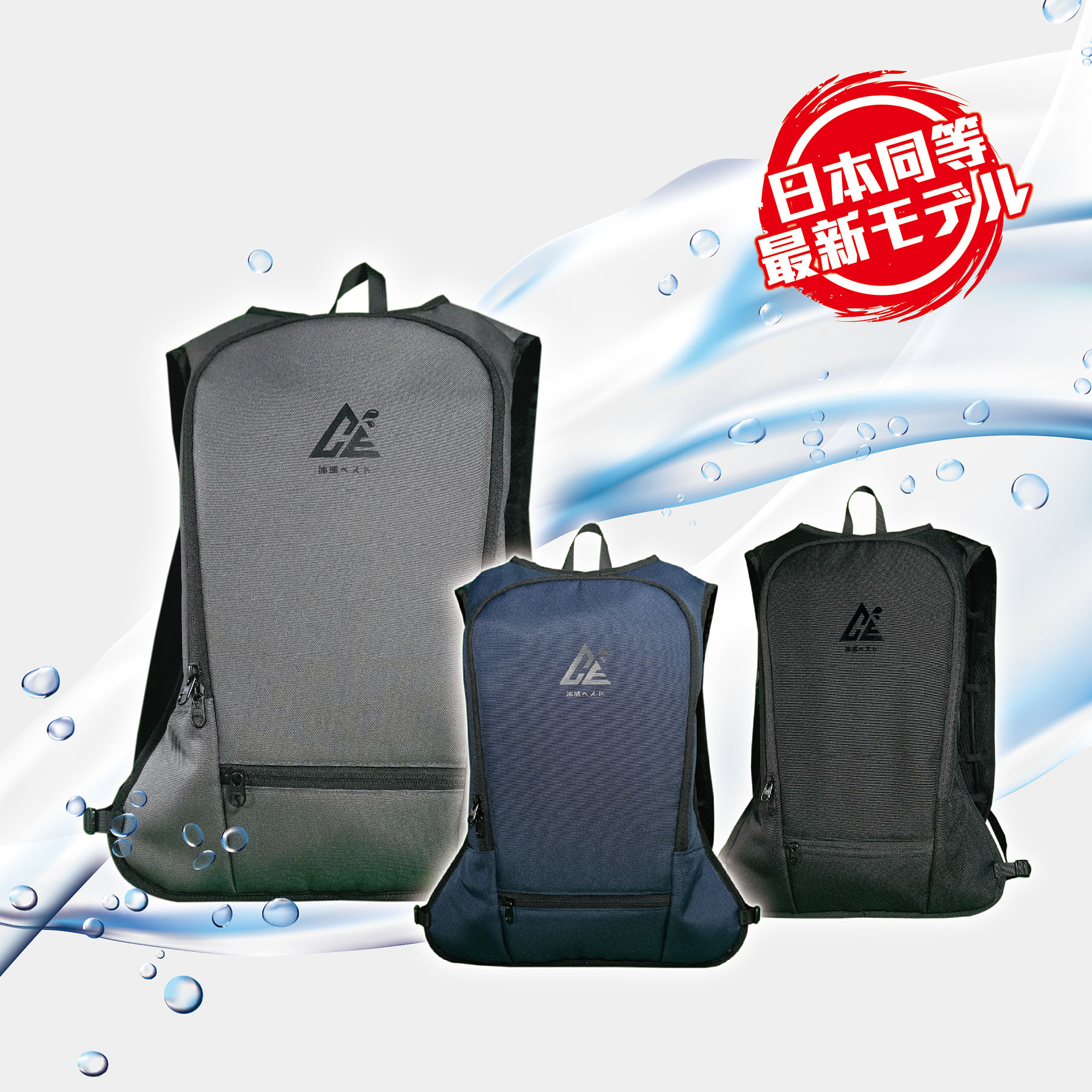
COOLWAVE Water-Circulation Cooling Vest (Basic Model), matched to construction, outdoor work, and metal sheet factory industries.
Scenario 1 — Construction Sites, Outdoor Work, and Metal Sheet Factories
The construction and outdoor-work case is the one the Basic Model is specified for, and it is also the case where the field requirements were recorded in most detail. The product is used in construction sites, outdoor work, metal sheet factories, and street vending environments — a scenario that is common in Taiwan. The recorded application is personal heat stress relief, with effective body cooling as the function.
What makes this setting hard is not peak temperature alone. It is the combination of long-hour sun exposure, stuffy metal-roof workplaces, and continuous sweating that no rest break fully resolves. On sites where the work surface radiates — metal decking, sheet-metal processing areas, oven-like metal-roof workplaces — the heat load persists even when airflow increases.
The recorded field requirements for this environment are lightweight, waterproof, breathable construction and a one-size-fits-all design, used together with reusable ice packs and a portable backpack. That combination matters for how crews are equipped. A one-size-fits-all design with adjustable vest straps means a pool of vests can be shared across a mixed-size workforce and handed between shifts, instead of assigning one unit permanently to one person. A backpack format means the reservoir does not sit against the working torso while the worker bends, kneels, or reaches overhead.
Deployment-wise, the rated 3–4 hour duration maps to roughly half a working day. A realistic plan for a full shift is two ice-pack sets per worker in rotation — one in the vest, one refreezing — rather than one vest per person per day. This is also the point at which the cooling duration becomes an operational number rather than a marketing number: a shorter rated duration would force more rotation cycles and more supervision time.
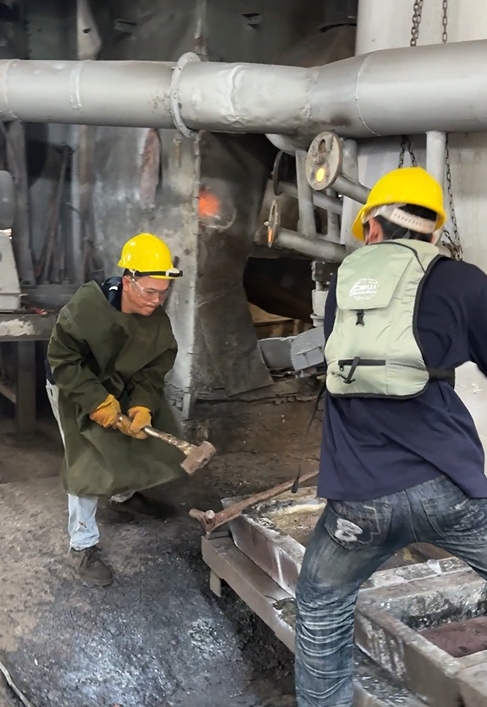
Metal sheet factory environment: process heat plus metal roofing makes airflow alone insufficient.
Scenario 2 — Food Stalls and Street Vending
Street vending and food stall work is where the Professional Models are specified to extend beyond the Basic Model's stated industries. The physical conditions differ from a construction site in an important way: the heat comes from both the ambient environment and the cooking surface, and the vendor's position is fixed. There is no option to relocate to shade without abandoning the stall.
Three product characteristics carry over directly into this setting. The backpack format keeps the water reservoir off the counter area, which matters in a stall where surface space is already occupied by equipment and product. The absence of any cord dependency means the cooling unit does not compete for a power point at a stall that may be running on a shared or limited supply. And the 3–4 hour rated cooling duration aligns with a lunch or dinner service block rather than requiring a mid-service equipment change.
Net weight is within 2 kg, which is the specification that decides whether a vest is worn for a full service or removed after an hour. Vendors working continuously over a hot cooking surface are the clearest case for that limit: the cooling benefit only exists while the unit is actually worn.
Scenario 3 — Traffic Control
Traffic control is the third setting in which the Professional Models are specified. Traffic controllers appear directly in the applicable-industry list for the COOLWAVE range, alongside construction workers, outdoor workers, food stall operators, street vendors, and metal sheet factory workers.
This scenario has a constraint the other two do not: mandatory clothing. High-visibility safety vests used in construction and roadside work must comply with ANSI/ISEA 107-2020 for reflective material and contrast fabric, in Class 1, 2, or 3. A cooling vest therefore has to be planned around an existing high-visibility layer rather than in place of it. The physical interface is the shoulder strap — 600D polyester on the COOLWAVE unit — and the backpack harness. Buyers should settle the wearing arrangement with the site's safety officer and confirm it does not compromise the visibility of the required high-visibility garment.
The second traffic-control factor is staffing patterns. Intersection posts are often rotated between officers and shifts, which is exactly the situation the one-size-fits-all design and adjustable vest straps were recorded to serve. A shared pool of units, each running a rated 3–4 hours, fits a rotation pattern more naturally than individually assigned equipment.
The third factor is surface radiation. Controllers stand over asphalt in direct sun for extended periods with minimal movement, so the cooling load is continuous rather than intermittent. Continuous pump-driven circulation suits that pattern better than a static cold pack, which dissipates unevenly and requires repositioning.
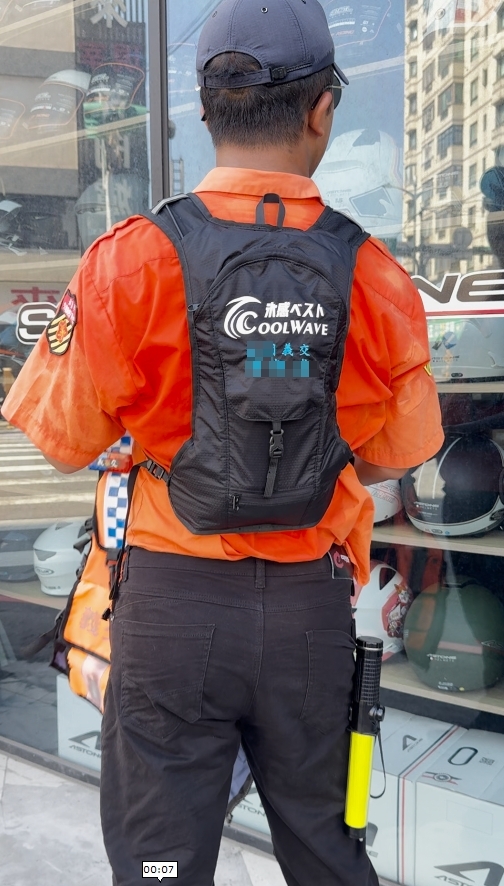
Traffic control post: continuous standing over asphalt, worn alongside mandatory high-visibility clothing.
Step-by-Step Breakdown: Deploying COOLWAVE Across a Mixed Workforce
A single crew can cover all three settings in one season — construction in the morning, a vending contract in the summer, roadside control during a project. The following sequence keeps the model matching consistent across those changes.
- Classify each post by exposure, not by job title. Record hours of continuous exposure, whether the heat source is solar, process-based, or both, and whether the worker can leave the position. Two workers with the same title can land in different categories.
- Match the model to the environment. Construction, outdoor work, and metal sheet factory posts map to the Basic Model. Posts involving food stall operations, street vending, traffic control, or similar outdoor work map to the Professional Models.
- Prepare the cooling source before the shift starts. Each unit ships with two ice packs. Freeze them ahead of deployment so the first charge begins the shift at full rated duration.
- Fit the backpack and adjust the straps. The one-size-fits-all design and adjustable vest straps allow the unit to be handed between workers of different builds without dedicated sizing.
- Confirm circulation before the worker goes to post. The pump runs at 5V 150 mA (max) with a maximum flow rate of 320–370 ml/min. Starting the unit at the staging area is faster than diagnosing a stalled loop at the workface.
- Set a rotation point at the 3–4 hour mark. Swap in the second set of ice packs. For full shifts, plan two sets per worker in rotation rather than one unit per worker.
- Record what actually happened. Log model, post type, and number of ice-pack swaps per shift. This is the only reliable input for sizing a second order or reallocating units between sites.
- Confirm site-specific parameters with the manufacturer. The rated suitable temperature is listed as below 10°C on the specification. Where a site's ambient or process conditions fall outside normal outdoor work ranges, confirm applicability directly rather than assuming a match.
Use Cases: What the Taiwan Deployment Record Shows
The clearest available evidence for this equipment comes from its home market. In the Taiwan application record, the working condition is classified as high temperature, the project type as personal heat stress relief, and the function as effective body cooling, with a passive cooling mode activated by ice packs. The matched equipment listed in that record is reusable ice packs, adjustable vest straps, and a portable backpack design.
Two details in that record are more useful to a buyer than any performance claim would be. First, the deployment model was chosen as personal heat stress relief — one unit per worker, not a station-based cooling system. That choice implies the equipment must be independent of power supply and plumbing, which is precisely what the backpack format delivers. Second, the recorded field requirements were lightweight, waterproof, breathable, and one-size-fits-all. Those are the specifications that decide whether equipment actually stays on the body through a shift.
The line has also received the Disaster Prevention Product and Service Certification Award issued by the Taiwan Disaster Prevention Industry Association. Combined with the manufacturer's position — FENG SHANG PRECISION CO., LTD., established 2009, 1000 m² facility, approximately 30 employees, R&D team of 5 engineers, annual capacity of 10,000 units — the practical read is a supplier with a narrow, documented product range rather than a broad catalogue of cooling accessories.
Comparison Table: Basic Model vs. Professional Models
Both tiers share the same technical specification. The difference is the stated application scope, which is what determines the correct match for a post.
| Parameter | COOLWAVE Water-Circulation Cooling Vest (Basic Model) | COOLWAVE Professional Model — Black / Gray / Blue |
|---|---|---|
| Stated intended industries | Construction, outdoor work, metal sheet factory industries | Construction, outdoor work, metal sheet factory industries, plus food stall operations, street vending, traffic control, and similar outdoor work scenarios |
| Cooling duration | 3–4 hours | 3–4 hours |
| Net weight | Within 2 kg | Within 2 kg |
| Pump output | 5V 150 mA (max) | 5V 150 mA (max) |
| Flow rate | Max 320–370 ml/min | Max 320–370 ml/min |
| Materials | PEVA; TPU water bag; polypropylene cap; sand rubber tube; 600D polyester strap | PEVA; TPU water bag; polypropylene cap; sand rubber tube; 600D polyester strap |
| Included contents | Water-cooled vest backpack ×1, ice packs ×2 | Water-cooled vest backpack ×1, ice packs ×2 |
| Rated suitable temperature | Below 10°C | Below 10°C |
| Best-fit posts | Construction sites, outdoor work, metal sheet factories | Food stalls, street vending, traffic control, plus all Basic Model environments |
FAQ
Is the COOLWAVE cooling vest recognized under any disaster-prevention or heat-safety framework?
COOLWAVE water-circulation cooling vests are classified as industrial cooling apparel and personal protective equipment (PPE), and the product line has received the Disaster Prevention Product and Service Certification Award issued by the Taiwan Disaster Prevention Industry Association. That recognition is separate from an employer's own obligations: OSHA's General Duty Clause, Section 5(a)(1) of the OSH Act, requires employers to provide a workplace free from recognized hazards, which includes heat stress at high-temperature construction sites. Personal cooling equipment supports such a program; it does not replace it.
How long does the cooling last, and what drives the circulation?
The rated cooling duration is 3–4 hours per charge. A pump rated at 5V 150 mA (max) drives water through the sand-rubber cooling tube at a maximum flow rate of 320–370 ml/min, and the cooling source is the reusable ice packs supplied with the unit — two per vest. Net weight is within 2 kg, and the product's rated suitable temperature is listed as below 10°C.
What should be included in the budget when outfitting a crew?
No price list is published for the COOLWAVE range, so quantities and commercial terms are quoted per order. Two variables change the size of a deployment. The first is the model mix: the Basic Model covers construction, outdoor work, and metal sheet factory industries, while the Professional Models are also specified for food stalls, street vending, and traffic control. The second is the number of ice-pack sets kept in rotation, because a single charge covers a rated 3–4 hours of a longer shift. Supplying headcount, shift length, and post types in the quotation request produces an accurate figure.
Can a team test one unit before committing to a full rollout?
Teams that want to validate fit, weight, and cooling duration under their own site conditions can contact FENG SHANG PRECISION CO., LTD. to arrange a trial unit before scaling up. The company can be reached at fsmarketing@fstool.com.tw or +886 3-312-6606, Monday to Friday, 8:30 AM – 5:40 PM. The full product brochure is also available for download at the link at the end of this guide.
How fast can an order be produced?
Production runs from a 1000 m² manufacturing facility with approximately 30 employees, an R&D team of 5 engineers, and an annual production capacity of 10,000 units. Scheduling is confirmed per order based on model mix and volume, so buyers should state their expected quantity and delivery window at the quotation stage.
Conclusion: Match the Model to the Post, Then Plan the Rotation
The three scenarios in this guide are not three products. They are three answers to the same question, which is how a cooling vest gets used when the worker cannot leave the position. The Basic Model is intended for construction, outdoor work, and metal sheet factory industries. The Professional Models extend the same 3–4 hour, pump-driven, backpack-mounted circulation system to food stall operations, street vending, and traffic control.
The deployment decisions that follow from that are straightforward. Classify posts by exposure hours and heat source, not by job title. Match the model tier to those environments. Then plan ice-pack rotation around the rated 3–4 hour duration rather than assuming one unit covers one shift. What changes between a construction site and a street stall is the environment and the clothing constraint — not the cooling engine.
Next step: if you are specifying cooling equipment for construction sites, metal sheet factories, food stalls, street vending, or traffic control teams, request a quotation or arrange a trial unit. Send headcount, shift length, and post types to fsmarketing@fstool.com.tw, or reach the team on WhatsApp at +86 18858260055.
Full specifications, model options, and materials are documented in the Shokunin COOLWAVE product brochure (PDF). More information on FENG SHANG PRECISION CO., LTD. and the Shokunin range is available at www.fstool.com.tw.
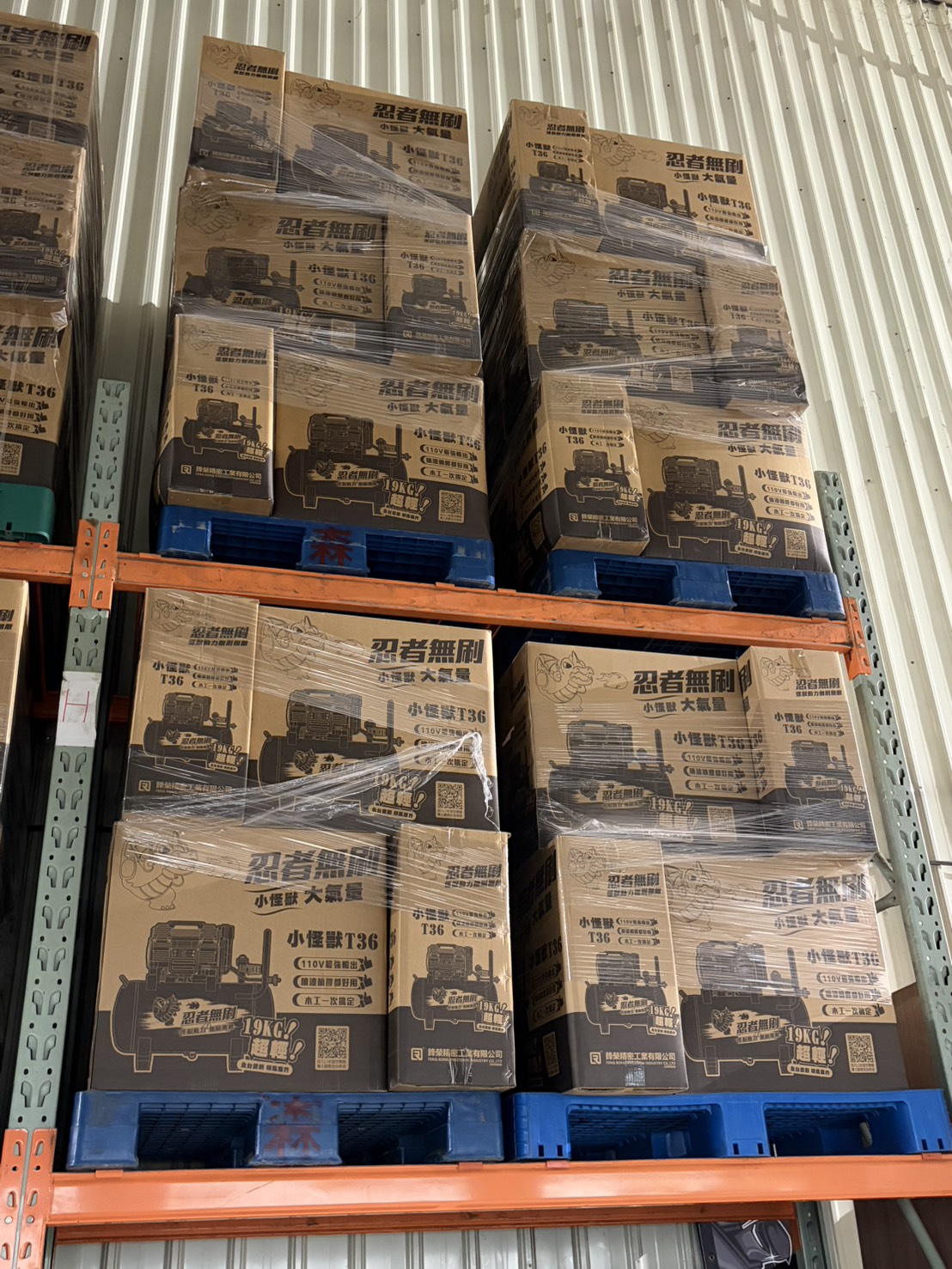
Shokunin COOLWAVE cooling vest stock, produced by FENG SHANG PRECISION CO., LTD. in Taoyuan, Taiwan.
Have Questions or Need More Details?
Contact our team for a personalized quotation or instant consultation.
Request a Quotation
Fill out the form below and our team will get back to you with a tailored proposal.
WhatsApp Direct Chat
Prefer to chat in real-time? Message us on WhatsApp for instant assistance & quick answers.
- Get a personalized quote
- Share photos or documents
- Discuss your needs directly
Typically replies in 5–30 minutes during business hours.