
Application Guide: Matching the Dual Cooling Water Cooling Vest to Industrial Job Sites
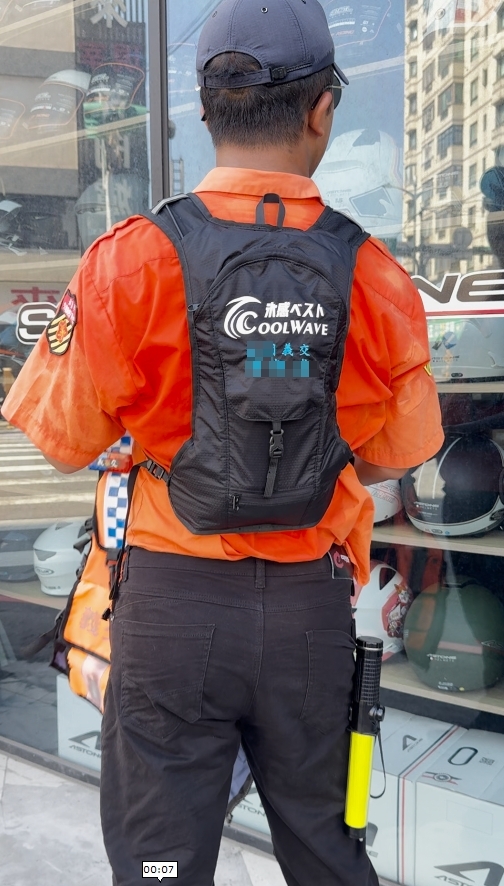
COOLWAVE Water-Circulation Cooling Vest in a direct traffic control application (Taiwan).
A dual cooling water cooling vest is a job-site decision before it is a product decision. Two crews working under the same temperature reading can get very different results from the same vest, because the variables that decide comfort — duty cycle, radiant heat, sweat load, movement pattern, and how quickly ice packs can be refreshed — change from one workplace to the next.
This guide is written for buyers, safety officers, and site managers who are past the "what is a cooling vest" stage and are now asking which configuration fits a specific application. It uses the COOLWAVE Water-Circulation Cooling Vest from Shokunin — the professional tools brand of Feng Shang Precision Co., Ltd., a Taiwan manufacturer founded in 2009 — as the working example, and it keeps every specification tied to a documented figure from the manufacturer's product and compliance records.
Quick answer. Application fit for a dual cooling water cooling vest comes down to four constraints: cooling duration (3–4 hours), carried weight (within 2 kg), chilled-water circulation capacity (maximum 320–370 ml/min through the cooling tube), and documentation (ROC Patent No. I886033 covering the water-cooled vest structure and cooling system, plus the Disaster Prevention Product and Service Certification Award from the Taiwan Disaster Prevention Industry Association). Match those four to the duty cycle of the site, and the vest becomes predictable equipment rather than a seasonal accessory.
Problem Definition: Most Cooling-Vest Failures Are Fit Failures
Cooling apparel usually disappoints on a job site for reasons that have little to do with how cold the vest can get. The recurring failure modes are structural, and they repeat across industries:
- Duration mismatch. A vest rated for a few hours of cooling is issued to a crew working a much longer shift, so the final part of the shift is unprotected.
- Weight and bulk fatigue. A cooling system heavy enough to be noticed gets removed halfway through the shift, no matter how effective it is.
- Fit and movement. Rigid or poorly sized garments restrict reaching, kneeling, and climbing — the movements that construction and factory work depend on.
- Sweat and breathability. A vest that traps moisture during prolonged sun exposure becomes a second heat load instead of a cooling layer.
- Recharge logistics. Ice packs and water need a refreeze and refill plan, or the whole system stops at lunch.
- Documentation gaps. Safety officers and procurement teams need certification and IP records before cooling apparel can be written into a heat-management procedure.
None of these are cooling-power problems. They are application-fit problems. That is why the practical question is not "which vest is the coldest" but "which cooling configuration matches this site's duty cycle, movement pattern, and compliance file" — and why a specific, documented specification sheet matters more than a general claim about cooling performance.
Industry Background: Where Cooling Vests Are Being Deployed Now
Cooling vests have moved from a niche occupational product to a measurable category, which is why buyers now see far more options than they did a few years ago. The available market data explains the shift:
- The cooling vest category specifically was valued at approximately USD 215 million in 2024 and is projected to reach USD 385 million by 2033 (Dataintelo).
- The wider personal cooling device market — a broader scope that includes handheld fans and other devices — was valued at USD 25.16 billion in 2024 and projected to reach USD 94.85 billion by 2035 (Market Research Future). The two figures measure different scopes and should not be compared directly.
- Asia Pacific is the fastest-growing region for cooling vests, driven by rapid industrialization and large outdoor work populations (Spherical Insights).
- Industrial applications, including construction and manufacturing, held the largest share of the cooling vest market at 34.5% in 2025 (Dataintelo).
- Phase Change Material (PCM) vests captured 28.7% of the market in 2025 and represent the fastest-growing technology segment (Dataintelo) — useful context when weighing water-circulation designs against PCM alternatives.
- Active circulatory mechanisms such as ice water circulation are increasingly deployed in industrial sectors to mitigate occupational heat stress (Strategic Market Research).
On the standards side, cooling systems are generally expected to comply with ISO 9001:2015 for quality management, and electrical components often require CE or UL marks depending on the destination market (International Organization for Standardization / UL).
For an application guide, the implication is direct: the industrial segment is where cooling vests are most heavily used, and it is also the segment with the heaviest documentation requirements. Application fit and compliance fit have to be solved together, not sequentially.
Detailed Solution: How the COOLWAVE Dual Cooling System Is Built
In the COOLWAVE design, "dual cooling" describes two stages operating as one loop. Pre-chilled ice packs sit in the backpack reservoir as the cooling source, and a pump-driven water circuit carries that chill through the cooling tube into the vest body, so the torso is cooled by circulating chilled water rather than by a single static pack. That is the mechanism behind the ice water circulation cooling vest category, and it is what allows the system to keep delivering cooling after a passive pack would already be spent.
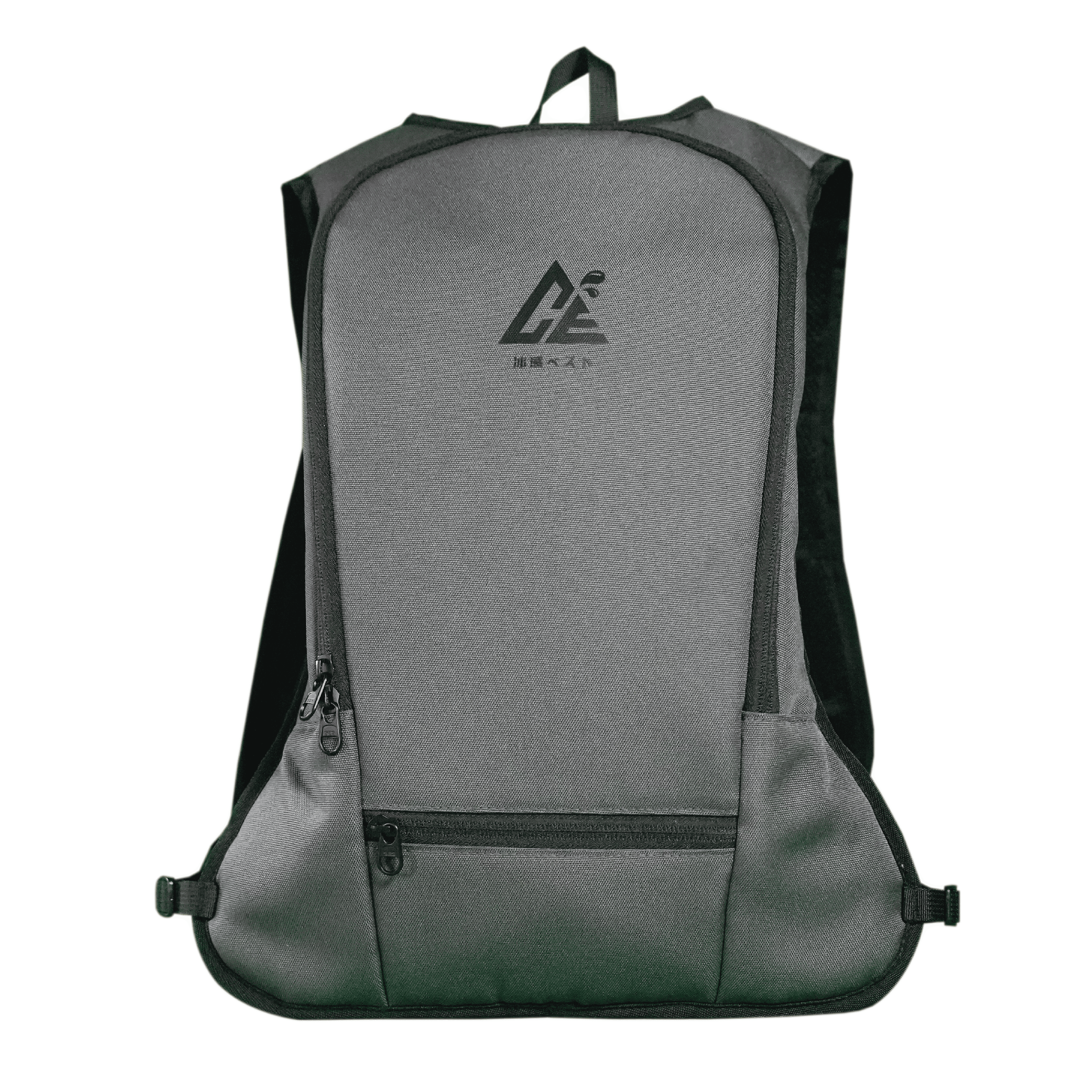
COOLWAVE Water-Circulation Cooling Vest (Professional Model – Gray).
| Specification | COOLWAVE Water-Circulation Cooling Vest |
|---|---|
| Product type | Industrial cooling apparel / Personal Protective Equipment (PPE) |
| Cooling duration | 3–4 hours |
| Weight | Within 2 kg |
| Suitable temperature | Below 10 °C |
| Vest body material | PEVA |
| Water bag material | TPU |
| Water bag cap | Polypropylene |
| Cooling tube | Sand rubber (black) |
| Shoulder strap material | 600D polyester |
| Pump output | 5 V 150 mA (max) |
| Flow rate | Max 320–370 ml/min |
| Included contents | Water-cooled vest backpack ×1, ice packs ×2 |
| Available models | Basic Model; Professional Model in Blue, Gray, and Black |
| Documented applications | Construction workers, outdoor workers, food stall operators, street vendors, traffic controllers, metal sheet factories |
The material list is worth reading as a durability statement rather than a parts list. The vest body is PEVA, the water bag is TPU, the cap is polypropylene, the cooling tube is black sand rubber, and the shoulder straps are 600D polyester — a combination selected for repeated wet-and-dry cycling, because every one of these applications involves water contact, sweat, and daily handling. Each unit ships as a complete kit: one water-cooled vest backpack plus two ice packs, so a crew can rotate the cooling source while the vest stays in service.
Documentation That Travels With the Product
Two records matter most when cooling apparel is written into a site procedure. The first is intellectual property: the COOLWAVE water-circulation cooling vest (Basic Model) is protected by Patent No. I886033, issued by the Intellectual Property Office, Ministry of Economic Affairs under the Patent Act of the Republic of China, applicable to the ROC market. The patent covers the water-cooled vest structure and cooling system, was issued on 1 June 2025, and runs to 27 August 2044. The second is disaster-prevention recognition: the COOLING water-cooled vest received the Disaster Prevention Product and Service Certification Award from the Taiwan Disaster Prevention Industry Association.
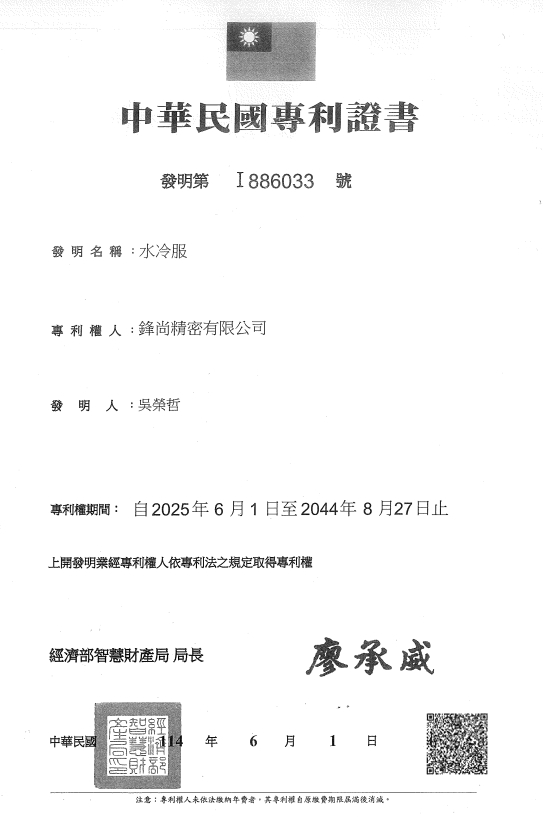
Water-Cooled Vest Patent Certificate — Patent No. I886033 (ROC market).
For buyers in other regions, the same logic applies with local evidence: check the quality-management system and the electrical-component marks that apply to your market. ISO 9001:2015 is the common quality benchmark, and CE or UL marks are typically what an electrical component — such as the 5 V 150 mA circulation pump — is measured against where those schemes apply.
Supply, Volume, and Service Facts Buyers Should Know Up Front
Shokunin is positioned as an ODM supplier for this category. Documented figures: minimum order quantity of 10 units, lead time of 7–14 days, monthly capacity of 3,000 units, a 6-month warranty for the water-cooled vest, and export markets served globally. Customization is not offered on this product, so buyers work within the existing model and colour range rather than commissioning a new design. Feng Shang Precision Co., Ltd. produced 10,000 units annually across its product lines and exports roughly 50% of output, with the United States and ROC as its main markets.
Step-by-Step Breakdown: Matching the Vest to an Application
The following six steps turn the specification table above into a site decision. Each step pairs a site condition with a documented product figure, so the outcome can be defended in a procurement review.
- Define the exposure window per worker, not per shift. Write down how many hours each crew member is actually exposed to heat and sun, including waiting time and the walk to and from the work face. This is the number that will be compared against the 3–4 hour cooling duration.
- Decide how the cooling loop must cover that window. If the exposure window sits inside the cooling duration, one vest per worker with two ice packs is a straightforward configuration. If the window is longer, the 3–4 hour rating tells you to plan a rotation — either a second ice-pack set per worker or a second vest — rather than to extend a single cooling cycle beyond its documented rating.
- Match weight and fit to the movement profile. The vest weighs within 2 kg and uses an adjustable one-size-fits-all design with 600D polyester shoulder straps and a backpack format. For crews that climb, kneel, or carry loads, that weight figure and the adjustable strap are the variables to verify on the people who will actually wear it.
- Verify documentation before the pilot, not after. Collect the ROC Patent No. I886033 record for the water-cooled vest structure and cooling system, the Disaster Prevention Product and Service Certification Award, and whichever quality or electrical-component marks your market requires. This is the step that keeps a pilot from stalling later.
- Plan ice and water logistics. Each vest ships with two ice packs and a backpack reservoir. Map where those packs will be refrozen or exchanged, because the cooling duration assumes the packs start at their intended temperature. A refreeze point within walking distance of the work face is what turns the specification into a result.
- Plan replenishment against real lead time. With a 7–14 day lead time, a 3,000-unit monthly capacity, a 10-unit minimum order quantity, and a 6-month warranty, seasonal demand spikes need to be planned in advance rather than ordered at the first heat alert.
Use Cases: Documented Worksite Applications
The manufacturer's documented application list for this vest names construction workers, outdoor workers, food stall operators, street vendors, traffic controllers, and metal sheet factories. Each of those groups fails differently when cooling is mismatched, which makes them useful as separate design cases.
Construction Sites: Continuous Sun Exposure With Constant Movement
Construction work combines prolonged sun exposure with movement, sweat, and tool handling. The constraints that matter here are weight and movement: a vest within 2 kg with adjustable straps and a backpack format can stay on through a work cycle instead of being set down at the first task that requires reaching. The lightweight, waterproof and breathable design specified for these conditions is what makes the vest viable as sweat-management cooling gear for construction crews rather than a garment that has to be removed to stay comfortable.
Traffic Control: Stationary Work in Prolonged Sun Exposure
Traffic controllers present the opposite profile to construction: low physical movement, long stationary exposure, and continuous direct sun. With little air movement generated by the body, radiant load dominates, which is why this is one of the clearest cases for active ice water circulation rather than passive cooling. For cooling gear aimed at prolonged sun exposure, a circulating loop keeps transferring chilled water to the torso even when the wearer is standing still.
Metal Sheet and Metal-Roof Factories: Radiant Heat Indoors
Metal sheet factories and metal-roof buildings add radiant heat and reflected load to ambient temperature, and the crew is often working with metal surfaces that stay hot after the air has cooled. This is the scenario behind the cooling solution for metal-roof factories use case: the vest's job is to hold the wearer's core condition down during intermittent bursts of heavy work near hot surfaces, where the backpack-format water reservoir can be kept close to the work area rather than in a distant rest room.
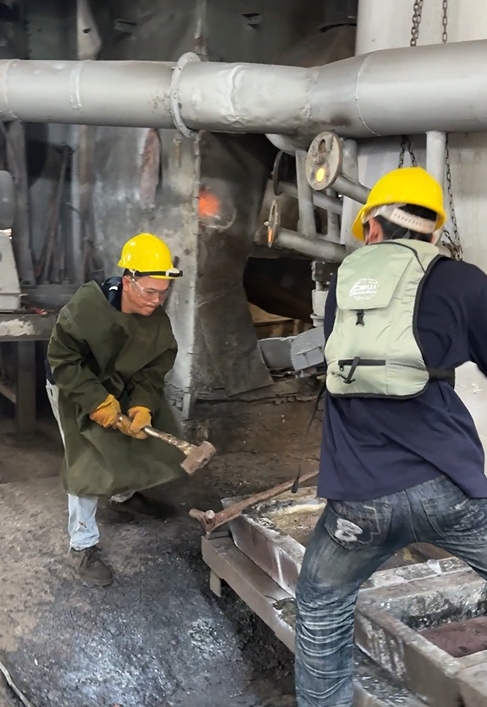
Water-circulation cooling vest deployed in a metal sheet factory environment.
Street Vendors and Night-Market Operators: Long Shifts, No Fixed Rest Area
Food stall and night-market work is characterised by long continuous shifts, limited space, and no dedicated cooling room. The portable cooling vest format — a self-contained backpack plus ice packs, with no fixed installation — is what makes the system practical in this setting. Shokunin's own case record for these combined high-temperature applications documents a 100-unit deployment in Taiwan, with a recorded field duration of 10 years and reported outcomes of effective body cooling, heatstroke prevention, and improved work efficiency and worker comfort.
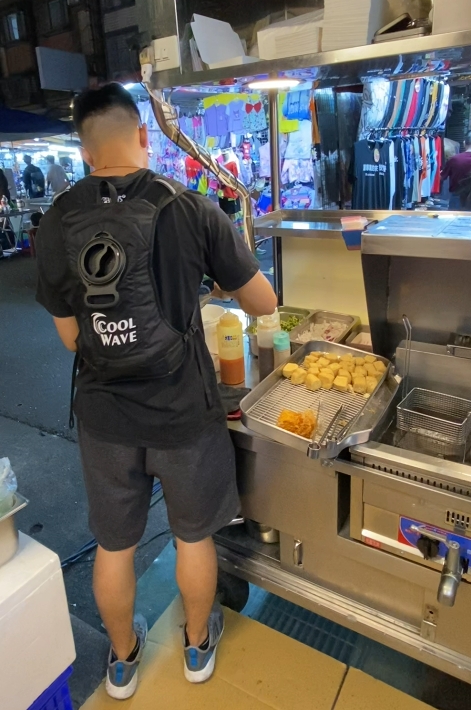
Night-market vendor wearing the water-circulation cooling vest.
Outdoor and Waterfront Work: Hours Under Direct Sun
Fishing and other waterfront or open-air tasks share the same basic profile — many hours under direct sun with intermittent physical effort and no shade structure. The relevant product characteristics are the adjustable one-size-fits-all fit, which allows one specification to cover a mixed crew, and the 3–4 hour cooling duration, which sets the rotation interval for shifts that run longer. Where the vest cannot be fully covered, plan one vest per worker plus two ice packs per vest.
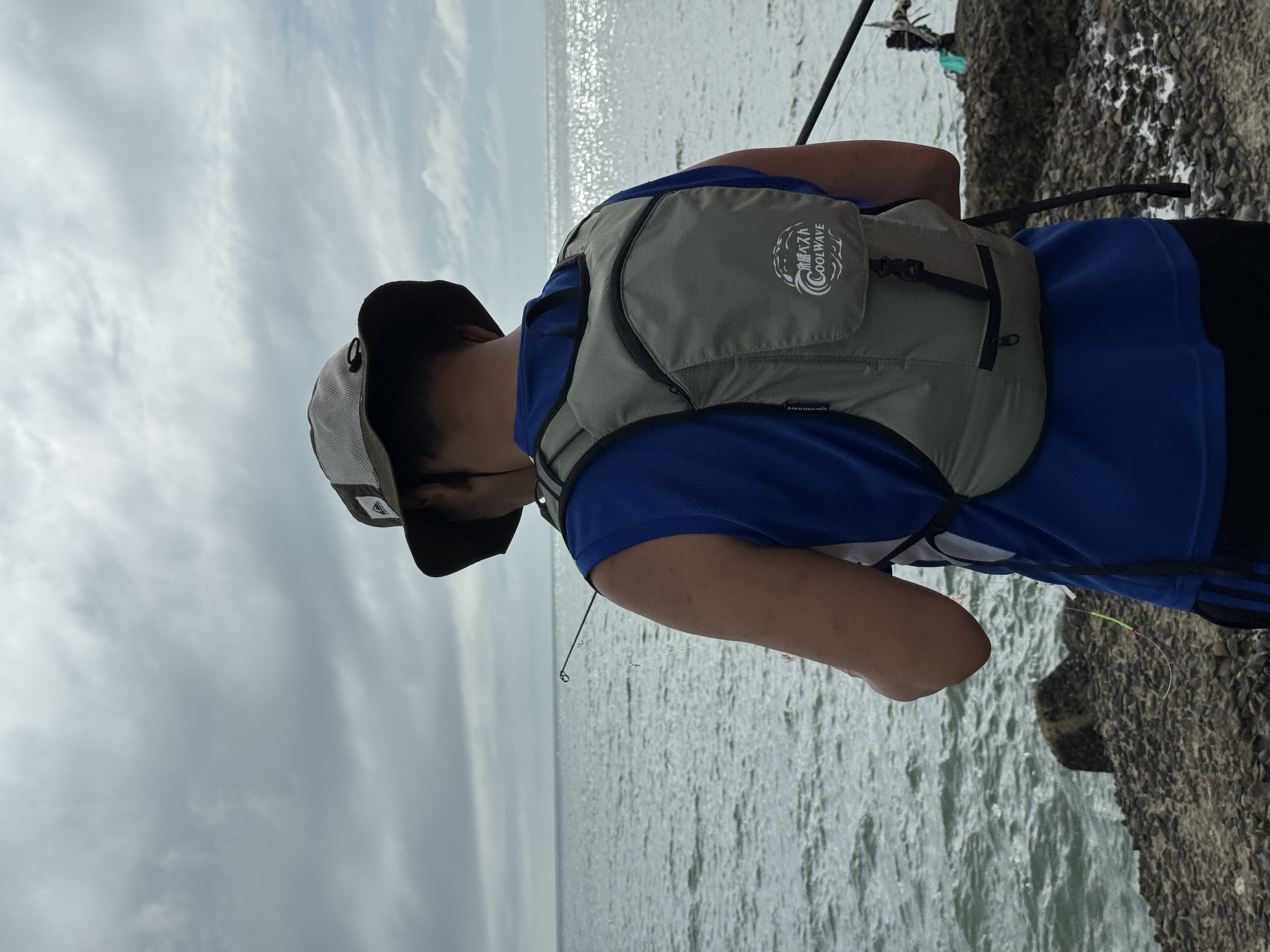
Outdoor and waterfront use — long hours of direct sun exposure.
Comparison Table: Application Fit Matrix
The matrix below maps each documented application to the product figure that decides whether the configuration will hold up. It is a fit comparison, not a ranking of scenarios.
| Application | Dominant heat condition | Product figure that decides fit | Buyer check before rollout |
|---|---|---|---|
| Construction sites | Direct sun plus constant movement | Weight within 2 kg; adjustable one-size-fits-all straps | Confirm the vest stays worn through reaching, kneeling, and climbing tasks |
| Traffic control | Long stationary exposure to direct sun | Pumped circulation, max 320–370 ml/min through the cooling tube | Confirm cooling continues while the wearer is standing still |
| Metal sheet / metal-roof factories | Radiant and reflected heat | 3–4 hour cooling duration per ice-pack set | Check work-cycle length against the cooling duration |
| Street vendors / night markets | Long shifts with no fixed rest area | Backpack format, ice packs ×2 included, no fixed installation | Identify where ice packs will be refrozen or exchanged |
| Outdoor and waterfront work | Prolonged direct sun exposure | Adjustable one-size-fits-all design for mixed crews | Plan one vest plus two ice packs per worker for long shifts |
Scope note on market numbers. Published figures for cooling apparel differ widely by scope. The cooling vest category was valued at approximately USD 215 million in 2024 (Dataintelo), while the broader personal cooling device market was valued at USD 25.16 billion in the same year (Market Research Future). These are different product boundaries and should not be placed side by side in a procurement document without that context.
Where This Vest Is Not the Right Fit
A cooling vest is not a universal answer, and the documented specifications set real boundaries. The cooling duration is 3–4 hours, so sites with continuous exposure well beyond that window need a rotation plan rather than a single extended cycle. Customization is not offered on this model, so buyers requiring a bespoke pattern or a different cut should not plan around an ODM configuration that does not exist for this product. The lead time of 7–14 days makes last-minute seasonal ordering impractical. And because the cooling source is the ice pack set, whether the ice packs ship and the refreeze logistics work matters as much as whether the vest itself is right for the wearer.
FAQ: Dual Cooling Water Cooling Vest in Application
Does the COOLWAVE water-circulation cooling vest carry documented certification for the ROC market?
Yes. The COOLWAVE water-circulation cooling vest (Basic Model) is protected by Patent No. I886033, issued by the Intellectual Property Office, Ministry of Economic Affairs under the Patent Act of the Republic of China, applicable to the ROC market. The patent covers the water-cooled vest structure and cooling system, was issued on 1 June 2025, and runs to 27 August 2044. Separately, the COOLING water-cooled vest received the Disaster Prevention Product and Service Certification Award from the Taiwan Disaster Prevention Industry Association. For markets outside the ROC, buyers should also confirm the quality-management and electrical-component marks that apply locally — ISO 9001:2015 is the common quality benchmark, and CE or UL marks are typically required for electrical components where those schemes apply.
Can one vest configuration cover construction, traffic control, metal sheet factories, and street vending?
The documented applicable industries for this product are construction workers, outdoor workers, food stall operators, street vendors, traffic controllers, and metal sheet factories, and the vest is built with an adjustable one-size-fits-all design, a backpack format, and shoulder straps in 600D polyester. It weighs within 2 kg and delivers a cooling duration of 3–4 hours. Because customization is not offered, one configuration is adapted to different crews through the adjustable fit and the colour range (Blue, Gray, Black) rather than through a bespoke build, and the differences between sites are handled at the deployment step — rotation planning, ice-pack logistics, and shift structure — rather than at the product step.
What order size and volume should a site plan for?
The documented commercial parameters for this product are a minimum order quantity of 10 units, a monthly capacity of 3,000 units, and a lead time of 7–14 days, under an ODM production model. That combination allows a site to begin with a small pilot quantity and scale toward a full crew rollout without switching suppliers. Feng Shang Precision Co., Ltd., the manufacturer behind the Shokunin brand, produces 10,000 units annually and exports roughly 50% of its output, with the United States and ROC as its main markets.
How should a buyer validate a vest before deploying it site-wide?
Validate against the documented specifications rather than against general impressions. Four figures cover most of the risk: the 3–4 hour cooling duration, which must match the exposure window; the weight within 2 kg, which determines whether the vest stays on through a full work cycle; the flow rate of max 320–370 ml/min delivered by the 5 V 150 mA circulation pump, which is the number to compare against the intended power source when specifying a portable cooling vest configuration; and the contents of water-cooled vest backpack ×1 plus ice packs ×2. Add the ROC Patent No. I886033 record and the Disaster Prevention Product and Service Certification Award to the pilot file. Buyers who want to test the configuration on their own site can request a sample or a quotation through fsmarketing@fstool.com.tw or WhatsApp +86 18858260055.
What lead time and after-sales terms apply to reorders?
Lead time is 7–14 days, the minimum order quantity is 10 units, and the water-cooled vest carries a 6-month warranty. Monthly capacity stands at 3,000 units, which matters for seasonal planning: because heat-season demand concentrates into a short window, reorders placed at the first heat alert can arrive after the peak instead of before it. The product brochure with the full specification set is available at the COOLWAVE cooling vest brochure.
Conclusion: Turn the Specification Into a Site Decision
Application fit for a dual cooling water cooling vest is decided by four numbers and one file: 3–4 hours of cooling duration, a carried weight within 2 kg, a circulation flow rate of max 320–370 ml/min from a 5 V 150 mA pump, and a documentation set that includes ROC Patent No. I886033 and the Disaster Prevention Product and Service Certification Award from the Taiwan Disaster Prevention Industry Association. Construction sites test the weight and fit, traffic control tests whether cooling continues while standing still, metal sheet factories test the cooling duration against the work cycle, and street vendors and outdoor crews test the refreeze logistics. Match those tests to the site, and the vest stops being a seasonal purchase and starts being part of the heat-management procedure.
Next Step: Sample, Quotation, or Specification Pack
Shokunin, the professional tools brand of Feng Shang Precision Co., Ltd., supplies the COOLWAVE Water-Circulation Cooling Vest under an ODM model with a 10-unit minimum order quantity and a 7–14 day lead time. Site managers and distributors can request a sample, a quotation, or the full specification brochure before committing to a rollout.
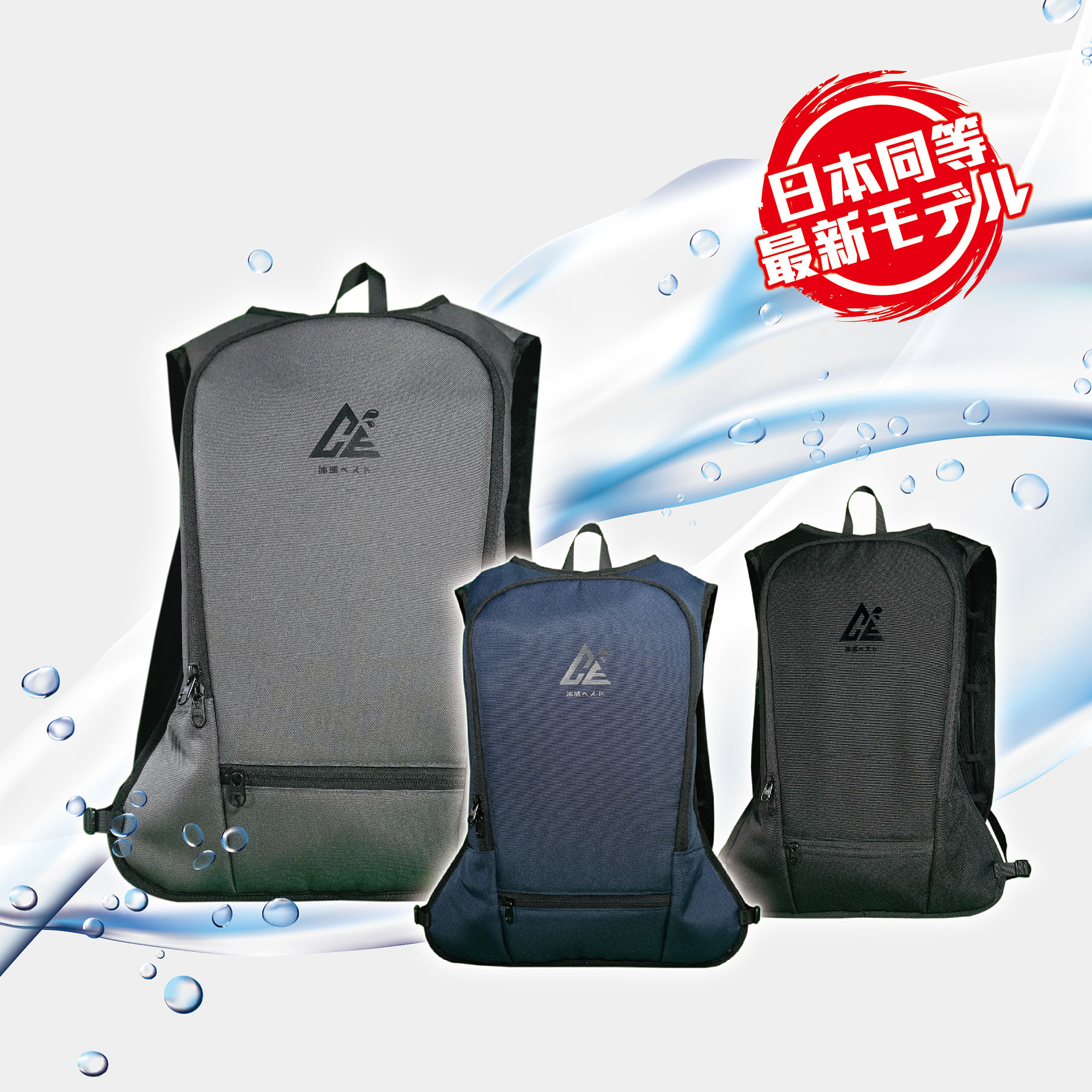
COOLWAVE Water-Circulation Cooling Vest — industrial cooling apparel by Shokunin.
Email: fsmarketing@fstool.com.tw | WhatsApp: +86 18858260055 | Phone: +886 3-312-6606
Business hours: Monday to Friday, 8:30 AM – 5:40 PM
Address: No. 155-17, Sec. 2, Nanzhu Rd., Luzhu Dist., Taoyuan City 338454, Taiwan
Website: www.fstool.com.tw | Product brochure: download the PDF
Have Questions or Need More Details?
Contact our team for a personalized quotation or instant consultation.
Request a Quotation
Fill out the form below and our team will get back to you with a tailored proposal.
WhatsApp Direct Chat
Prefer to chat in real-time? Message us on WhatsApp for instant assistance & quick answers.
- Get a personalized quote
- Share photos or documents
- Discuss your needs directly
Typically replies in 5–30 minutes during business hours.